Reshaping Corporations: Can Divestment Work?

See on Scoop.itGreen & Sustainable News

With enough collective action, mass divestment campaigns can be effective in creating social change. 

Duane Tilden‘s insight:

>To be effective, a huge amount of money must be withdrawn from a company. Where boycotting unites individual buyers to have impact, individual stockowners aren’t likely to make a huge enough hit with divestment or negative investing for a corporation to take notice. Institutional owners, though, could impact a company or industry because collectively they control vast amounts. 

The Fossil Fuel Divestment Campaign

The current student campaign to divest from fossil fuels is interesting. For example, Harvard has $30 billion in endowment while Yale has $16.7 billion.

While it’s clearly not all in one company or industry, what kind of impact could university endowments have if they withdrew from fossil fuel companies and allied industries? By my count, there are well over a hundred campaigns at universities around the nation, and there are additional groups working to get towns and communities to join the fight. As a collective action, the potential for these divestment campaigns is fascinating to ponder.

Mass Divestment Creates Cultural Change

Perhaps the most important thing divestment shares with boycotting is publicity.  The attention that a mass divestment can bring to an issue could be profound. The student fossil fuels divestment effort is garnering national media attention, and rather than fizzling out seems to be gaining momentum. This attention could be as effective as actual divestment for dealing with climate change and fossil fuel issues. 

As Cecelie Counts wrote in January, divestment was just one tool used to combat apartheid and bring change in South Africa. I don’t know if there will be mass divestment among universities, but I suspect that this campaign will be successful in the long run because it’s educating a generation and could create the cultural change necessary to pursue long-term alternatives, change policy and pressure energy companies to adapt.<

See on csrwire.sharedby.co
Energy Management – Determining Load Factor to Maximize Control

See on Scoop.itGreen Building Operations – Systems & Controls, Maintenance & Commissioning

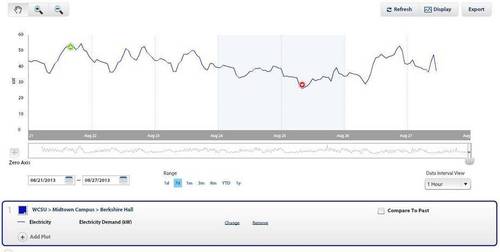
Understanding load factor is an important component to energy management and learning how to take control of your electricity use.

Duane Tilden‘s insight:

>Load factor is a ratio or percentage of the consistency of your electricity consumption – in other words, load factor is a way to answer the “how ‘spikey’ is your load?” question. The easiest way to understand your own load factor is by looking at your real-time energy data. Not only will your energy data indicate your load factor, but it will also highlight other important aspects of your electricity use over time that will enable you to make smarter energy management decisions.

While looking at your real-time energy data is the best way to accurately get your load factor, you can approximate it from your utility bill information. To manually find out your load factor, divide your total consumption (in kWh) by the number of hours in your billing period. Then, divide the result by your peak demand during the billing period, and the number you compute is your load factor. A load factor closer to 1, or 100%, indicates that you are using energy more evenly or consistently over time. It might also mean you are reducing your peak demand or otherwise avoiding spikes.<

See on energysmart.enernoc.com

Renewable Energy Tops 14% of US Electrical Generation During First Half of 2013

See on Scoop.itGreen Energy Technologies & Development

WASHINGTON, D.C. — According to the latest issue of the U.S. Energy Information Administration’s (EIA) “Electric Power Monthly,” with preliminary data through to June 30, 2013, renewable energy sources (i.e., biomass, geothermal, hydropower, solar, wind) provided 14.20 percent of the nation’s net electric power generation during the first half of the year.

Duane Tilden‘s insight:

>The balance of the nation’s electrical generation mix for the first half of 2013 consisted of coal (39.00 percent – up by 10.3 percent), natural gas and other gas (26.46 percent – down by 13.6 percent), nuclear power (19.48 percent – up by 0.2 percent), and petroleum liquids + coke (0.66 percent – up by 15.6 percent). The balance (0.21 percent) was from other sources and pumped hydro storage.<


See on www.renewableenergyworld.com

Detroit Completes One of Nation’s Largest LED Parking Garage Retrofits – WSJ.com

See on Scoop.itGreen Building Design – Architecture & Engineering
Sixty-one Acres of LED Lighting will reduce garage energy-use by 80 percent; Entire property by 7 percent

Duane Tilden‘s insight:

>LED technology is one of the highest performing, currently available methods of lighting. Energy savings of 50 to 80 percent are common when compared to the lamps that are typically used in garages. LED lamps also have much longer operating lives, resulting in fewer materials and transportation resources needed over time. The MGM Grand Detroit LED retrofit, will save enough electricity to power more than 350 average homes per year. […]

Earlier this year, the company initiated a program to install 1,600 induction technology lighting fixtures covering 160 acres of open lot parking area at its resorts in Las Vegas. These lamps are ideal for the hot Las Vegas climate and will have an operating life of up to 20 years. An estimated 2.7 million kWh will be saved annually following the project’s completion.

Additionally, MGM Resorts recently announced the planned installation of one of the largest rooftop solar photovoltaic arrays in the world at the Mandalay Bay Resort Convention Center. The 6.2-megawatt installation will be MGM Resorts’ first commercial solar project in the United States and will generate enough electricity to power the equivalent of 1,000 homes.<

See on online.wsj.com

The Datacenter & Cloud Computing: Design of Warehouse-Scale Machines


Clipped from http://www.morganclaypool.com/doi/pdfplus/10.2200/S00516ED2V01Y201306CAC024

“While we draw from our direct involvement in Google’s infrastructure design and operation over the past several years, most of what we have learned and now report here is the result of the hard work, insights, and creativity of our colleagues at Google. The work of our Technical Infrastructure teams directly supports the topics we cover here, and therefore, we are particularly grateful to them for allowing us to benefit from their experience.”

DOE Regulations: Energy Efficiency Improvements for Motors cause Industry Challenges

See on Scoop.itGreen Building Design – Architecture & Engineering

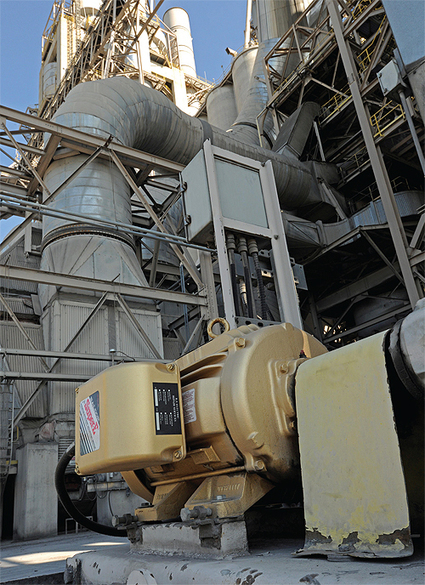
The United States has had efficiency regulations for industrial electric motors in place since October 1997, when the Energy Policy Act of 1992 (EPAct 92) set minimum efficiency levels for 1- to 200-hp general-purpose three phase motors. EPAct 92 was upgraded when the Energy Independence and Security Act of 2007 (EISA) went into effect in December 2010.

Duane Tilden‘s insight:

>Several years ago, the U.S. Department of Energy (DOE) conducted a technical study as to what could be done to raise the efficiency levels of “small” motors. After years of study and litigation, the Small Motor Rule was passed that covers two-digit NEMA frame single- and three-phase 1/3 through 3 horsepower motors in Open enclosures.

Although the Small Motor Rule seems simple, it has the effect of creating motors with much larger footprints, particularly on single phase designs where capacitor start/induction run motors may largely be discontinued in Open enclosures. In some cases, a TEFC motor may be more cost effective and smaller than an Open motor.

The DOE is presently conducting another technical study on “medium” AC induction motors of 1- to 500-hp. In their study, DOE is evaluating a possible increase in nominal motor efficiency of 1 – 3 NEMA bands (approximately 0.4 to 1.5%) above NEMA Premium Efficiency levels as defined in MG 1-2011 table 12-12. Although this sounds simple to do, such a motor redesign could entail new laminations, winding equipment and in many cases, new frames to fit the extra material. Some designs may not fit where existing motor designs of the same ratings fit today. This means that OEMs would need to redesign their machine if that is an issue and end users may have trouble fitting the new higher efficiency replacement motor into their equipment or existing envelope.<

See on www.designworldonline.com

Air Conditioning the World stresses Global Energy Supply

See on Scoop.itGreen Building Design – Architecture & Engineering

The United States currently uses more energy for air- conditioning than all other countries combined—a sobering statistic from Stan Cox of the Land Institute in Salina, Kansas.

Duane Tilden‘s insight:

>According to the U.S. Energy Information Administration, 87 percent of American households are equipped with air-conditioning, and the United States expends about 185 billion kilowatt hours of energy annually on residential cooling.  […]

Rapid increases in the ownership of air conditioners are already occurring in many developing countries. According to research by McNeil and Letschert, the percentage of urban Chinese households with an air conditioner jumped from less than 1 percent in 1990 to 62 percent in 2003. In 2010 alone, 50 million air-conditioning units were sold in China.  […]

[…] eight countries have the potential to exceed the United States’ yardstick of high air-conditioning usage, because of their warm climates and significant populations. Furthermore, the top three could surpass the United States by substantial amounts: India, China, and Indonesia by factors of 14, 5.2, and 3.1, respectively, if they adopt American standards of cooling.

[…] Several institutions have recently made major technical advances in the design of more energy-efficient air conditioners. For example, developments at the National Renewable Energy Laboratory suggest that efficiency improvements of 20 to 70 percent are possible compared to current models of air conditioners. Changes in housing design and urban planning are also needed […]<

See on www.americanscientist.org

Biofuel Production from Palm oil plantation waste

See on Scoop.itGreen Building Design – Architecture & Engineering

NextFuels to produce biofuels from palm plantation residue – Renewable Energy Magazine, at the heart of clean energy journalism

Duane Tilden‘s insight:

>Edible palm oil has surpassed soybean to become the largest source of cooking oil in the world, accounting for over 50 million tons of oil annually.

While plantation owners have managed to increase the productivity of their land by 15X since the late 80s, the growth of the industry has created a corresponding residue problem. Approximately 4.4 to 6 metric tons of agricultural waste is generated for each metric ton of oil. There are over 1,000 crude palm oil (CPO) mills in Southeast Asia and a single (60 tons per hour) mill can generate 135,000 tons of agricultural residue a year.

NextFuels uses a system called bio-liquefaction that efficiently transforms agricultural biomass to green energy. Biomass is placed into the plant mixed with water. The mixture is then heated to 330-degree Celsius while pressure is increased to 220 bar. Increasing the pressure keeps the water from coming to a boil, which conserves energy.

When cooled, the hydrocarbons form a putty-like substance called GreenCrude. Roughly 25 percent of the GreenCrude can be burned as a solid fuel in industrial boilers. The remaining 75 percent can be converted into a liquid-fuel equivalent to petroleum that is compatible with existing pipelines and vehicles.

The equipment required to convert GreenCrude into liquid fuels, in a process called hydrodeoxygenation, is already installed at most refineries and can… <

See on www.renewableenergymagazine.com

Quantitative Analysis of Factors Contributing to Urban Heat Island Intensity

See on Scoop.itGreen Building Design – Architecture & Engineering

Ryu, Young-Hee, Jong-Jin Baik, 2012: Quantitative Analysis of Factors Contributing to Urban Heat Island Intensity. J. Appl. Meteor. Climatol., 51, 842–854.

Duane Tilden‘s insight:

>This study identifies causative factors of the urban heat island (UHI) and quantifies their relative contributions to the daytime and nighttime UHI intensities using a mesoscale atmospheric model that includes a single-layer urban canopy model. A midlatitude city and summertime conditions are considered. Three main causative factors are identified: anthropogenic heat, impervious surfaces, and three-dimensional (3D) urban geometry. Furthermore, the 3D urban geometry factor is subdivided into three subfactors: additional heat stored in vertical walls, radiation trapping, and wind speed reduction. To separate the contributions of the factors and interactions between the factors, a factor separation analysis is performed. In the daytime, the impervious surfaces contribute most to the UHI intensity. The anthropogenic heat contributes positively to the UHI intensity, whereas the 3D urban geometry contributes negatively. In the nighttime, the anthropogenic heat itself contributes most to the UHI intensity, although it interacts strongly with other factors. The factor that contributes the second most is the impervious-surfaces factor. The 3D urban geometry contributes positively to the nighttime UHI intensity. Among the 3D urban geometry subfactors, the additional heat stored in vertical walls contributes most to both the daytime and nighttime UHI intensities. Extensive sensitivity experiments to anthropogenic heat intensity and urban surface parameters show that the relative importance and ranking order of the contributions are similar to those in the control experiment.

Keywords: Urban meteorology

Received: May 7, 2011;<

See on journals.ametsoc.org

NASA – Ecosystem, Vegetation Affect Intensity of Urban Heat Island Effect

See on Scoop.itGreen Building Design – Architecture & Engineering

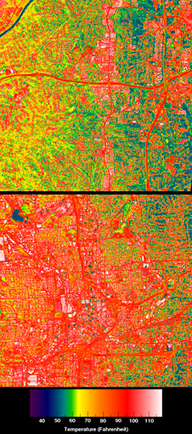
NASA researchers studying have found that the intensity of the “heat island” created by a city depends on the ecosystem it replaced and on the regional climate.

Duane Tilden‘s insight:

I have measured the heat island effect in the Greater Vancouver area, specifically Metrotown, Burnaby to be in the order of 6 deg C, during a late summer evening.

>”The placement and structure of cities — and what was there before — really does matter,” said Marc Imhoff, biologist and remote sensing specialist at NASA’s Goddard Space Flight Center in Greenbelt, Md. “The amount of the heat differential between the city and the surrounding environment depends on how much of the ground is covered by trees and vegetation. Understanding urban heating will be important for building new cities and retrofitting existing ones.”

Goddard researchers including Imhoff, Lahouari Bounoua, Ping Zhang, and Robert Wolfe presented their findings on Dec. 16 in San Francisco at the Fall Meeting of the American Geophysical Union.

Scientists first discovered the heat island effect in the 1800s when they observed cities growing warmer than surrounding rural areas, particularly in summer. Urban surfaces of asphalt, concrete, and other materials — also referred to as “impervious surfaces” — absorb more solar radiation by day. At night, much of that heat is given up to the urban air, creating a warm bubble over a city that can be as much as 1 to 3°C (2 to 5°F) higher than temperatures in surrounding rural areas.

The impervious surfaces of cities also lead to faster runoff from land, reducing the natural cooling effects of water on the landscape. More importantly, the lack of trees and other vegetation means less evapotranspiration — the process by which trees “exhale” water. Trees also provide shade, a secondary cooling effect in urban landscapes.

Using instruments from NASA’s Terra and Aqua satellites, as well as the joint U.S. Geological Survey-NASA satellite Landsat, researchers created land-use maps distinguishing urban surfaces from vegetation. The team then used computer models to assess the impact of urbanized land on energy, water, and carbon balances at Earth’s surface. <

See on www.nasa.gov