Buildings are biggest source of GHG’s in Vancouver & City recommends Energy Retrofits

Buildings spew more than half of all Vancouver’s total greenhouse gas (GHG) emissions every year and detached houses are the biggest culprit […] That fact is key to a staff recommendation that council adopt an energy retrofit strategy for existing buildings to drastically cut GHG emissions.

Source: www.vancouversun.com

>”About 40,000 of Vancouver’s 77,000 detached homes were built before 1960. The report said most older homes could improve their energy efficiency with weather sealing, wall and attic insulation, furnace/boiler/hot water heater replacements and replacing old windows with new energy-efficient glazing.

About 55 per cent of GHG emissions in Vancouver come from buildings and of those detached homes create 31 per cent of building emissions, the report said.

That compares with industry’s 20-per-cent share and 18 per cent from multi-unit residential buildings.

The city’s Greenest City Action Plan has targeted a 20-per-cent reduction in GHG emissions from Vancouver buildings by 2020, which would eliminate 160,000 tonnes of emissions annually — the equivalent of taking 40,000 cars off the road.

The report recommends the city partner with BC Hydro and/or FortisBC to study the effectiveness of using thermal imaging to identify poorly insulated homes.

[…]

… common energy-efficient building practices today include using vinyl or wood window frames instead of aluminum, along with the use of heat pumps, solar panels and drainwater recovery systems.

But Kerchum noted it can cost nothing to improve a home’s energy efficiency.

[…]

A recent Vancouver city initiative to improve energy efficiency in Vancouver homes — the Home Energy Loan Program — had a very low participation rate among homeowners.

The program called for homeowners to have an energy audit by a federally licensed auditor, who would recommend the best ways to reduce a home’s carbon footprint.”<

Grid Scale Energy Storage Solutions For Future Virtualization

Examines grid scale energy storage solutions ranging from pumped hydro, compressed air, thermal storage, advanced batteries, fuel cells and purely electric storage systems.

Source: greeneconomypost.com

Renewable energy sources often have a common problem of matching supply with demand, hence the need for energy storage to bridge the gap.  One major component of future VPP (Virtual Power Plants) is energy storage, in the form of battery storage, fuel cells, pumped hydro, flywheels, compressed air or other forms of existing and new technologies.

One promising form of energy storage combines gravity with water where energy is stored in raising heavy weights.  Electrical energy is converted to potential energy during periods of over-supply and then converted back to electricity when demand is greater than supply.

>”A Cutting Edge Variation of Pumped Hydro

Gravity Power, LLC, a privately-held company, based in Southern California (in Goleta, CA just north of Santa Barbara) is developing a novel grid-scale energy storage system for global commercialization called the Gravity Power Module (GPM). Like pumped hydro the working energy carrier is water that is pumped between a high pressure and a low pressure reservoir running a reversible generator/pump assembly to either produce power by drawing down the high pressure reservoir or store it up by pumping water from the low pressure store back into the high pressure store. In this sense it operates on the very same principles – and thus can also benefit from existing capital equipment, such as the reversible hydro generator/pump assemblies for example – as traditional pumped hydro.

Gravity Powers technology circumvents traditional pumped hydro difficulties related to siting, negative environmental impact, huge land demands, permitting, long-lead times and the very large investment required, by burying it all underground…. literally.

The GPM system uses a very large and very dense high mass piston that is suspended in a deep, water-filled shaft. The piston is equipped with sliding seals to prevent leakage around the piston/shaft interface and its immense mass pressurizes the supporting water column beneath it. A high pressure pipe from the bottom of this shaft enables water to be run or pumped through a generator/pump assembly of the same types now used in pumped hydro systems. The low pressure low energy potential water is returned above the piston adding somewhat to its weight and further pressuring the remaining high energy potential water column.

The massive piston moves up and down the shaft, storing and releasing power in a closed sealed cycle. It is compact with a small land footprint and the units can be clustered together into larger groups. It also is environmentally benign, no toxic chemicals or explosive dangers.

I like the scalable nature of this store that makes it suited to incremental growth of capacity. I also like how this energy storage system could be placed very near the big urban areas of greatest need for this kind of electric capacity. The fact that this energy storage system can take advantage of a lot of already existing infrastructure and technical knowhow from the existing pumped hydro sector is a definite advantage.

I would like to see more details on the costs of the boring of the immense vertical shafts; the long term performance metrics of the shaft seals (that would be an expensive repair job I would think. All in all I think this or something like it is a strong contender in the energy storage sector.”<

Read more: http://greeneconomypost.com/fifteen-grid-scale-energy-storage-solutions-watch-15924.htm#ixzz35bedEesM

Kitimat community prefers LNG projects over the Enbridge pipeline

“We’re not trying to hold out for a better deal,” said Chief Ellis Ross from the Haisla First Nation. “We know the potential for wealth here. We’ve been doing it for 10 years, we know how to negotiate but there’s no real price we can put on an oil spill happening in these waters.”

VPP – New Models for the Distributed Grid Network

National Instruments, LocalGrid, and Toronto Hydro pilot the software-defined, peer-to-peer distributed grid architecture.

Source: www.greentechmedia.com

>” […] Because each CompactRIO endpoint is inherently flexible, LocalGrid can provide “protocol conversion which we can update dynamically over the air, analytics that we can update to the system, and run multiple applications on the same device,” he said. This is similar in intent to the kind of field-distributed computing capability that Silver Spring Network’s new SilverLink Sensor Network platform and Cisco’s new IOx platform are opening up to partners, but it’s pretty far ahead of the capabilities of the vast majority of today’s grid edge devices.

In fact, in terms of technology that allows interoperability without a lot of expensive and complex pre-integration work, “The existing players do not have solutions that will do this job,” Leigh said. “They’re not fast enough, they’re not open enough, or they don’t have solutions that are cost-effective enough in the distribution space.”

So far, LocalGrid has connected four sites with a combination of solar PV and wind turbine inverters and metering hardware, and is now in the midst of its second phase of developing custom algorithms for tasks such as detecting faults and forecasting solar and wind generation and loads on distribution circuits, Leigh said. These aren’t necessarily huge challenges for Toronto Hydro’s existing IT infrastructure at pilot scale, “But if we were to multiply that across the network, it’s just not feasible to get all that data to be analyzed into a back-end system,” he said.

As for how to expand LocalGrid’s software capabilities to a broader set of grid endpoints, Leigh cited Cisco’s IOx-enabled grid routers as potential future partners. Other big grid vendors like General Electric, ABB and Siemens “are at different stages starting to open up their systems,” he said. “The question that still has to be worked out is how much third-party development can take place on their new systems.”

That’s the same question that Duke has been asking the grid vendor community, via its plans to open its source code and hardware adapter reference designs to the public. The past half-decade has seen open-source grid systems emerge from simulation software and data management tools to a few real-world grid applications, albeit still in the experimental stage. Perhaps the next half-decade will see the open grid edge platform attain real-world status.”<

Virtual Power Plants (VPP): A New Tech Based Utility Model for Renewable Power Integration

Today’s global energy market is in the midst of a paradigm shift, from a model dominated by large centralized power plants owned by big utilities to a mixed bag of so-called distributed energy generation facilities — smaller residential, commercial and industrial power generation systems &mdas

Source: www.renewableenergyworld.com

>”Virtual Power Plants

One distributed generation technology with significant growth potential is the virtual power plant (VPP). In the VPP model an energy aggregator gathers a portfolio of smaller generators and operates them as a unified and flexible resource on the energy market or sells their power as system reserve.

VPPs are designed to maximize asset owners’ profits while also balancing the grid. They can match load fluctuations through forecasting, advance metering and computerized control, and can perform real-time optimization of energy resources.

“Virtual power plants essentially represent an ‘Internet of Energy,’ tapping existing grid networks to tailor electricity supply and demand services for a customer,” said Navigant senior analyst Peter Asmus in a market report. The VPP market will grow from less than US $1 billion per year in 2013 to $3.6 billion per year by 2020, according to Navigant’s research — and one reason is that with more variable renewables on the grid flexibility and demand response are becoming more crucial.

Asmus called VPPs “an ideal optimization platform for the coming transformation of the power grid,” adding that both supply and demand flexibility will be increasingly necessary to accommodate fast ramping periods and address corresponding supply forecast errors.

German utility RWE began a VPP in 2012 that now has around 80 MW of capacity. According to Jon-Erik Mantz, commercial director of RWE Energy Services in Germany, in the near future flexibility will become a commodity. Virtual power plants generate additional value from the flexibility they can offer the grid, he said-so, for RWE, “this is why we concentrate on building VPPs.” As large utilities’ market share falls in response to growing self-consumption, he said, utilities can still “be part of a VPP and profit.”

Dr. Thomas Werner, senior key expert in product lifecycle management at Siemens, said that in order to integrate diverse smaller energy sources, “You need an energy management system with good data models which represents energy resources on the one hand and, on the other, the energy market environment.” Werner believes VPPs fulfill these conditions and are the best way to integrate a growing number of power sources into the grid and the market.

“VPPs can be handled like other conventional generation,” he said. “They can target different energy markets and regulatory environments. They can play as important a role as conventional concentrated generation.”

“No Real Competition”

“From my point of view, there is no real competition for the VPP concept,” Werner said, pointing to VPPs’ use of cheap and ubiquitous information and communication technologies, while other technology trends like building energy storage systems incur comparatively heavy costs. VPPs can also avoid expensive installation costs in, for example, a home system, he notes. Self-consumption for home or industrial use is hampered by having to produce “the right amount of power at the right time.”

VPPs can deliver needed energy at peak usage times, and can store any surplus power, giving the energy aggregator more options than would exist in a single power plant. Other advantages include improved power network efficiency and security, cost and risk savings in transmission systems, increased value from existing infrastructure assets and reduced emissions from peaking power plants. And, importantly, VPPs can also enable more efficient integration of renewable energy sources into the grid by balancing their variability.

For example, explains Werner, if one wind power source generates a bit more energy than predicted and another generates a bit less, they will compensate for each other, resulting in a more accurate forecast and making it easier to sell the capacity in the market or to use it in power systems operation.

A VPP can also combine variable renewable power sources with stable, controllable sources such as biomass plants, using the flexibility of the biomass source to smooth out any discrepancy between planned and actual production.”<

Australian Waste to Energy Gasification Plants Secure $50m Financing

See on Scoop.itGreen & Sustainable News

“Australian renewable energy investment firm, Clean Energy Finance Corporation (CEFC) has agreed provide up to AU$50 million ($47 million) in senior debt finance for the development of two waste to energy facilities that will use low temperature gasification in Western Australia.”

Duane Tilden‘s insight:

>”According to CEFC CEO, Oliver Yates waste management has been a growing issue in Australia for all levels of government and with recycling rates remaining fairly constant, the country will need to seek solutions to its increasing dependence on landfill.

[…]

The company added that the facilities will generate cost competitive, base load energy and a lower emissions outcome than current grid electricity sources.

The investor also noted that while both projects will be eligible for Australian Renewable Energy Certificates (RECs) for the majority of the energy produced, their financial viability is not reliant on RECs.

The investment is also expected to help to encourage further waste to energy facilities across the country and facilitate access to private sector funding for similar projects in the future which divert waste from landfills, increase recycling rates, recover energy and reduce greenhouse gas emissions.

CEFC said that its finance for the New Energy facilities takes its total investment in waste-to-energy projects to over $150 million, and that it has another $280 million of waste to energy proposals in its project pipeline that would unlock a further $1.0 billion in additional finance.

Technology

According to New Energy, its low temperature gasification process ‘cooks’ waste over a 16 to 24 hour period at temperatures of between 600°C and 875°C during which small amounts of air and steam are introduced.

This is said to break the molecules in the waste which are converted into a syngas that contains molecules such as methane with a high energy content.

The syngas is combusted to heat water and produce steam, either for use as either heat or for electrical generation. This secondary oxidation stage is said convert the syngas into water vapour and carbon dioxide.

The exhaust gases are cleaned and filtered, which the company said to neutralises acidic gases such as sulphur dioxide, as well as particulates and heavy metals. It is then released to the atmosphere.”<


See on www.waste-management-world.com

Russia-China Liquified Natural Gas Deal Limits BC’s LNG Market and Economic Appeal

See on Scoop.itGreen & Sustainable News

The new Russia-China gas deal “could squeeze the economics” of proposed LNG projects, according to a new report by Toronto-Dominion Bank

Duane Tilden‘s insight:

>"Russia recently clinched a US$400-billion deal to feed China around 38 billion cubic metres of natural gas via pipelines at a chummy price of $10-$11 per million cubic feet, shaking up an industry that is used to fetching $14-$18 per mcf from Asian markets.

The deal, along with a new trend of setting prices linked to gas prices rather than the traditional crude oil benchmarks, could upset British Columbia’s dream of launching a liquefied natural gas export industry.

“Clearly with so much LNG supply capacity set to come on stream, Asian buyers have more power to bargain for lower prices in LNG contracts, lowering the potential prices Canadian producers would receive, and could squeeze the economics of certain LNG projects,” TD said in a note published Thursday.

The deal has already created ripples across LNG-dependent markets such as Japan. This week, 38 Japanese lawmakers said they plan to lobby Prime Minister Shinzo Abe to revive a stalled Russia-Japan natural gas pipeline."<


See on business.financialpost.com

Fracking linked to BC’s liquefied natural gas gambit

See on Scoop.itGreen & Sustainable News

A surplus of natural gas in North America explains why the B.C. government is so desperate to launch a new industry

Duane Tilden‘s insight:

>“The prices that the [B.C.] government is looking at in paving the roads with gold is basically based on these short-term factors that are not likely to persist,” Lee said.

Natural Gas Development Minister Rich Coleman did not make himself available for an interview to respond to Lee’s comments.

B.C. misread U.S. energy revolution

The B.C. government missed the mark with its earlier forecasts on royalties because it failed to predict an explosion in U.S. energy production.

This largely came about through hydraulic fracturing, otherwise known as “fracking”, and horizontal drilling. Technological innovations in fracking generated huge new supplies, causing North American natural-gas prices to plummet.

The falling prices resulted in fewer royalties flowing into the B.C. government treasury.

Fracking involves pumping huge amounts of water along with sand and chemicals into shale-rock formations to free trapped gas.

Horizontal drilling enables companies to retrieve locked supplies by moving the drill bit across a deposit rather than going straight down.

A single platform can send horizontal drills in a multitude of directions, enhancing efficiency and saving money.

In his 2013 book, The Frackers: The Outrageous Inside Story of the New Billionaire Wildcatters (Penguin), Gregory Zuckerman chronicled how a handful of U.S. energy-industry outcasts refined these techniques and caused an American energy revolution.

“To me, it’s fascinating that this resurgence started in 2007 and 2008, which is right when America was sort of on its back,” he told the Straight by phone.

Zuckerman, a Wall Street Journal reporter, said that the United States is now producing about eight million barrels of oil per day, up from five million barrels per day in 2008.

In addition, U.S. natural-gas production rose more than 21 percent between 2008 and 2013.

ExxonMobil CEO Rex Tillerson has predicted that the U.S. will be energy self-sufficient by 2020.

The Frackers reveals that the people who spearheaded this sharp increase in energy production were not working for major oil companies like ExxonMobil, Shell, BP, or Chevron.

Rather, they were an assortment of little-known wildcatters from Texas and Oklahoma—George Mitchell, Aubrey McClendon, Tom Ward, and Harold Hamm—who became billionaires as a result.

They crisscrossed areas with shale reserves, buying drilling rights from property owners. Although there has been a lot of howling from environmentalists about the contamination of water supplies with fracking chemicals, the industry continues to grow.

“Everyone focuses on fracking—and fracking is key, as is horizontal drilling—but the most important thing is that innovators like Mitchell got it to work in shale, which everyone kind of ignored, especially the big guys and the experts,” Zuckerman said.

By targeting shale, Zuckerman maintained, Mitchell changed the country and the world.

That’s because manufacturers with high natural-gas input costs—such as makers of chemicals, tires, cement, and aluminum—are basing operations in the United States because of the low natural-gas prices. And Zuckerman said that this will give the U.S. a competitive advantage against other countries for years to come.

“Some economists say as many as two million jobs are going to be created,” he stated.<

See on www.straight.com

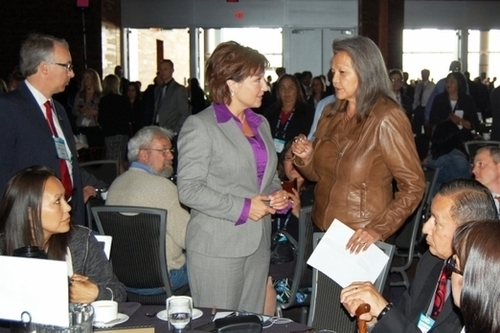
BC Premier Christy Clark confronted by Aboriginal leaders torn over LNG plans

See on Scoop.itGreen Energy Technologies & Development

Treaty 8 Chiefs had a hard time delivering a scathing letter to the Premier at a Vancouver LNG summit.

Duane Tilden‘s insight:

>The northeast First Nations have lived with oil and gas for 60 years, and understand the economic opportunities that could flow LNG.  But they also worry just how much more the region can take.  

Site C Dam and LNG together would cause massive disruption of the land, air and water.  Their polling shows 50% of their members are uncertain about LNG in particular, and 20% are vehemently opposed. 

Many fear an Alberta-Tar-Sands-scale industrialization coming to their territories.

“That’s what we’re afraid of.  If LNG goes through, they’re predicting upwards of 50,000 to 60,000 new frack wells… and all the associated infrastructure that goes with it: roads, pipelines, seismic, drilling.  It’s scary,” said Tribal Chief Logan.

“We’re not opposed to creating a good economy for everybody, but there has to be some type of sustainable development.  We can’t drink the water up there any more.”

“There’s more and more moose, rabbit and beaver organs that we’re finding that have [puss-like] abscesses on them.  Sometimes we open an animal and it smells almost rotten.”<

See on www.vancouverobserver.com

DOE Announces $10 million Funding for Wave Energy Demonstration at US Navy’s Hawaii Test Site

See on Scoop.itGreen Energy Technologies & Development

will help develop reliable wave energy options and collect important performance and cost data for wave energy conversion (WEC) devices.

Duane Tilden‘s insight:

"The U.S. Energy Department  announced $10 million to test prototypes designed to generate clean, renewable electricity from ocean waves and help diversify America’s energy portfolio. The Energy Department-supported demonstrations at the U.S. Navy’s wave energy test site off Hawaii’s island of Oahu will help develop reliable wave energy options and collect important performance and cost data for wave energy conversion (WEC) devices.

The Energy Department plans to test two WEC devices at depths of 60 and 80 meters at the open-water site offshore from Marine Corps Base Hawaii in Kaneohe Bay. These projects will enable the Energy Department to evaluate technology performance, reliability and cost of energy to achieve cost-competitive wave energy deployments in the future.

The two-phase demonstration projects will focus on WEC devices in the late stages of technology development–those ready to be tested at close to full-scale in the open-ocean environment. The first phase of this fundingopportunity will optimize designs and plan for the deployment and testing of WEC systems. The second phase will support permitting, fabrication, deployment, retrieval, and decommissioning of these systems after 12 months of testing and data collection."

See on solarthermalmagazine.com