Province Calls for Renewable Energy Storage Systems Demonstration Projects

Most of the new systems will be able to turn on a dime, storing and releasing energy almost instantaneously to help balance out the supply and demand over the course of a day

Source: www.theglobeandmail.com

>”Ontario has embarked on a quest to find the holy grail of renewable energy – an effective means to store the power generated by intermittent wind and solar installations.

The province’s Independent Electricity System Operator (IESO) recently chose five companies who will build a dozen demonstration projects designed to capture and release energy. That would allow the electricity grid to react to fluctuations in power production, which are becoming more significant with the addition of renewables whose output varies depending on how the wind blows and sun shines.

[…]

The technologies that will be tested include advanced batteries, systems that store power in the form of hydrogen, and even flywheels that hold energy as kinetic energy in a spinning rotor.

Bruce Campbell, president of the IESO, called storage facilities a “game changer” for a grid that was designed to produce electricity at exactly the same time it is consumed. “Energy storage projects will provide more flexibility and offer more options to manage the system efficiently,” he said.

The test projects will be distributed at various locations around the province, and will be connected to different parts of the grid to see how effectively they can help balance supply, demand and other transmission issues.

Among the suppliers are Hydrogenics Corp., which will test a hydrogen storage system, and Hecate Energy and Canadian Solar Solutions Inc., which will use various battery technologies. Convergent Energy and Power LLC will test a flywheel that converts electricity to kinetic energy stored in a rotor. Dimplex North America Ltd. will install thermal systems in apartments in Hamilton, Ont., that store electricity as heat in special bricks, releasing it later when the building needs to be warmed.

Rob Harvey, director of energy storage at Hydrogenics, said his company’s test system will incorporate an advanced electrolysis system that uses electricity to split water into hydrogen and oxygen. That hydrogen can then be used in a fuel cell to generate electricity when needed. Coupling the fuel cell and the electrolyser means power can be effectively stored for any length of time and dispatched as needed.

If the tests are successful, Mr. Harvey said, this could be a significant new line of business for Hydrogenics, which now makes hydrogen-producing systems for industrial customers, as well as fuel cells, which are essentially engines that use hydrogen as fuel.”<
 

See on Scoop.itGreen Energy Technologies & Development

Maintaining High Performance HVAC Control Systems for Cost Savings in Building Operations

The performance level of a building is directly related to the performance level of its control systems. You cannot manage a high performance building without high performing control systems.


Source: www.automatedbuildings.com

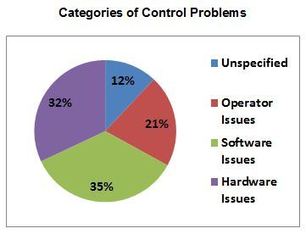
>”We rely on control systems to monitor and manage our building systems. For the most part it’s been assumed that once the control system is installed and configured it will work for years with little attention and minimal maintenance. Some systems may be trouble-free, but the majority of them will need regular attention and maintenance. Over time hardware will fail, software parameters and versions change and slowly the control system will “drift” from its original configuration and performance.

The role of control systems is somewhat undervalued. When you examine the most complex system in most buildings, the HVAC infrastructure, you find that it’s the HVAC control system, not the HVAC equipment, which produces the most operational issues and is the leading cause of inefficient energy use. Lawrence Berkley National Laboratories examined 60 buildings and found the highest frequency of common problems with HVAC was in the control system. Texas A&M research determined that of the operational and maintenance measures that could produce significant energy savings, 77% of the savings were from correcting control problems.

Maintaining a high performing control system involves regular maintenance, software and data management and organizational policies. The issues that can cause problems with a building control system are the same challenges all of us have had at one time or another with our computer or smartphone: problems related to software, hardware, communications networking and “user” mistakes. What follows is an overview of some of the typical control system issues and recommendations as to how to keep it performing at a high level.”<

See on Scoop.itGreen Building Operations – Systems & Controls, Maintenance & Commissioning

How to Get Started With LEED

Lesley's avatarLEED Certification

One of the most common questions we see is, “How do I get started with LEED?” LEED, or Leadership in Energy and Environmental Design, is the leading green building standard around the world. If you’re working in the architecture, engineering, or construction industries, you’ve probably heard the acronym tossed around by your colleagues. Before you dive into the rabbit role of Google searches (because trust me, there will be THOUSANDS of websites about LEED Certification), let’s go over the major things you need to know.

History of LEED
The United States Green Building Council (USGBC) created the LEED standard in 1993 to set a benchmark for the design, construction, and operations of “green” buildings. Since its inception, LEED has undergone a series of updates in order to stay relevant and provide effective solutions for the future.

Enter LEED Version 4
We’re now in the fourth version of the LEED standard…

View original post 457 more words

Net-Zero Energy for Buildings – ASHRAE Engineering Design and Construction

Integration: Net-zero energy design

ASHRAE has a goal: net-zero energy for all new buildings by 2030. What do engineers need to know to achieve this goal on their projects?

Source: www.csemag.com

>”As net-zero energy and low-energy design projects become more prevalent, engineers must be prepared to collaborate with all members of a project team including architects, energy specialists, lighting designers, builders, and owners in order to accomplish net-zero energy goals with little to no cost premium. Is this possible today or will it take another 10 or more years to get there?

There are many examples of completed projects demonstrating that not only is this possible, but it has been done in all regions of the country using readily available building products and common construction methods. So what’s the secret? It’s all about the design.

Net-zero energy defined

The term “net-zero energy” is abundantly used, but a single universally accepted definition does not exist. In general terms, a net-zero energy building (NZEB) has greatly reduced energy needs achieved through design and energy efficiency, with the balance of energy supplied by renewable energy. In an effort to clarify the issue, the National Renewable Energy Laboratory (NREL) published a paper in June 2006 titled “Zero Energy Buildings: A Critical Look at the Definition,” in which it defined the following four types of NZEBs:

Net Zero Site Energy: A site NZEB produces at least as much renewable energy as it uses in a year, when accounted for at the site.Net Zero Source Energy: A source NZEB produces (or purchases) at least as much renewable energy as it uses in a year, when accounted for at the source. Source energy refers to the primary energy used to extract, process, generate, and deliver the energy to the site. To calculate a building’s total source energy, imported and exported energy is multiplied by the appropriate site-to-source conversion multipliers based on the utility’s source energy type.Net Zero Energy Costs: In a cost NZEB, the amount of money the utility pays the building owner for the renewable energy the building exports to the grid is at least equal to the amount the owner pays the utility for the energy services and energy used over the year.Net Zero Energy Emissions: A net-zero emissions building produces (or purchases) enough emissions-free renewable energy to offset emissions from all energy used in the building annually. Carbon, nitrogen oxides, and sulfur oxides are common emissions that zero-energy buildings offset. To calculate a building’s total emissions, imported and exported energy is multiplied by the appropriate emission multipliers based on the utility’s emissions and on-site generation emissions (if there are any).

A subsequent paper was published by NREL in June 2010 titled “Net-Zero Energy Buildings: A Classification System Based on Renewable Energy Supply Options,” where four classifications of NZEBs were defined:

NZEB:A: Building generates and uses energy through a combination of energy efficiency and renewable energy (RE) collected within the building footprint.NZEB:B: Building generates and uses energy through a combination of energy efficiency, RE generated within the footprint, and RE generated within the site.NZEB:C: Building generates and uses energy through a combination of energy efficiency, RE generated within the footprint, RE generated within the site, and off-site renewable resources that are brought on site to produce energy.NZEB:D: Building uses the energy strategies described for NZEB:A, NZEB:B, and/or NZEB:C buildings, and also purchases certified off-site RE such as Renewable Energy Certificates (RECs) from certified sources. […]

Integrated building design

Integrated building design is a process that promotes holistic collaboration of a project team during all phases of the project delivery and discourages the traditional sequential philosophy. According to ASHRAE, the purpose of the integrated design process is to use a collaborative team effort to prepare design and construction documents that result in an optimized project system solution that is responsive to the objectives defined for the project. […]

Commissioning is an important part of every project, and for NZEB projects the commissioning authority should be a member of the design team and involved throughout the design process. […]”<

See on Scoop.itGreen Building Design – Architecture & Engineering

Tesla – Panasonic Confirms Gigafactory Swappable Battery Deal

Tesla and Panasonic make their partnership on the Gigafactory official as the automaker prepares to announce second-quarter earnings. Analysts will watch closely to see how well Tesla is tracking on its plan to deliver 35,000 cars this year as whether Elon Musk has any surprises up his sleeve.

Source: www.forbes.com

>"The wording of the press release suggests many details remain to be worked out, including how much Panasonic will be investing. Earlier reports, however, suggested a sum on the order of $200-300 million initially, which is expected to grow over time to perhaps $1 billion. In addition to building batteries at the new plant, Panasonic will continue to make them elsewhere and deliver them to the Gigafactory for assembly. The reason is that even the massive facility will only be able to produce about 70% of the cells needed for all the packs Tesla hopes to build — enough for 500,000 cars annually by 2020. […]

Deliveries, now and next quarter. Tesla has a stated goal of delivering 35,000 vehicles in 2014. It started off the year with 6,457 in the first quarter, which was slightly ahead of its target. Guidance for the current quarter was 7,500 deliveries, with significantly higher production of 8,500-9,000. The company has been trying to push production in order to get more cars into Europe and Asia, where the longer delivery pipeline isn’t quite full yet. If Tesla managed the 9,000 figure that would be nearly 20% higher than Q1 and would be an especially bullish sign.

[…]

Gross margin progress continues? Tesla is already past last year’s gross margin goal of 25% and is targeting 28% for 2014. As with 2013, the company expects progress to occur in a step-wise fashion each quarter. […] "<


See on Scoop.itGreen Energy Technologies & Development

Kitimat community prefers LNG projects over the Enbridge pipeline

“We’re not trying to hold out for a better deal,” said Chief Ellis Ross from the Haisla First Nation. “We know the potential for wealth here. We’ve been doing it for 10 years, we know how to negotiate but there’s no real price we can put on an oil spill happening in these waters.”

Australian Waste to Energy Gasification Plants Secure $50m Financing

See on Scoop.itGreen & Sustainable News

“Australian renewable energy investment firm, Clean Energy Finance Corporation (CEFC) has agreed provide up to AU$50 million ($47 million) in senior debt finance for the development of two waste to energy facilities that will use low temperature gasification in Western Australia.”

Duane Tilden‘s insight:

>”According to CEFC CEO, Oliver Yates waste management has been a growing issue in Australia for all levels of government and with recycling rates remaining fairly constant, the country will need to seek solutions to its increasing dependence on landfill.

[…]

The company added that the facilities will generate cost competitive, base load energy and a lower emissions outcome than current grid electricity sources.

The investor also noted that while both projects will be eligible for Australian Renewable Energy Certificates (RECs) for the majority of the energy produced, their financial viability is not reliant on RECs.

The investment is also expected to help to encourage further waste to energy facilities across the country and facilitate access to private sector funding for similar projects in the future which divert waste from landfills, increase recycling rates, recover energy and reduce greenhouse gas emissions.

CEFC said that its finance for the New Energy facilities takes its total investment in waste-to-energy projects to over $150 million, and that it has another $280 million of waste to energy proposals in its project pipeline that would unlock a further $1.0 billion in additional finance.

Technology

According to New Energy, its low temperature gasification process ‘cooks’ waste over a 16 to 24 hour period at temperatures of between 600°C and 875°C during which small amounts of air and steam are introduced.

This is said to break the molecules in the waste which are converted into a syngas that contains molecules such as methane with a high energy content.

The syngas is combusted to heat water and produce steam, either for use as either heat or for electrical generation. This secondary oxidation stage is said convert the syngas into water vapour and carbon dioxide.

The exhaust gases are cleaned and filtered, which the company said to neutralises acidic gases such as sulphur dioxide, as well as particulates and heavy metals. It is then released to the atmosphere.”<


See on www.waste-management-world.com

Russia-China Liquified Natural Gas Deal Limits BC’s LNG Market and Economic Appeal

See on Scoop.itGreen & Sustainable News

The new Russia-China gas deal “could squeeze the economics” of proposed LNG projects, according to a new report by Toronto-Dominion Bank

Duane Tilden‘s insight:

>"Russia recently clinched a US$400-billion deal to feed China around 38 billion cubic metres of natural gas via pipelines at a chummy price of $10-$11 per million cubic feet, shaking up an industry that is used to fetching $14-$18 per mcf from Asian markets.

The deal, along with a new trend of setting prices linked to gas prices rather than the traditional crude oil benchmarks, could upset British Columbia’s dream of launching a liquefied natural gas export industry.

“Clearly with so much LNG supply capacity set to come on stream, Asian buyers have more power to bargain for lower prices in LNG contracts, lowering the potential prices Canadian producers would receive, and could squeeze the economics of certain LNG projects,” TD said in a note published Thursday.

The deal has already created ripples across LNG-dependent markets such as Japan. This week, 38 Japanese lawmakers said they plan to lobby Prime Minister Shinzo Abe to revive a stalled Russia-Japan natural gas pipeline."<


See on business.financialpost.com

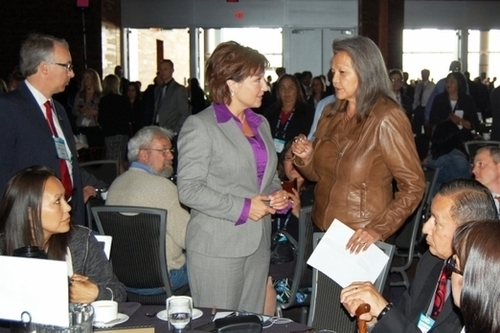
BC Premier Christy Clark confronted by Aboriginal leaders torn over LNG plans

See on Scoop.itGreen Energy Technologies & Development

Treaty 8 Chiefs had a hard time delivering a scathing letter to the Premier at a Vancouver LNG summit.

Duane Tilden‘s insight:

>The northeast First Nations have lived with oil and gas for 60 years, and understand the economic opportunities that could flow LNG.  But they also worry just how much more the region can take.  

Site C Dam and LNG together would cause massive disruption of the land, air and water.  Their polling shows 50% of their members are uncertain about LNG in particular, and 20% are vehemently opposed. 

Many fear an Alberta-Tar-Sands-scale industrialization coming to their territories.

“That’s what we’re afraid of.  If LNG goes through, they’re predicting upwards of 50,000 to 60,000 new frack wells… and all the associated infrastructure that goes with it: roads, pipelines, seismic, drilling.  It’s scary,” said Tribal Chief Logan.

“We’re not opposed to creating a good economy for everybody, but there has to be some type of sustainable development.  We can’t drink the water up there any more.”

“There’s more and more moose, rabbit and beaver organs that we’re finding that have [puss-like] abscesses on them.  Sometimes we open an animal and it smells almost rotten.”<

See on www.vancouverobserver.com

DOE Announces $10 million Funding for Wave Energy Demonstration at US Navy’s Hawaii Test Site

See on Scoop.itGreen Energy Technologies & Development

will help develop reliable wave energy options and collect important performance and cost data for wave energy conversion (WEC) devices.

Duane Tilden‘s insight:

"The U.S. Energy Department  announced $10 million to test prototypes designed to generate clean, renewable electricity from ocean waves and help diversify America’s energy portfolio. The Energy Department-supported demonstrations at the U.S. Navy’s wave energy test site off Hawaii’s island of Oahu will help develop reliable wave energy options and collect important performance and cost data for wave energy conversion (WEC) devices.

The Energy Department plans to test two WEC devices at depths of 60 and 80 meters at the open-water site offshore from Marine Corps Base Hawaii in Kaneohe Bay. These projects will enable the Energy Department to evaluate technology performance, reliability and cost of energy to achieve cost-competitive wave energy deployments in the future.

The two-phase demonstration projects will focus on WEC devices in the late stages of technology development–those ready to be tested at close to full-scale in the open-ocean environment. The first phase of this fundingopportunity will optimize designs and plan for the deployment and testing of WEC systems. The second phase will support permitting, fabrication, deployment, retrieval, and decommissioning of these systems after 12 months of testing and data collection."

See on solarthermalmagazine.com