Kyocera Opens Japan’s Largest Offshore Solar Power Plant

See on Scoop.itGreen & Sustainable News

The Kyocera Corporation just opened a 70 megawatt solar power plants off the southern coast of Japan.

Duane Tilden‘s insight:

>Kyocera partnered with six other companies to develop the solar plant, which is located in the Kagoshima Prefecture. The company hopes that this latest offshore venture will set a precedent for a cleaner Japan, especially in light of the 2011 Fukushima disaster. The solar plant is designed to inspire and encourage Japan to make the switch to more renewable energy sources.

The Kagoshima Nanatsujima Solar Power Plant was made possible in part because of Japan’s revised feed-in-tariff (FIT) program, which was restructured in July, 2012 to better accommodate solar energy. The adjusted FIT plan requires local utilities to purchase 100 percent of the power generated by solar plants that produce more than 10 kW.<

Read more: Kyocera Opens Japan’s Largest Offshore Solar Power Plant | Inhabitat – Sustainable Design Innovation, Eco Architecture, Green Building

See on inhabitat.com

Federal Energy Management Program: Online Training – Live & On-Demand – CEU’s

See on Scoop.itGreen & Sustainable News

FEMP trains Federal agency managers about the latest energy requirements, best practices, and technologies through eTraining Courses, First Thursday Seminars, and webinars.

See on apps1.eere.energy.gov

Lessons in Energy Saving, a guest blog by Roger Hunt

>The energy saving measures are being retrofitted during a wider refurbishment project. They range from secondary glazing, draught-proofing and new energy efficient boilers to roof insulation, LED lighting and the installation of wood burning stoves. There are also low volume baths, dual flush cisterns and heat recovery systems in the bathrooms. Full details of the Buscot and Coleshill refurbishments and a short video can be found at the SuperHomes website.<

84% Efficient Combined Heat & Power (CHP) Plant to be built by Siemens in Poland

See on Scoop.itGreen & Sustainable News

Through immediate publication of press releases, we keep the business, financial and public press informed on all important Siemens topics.

Duane Tilden‘s insight:

>The plant will be built in western Poland in the city of Gorzów Wielkopolski. Within the scope of turnkey construction, Siemens will deliver two SGT-800 gas turbines, one SST-400 steam turbine, three 11 kilovolt (kV) generators and two heat recovery steam generators. In addition, Siemens was awarded a long-term 12 years maintenance agreement for the gas turbines. The Gorzów plant will be fired with nitrogen-rich natural gas from gas reserves located in western Poland. This type of gas has a lower calorific value than conventional natural gas. […]

The Gorzów power plant will replace a currently used coal-fired block at the same location. The combined cycle power plant with district heat extraction will be able to generate electricity in a much more efficient and environmentally friendly manner. Compared to the old coal-fired power plant, the new plant will produce 95 percent less sulfur dioxide emissions, more than 30 percent less nitrogen dioxide emissions and more than 95 percent less particulate emissions.<

See on www.siemens.com

The Future of Green Building Codes

>However, as buildings get more and more efficient, elements such as building operation and occupant use make up a bigger slice of the building performance pie.

Even for buildings that commit to stringent building standards, there’s a large range of outcomes, Frankel says, as to how those buildings eventually perform based on factors that currently are almost entirely outside the purview of the building code.

For example, in a recently retrofitted office building engineered for high performance that Frankel profiled, plug loads made up nearly half of all the energy the building consumed. “That has nothing to do with code, and it doesn’t even have that much to do with operation,” Frankel said. “It has to do with the occupants.”

As a result, it’s these areas—operation and tenant behavior—that are going to see most of the action in code policy discussion in coming years, he says.

“We have to find a way to engage operators and occupants in this discussion,” he says, “or we are never getting to net zero.”<

Claire Easley's avatarThe Knowledge Builder

In many discussions of building performance, it’s builders and architects that are forced to take all the heat for buildings’ carbon footprints. But that wasn’t true of a recent presentation given by Mark Frankel, technical director of the Vancouver, Wa.–based New Buildings Institute, titled “Codes Standards and Rating Systems,” delivered at the recent Vision 2020 Sustainability Summit in Washington, D.C. While Frankel noted that there’s certainly more that can be done in design and construction to improve how a building will perform, “there’s not as much room left in building design as we’ve already captured,” he said.

That’s not to say there’s not still a long way to go. In the United States, the building sector is still the highest contributor to greenhouse gasses. And many builders and architects have yet to fully embrace the high-performance building practices that Frankel emphasized are available. “We have the technology…

View original post 222 more words

Clean Energy rebranded by DOE to Combined Heat and Power (CHP)

See on Scoop.itGreen Energy Technologies & Development

In a move that had been in the works for a while, the U.S. Department of Energy recently announced that its Clean Energy Application Centers have been rebranded as CHP Technical Assistance Partnerships, or CHP TAPs.

Duane Tilden‘s insight:

>The CHP TAPs maintain the same regional offices that existed under the former Clean Energy Application Centers:

  1. Pacific (California, Nevada);
  2. Southwest (Arizona, Colorado, New Mexico, Oklahoma, Texas, Utah, Wyoming);
  3. Northwest (Idaho, Montana, Oregon, Washington);
  4. Midwest (Illinois, Indiana, Iowa, Kansas, Michigan, Minnesota, Missouri, Nebraska, North Dakota, Ohio, South Dakota);
  5. Southeast (Alabama, Arkansas, Florida, Georgia, Kentucky, Louisiana, Mississippi, North Carolina, South Carolina, Tennessee);
  6. Mid-Atlantic (Delaware, Maryland, New Jersey, Pennsylvania, Virginia, West Virginia); and
  7. Northeast (Connecticut, Maine, Massachusetts, New Hampshire, New York, Rhode Island, Vermont).

With the new energy in these programs, now is the time to take advantage of the expertise offered by the Department of Energy and its CHP TAPs. Industrial users, municipalities, hospitals, college campuses and other large users of energy need to review and understand the significant benefits of CHP, district energy and waste heat capture technologies.<

See on www.natlawreview.com

Connecticut Storm Proofing with Micro-Grid Developments

See on Scoop.itGreen Energy Technologies & Development

Press Release Gov. Dannel P. Malloy announced Oct. 30 that nine towns that are part of a pilot microgrid program, including Windham and Storrs, are eligible for additional funding.

Duane Tilden‘s insight:

>A pilot microgrid program, administered by the state Department of Energy and Environmental Protection, was created under Public Act 12-148 to increase the safety and quality of life for Connecticut residents during electric grid outage situations.

Microgrids provide electricity to critical facilities and town centers on a 24/7, daily basis. They will also include a system of “trips” and “transfers” to isolate the microgrid and provide power within its network even when there is a large-scale outage.

The first round of the program awarded $18 million in grants to microgrid projects in Bridgeport, Fairfield, Groton, Hartford, Middletown, Storrs/Mansfield, Windham and Woodbridge as part of the Governor’s Storm Legislation.

Those projects are expected to become operational over the course of the next 18 months, with the first projects slated to come online in early 2014. […]

“Our first-in-the-nation microgrid program is an essential tool to help minimize hardships to our residents and businesses when severe storms occur. We all know that it is not a question of if, but when the next super storm will strike, and it is essential we do everything we can to be prepared,” Gov. Malloy said.

Commenting on the additional funding, DEEP Commissioner Daniel C. Esty said, “It is essential to public safety that power be maintained to critical facilities and town centers even when the electric grid is down… Connecticut and the northeast continue to experience more severe and more frequent storms, so it is vital that the state aggressively pursues the development of microgrids statewide so that we are in a better position to provide critical services to the state’s residents and businesses.”<

See on mansfield.htnp.com

In Commercial Buildings, Water Savings Lead to Big Benefits

“Existing buildings are also seeing more emphasis on water savings. In areas like San Francisco, where upgrading to high-performance lavatory fixtures is a requirement, some of that interest is a result of government stipulation; however, building owners everywhere can benefit from the financial benefits. “We’ve seen incredible financial returns” for upgrading to water-saving features, Macko says, adding that they can yield up to a 25% return on investment in the first year.”

Claire Easley's avatarThe Knowledge Builder

“Please do not drink the toilet water.”

While that statement might seem overly cautionary, it may soon appear over every toilet in some of the most cutting-edge high-rises in San Francisco thanks to a growing emphasis on water conservation and recent provisions allowing for greywater use in commercial buildings for flushing.

“For the first time in California’s history, we’ll see private commercial developers using non-potable sources for fixture supply. This is a marked departure from the norm,” says Matt Macko, principal at San Francisco–based Environmental Building Strategies.

In forward-thinking markets like San Francisco, LEED gold and platinum levels are becoming the standard as new buildings compete for status as the most cutting-edge and efficient in order to better attract tenants, and as corporations seek to brand themselves through their architecture. In order to reach these lofty certifications, planners “have to incorporate things like greywater and storm water systems,” Macko…

View original post 113 more words

US GSA Recognizes two 3rd-party Green Building Certification Systems

See on Scoop.itGreen Building Design – Architecture & Engineering
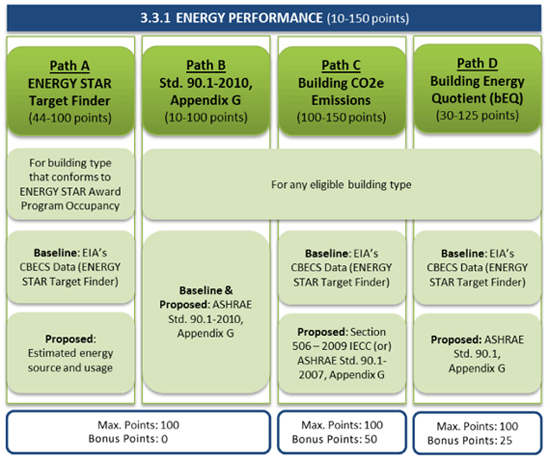
Green-Globes-NC-Building-Energy-Performance-Paths-chart

LEED and Green Globes approved as third party certification programs for federal facilities.

Duane Tilden‘s insight:

>In its recommendation to DOE, GSA recommended the Green Building Initiative’s Green Globes 2010 and the U.S. Green Building Council’s Leadership in Energy and Environmental Design (LEED) 2009 as the third party certification systems that the federal government can use to gauge performance in its construction and renovation projects. Other certification systems were not selected because they did not align with the government’s requirements. Additionally, under this recommendation, GSA will conduct more regular reviews in order to keep up with the latest green building tools that the market has to offer.

Third party certification systems like LEED and Green Globes help in measuring reduction targets for water, energy, and greenhouse gas emissions against industry standards. Agencies can use one of the two certification systems that best meet their building portfolios, which range from office buildings, to laboratories, to hospitals, to airplane hangars.

Federal construction and modernization projects must adhere to the government’s own green building requirements by law and executive orders. No one certification system meets all of the federal government’s green building requirements. Green building certification systems are just one tool that GSA uses to cut costs and meet sustainability and economic performance goals.<

See on www.todaysfacilitymanager.com

GBI’s Green Globes Recognized by Portland’s GSA as Equivalent to LEED for Green Building

See on Scoop.itGreen Building Design – Architecture & Engineering

PORTLAND, OR–(Marketwired – Oct 29, 2013) – The Green Building Initiative (GBI) applauds the General Services Administration on its recognition of Green Globes® alongside the U.S.

Duane Tilden‘s insight:

>GBI’s growth in the market is due to its commitment to the practicality of its tools for use by building owners, designers, and facility managers as well as its commitment to open, consensus-based review of its technical criteria. In 2010, GBI was recognized for developing Green Globes for New Construction as the first ever American National Standard for a commercial building rating system. As it continues to improve its rating systems based on changes in the market, GBI remains committed to using the American National Standards Institute (ANSI) approved consensus procedures.

“GBI is the only commercial building rating system developer to vet its technical criteria through the ANSI process,” stated GBI Chairman Tonjes. “This helps to ensure that GBI’s rating systems provide the opportunity to evaluate the widest range of buildings using an open, science-based approach to building performance.”

ANSI/GBI 01-2010, also known as Green Globes for New Construction, is due for revision before the end of 2015 based on ANSI periodic maintenance requirements. According to Tonjes, GBI’s ANSI-based rating system review process will begin before the end of this year with the filing of required documents followed by reformation of the technical review committee.

GBI’s tools have a significant focus on both the reduction and efficient use of energy and water in buildings. These, along with other criteria, help reduce building operating costs and their overall impact on the environment.

“Since 2005, the Green Globes product line has evolved to include several updated and expanded tools,” stated Erin Shaffer, vice president of federal outreach at GBI.<

See on www.marketwired.com