University to Install Combined Heat and Power Plant for Energy Savings and Climate Goals

“Construction is will soon begin on a $96 million combined heat and power (CHP) plant in another aging facility near the river’s edge that will dramatically cut the campus’ carbon footprint while driving down the cost of energy”

Source: www.midwestenergynews.com

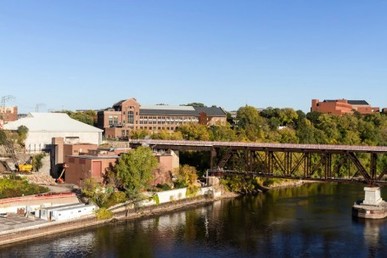
>” […] The project, in the 1912-vintage Old Main Utility Building, will produce enough steam to heat the entire campus and meet about half of its electricity demand.

CHP and carbon reductions

CHP will be a major tactic in the goal of reducing the University’s carbon emissions by 50 percent by 2020, said Shane Stennes, who serves as the University Services’ sustainability coordinator. The Southeast Steam Plant, itself a CHP facility, mainly used natural gas but still had a small measure of coal in its fuel mix, along with oat hulls.

“The carbon reduction is partly due to a change in fuel but mostly a result of increased efficiency,” Stennes said. The ability to use the waste heat from the electricity generation process is the real reason the University will see carbon emissions plummet, he added.

“From the sustainability point of view this plant is the right thing to do,” he said, noting that in 2008 the University’s campus system agreed to a net zero scenario in the American College and University Presidents’ Climate Commitment.

CHP is on a bit of a roll. President Barack Obama signed an executive order in 2012 promoting wider adoption of CHP and the state Department of Commerce recently held stakeholders’ meetings on the issue to determine how the state might help in moving forward projects.

The potential was described in a Commerce policy brief associated with the stakeholder meetings: “Power generation waste heat in Minnesota is nearly equal to the total requirement for heat energy in buildings and industry.” […]

Minnesota has at latest count 55 CHP systems in the state, according to the ICF International.

Reasons for CHP at the U

A campus CHP comes with another advantage by creating an “island” of energy independence should a regional blackout hit. Many major Midwest and coastal universities have CHP in part to rely less on power grids that are vulnerable to major storms or other weather maladies, he said.

“We see CHP as a way to be competitive with other schools and to protect research if we had a catastrophe,” he said.

The need for more boilers, said Malmquist, stems from growing demand for power. Although the nearly dozen new buildings constructed in the last few years meet rigorous energy efficiency standards they tend to demand more power due to their function as research centers.

The Biomedical Discovery District, a new physics laboratory, technology classroom and other science-related buildings, as well as a new residence hall, have added square footage for steam and electricity, he said.

“The buildings we’re putting up today are more energy intensive than the ones we’ve been taking down,” said Malmquist. […]”<

See on Scoop.itGreen Building Operations – Systems & Controls, Maintenance & Commissioning

Morgan Stanley Installs Bloom Energy Fuel Cells At Purchase, NY Facility

Morgan Stanley Installs Bloom Energy Fuel Cells At Purchase, NY Facility

Source: www.bloomenergy.com

“The project will provide clean and uninterruptible power for the 750,000 Sq. Ft. Office Building

PURCHASE, NY, Nov. 14 — […] The fuel cell system, along with a solar panel field completed earlier this year, are the latest in a series of initiatives to improve the facility’s energy efficiency and resiliency.

The Bloom Energy fuel cell system produces electricity without burning fossil fuels, thus reducing emission of greenhouse gases. It will supply approximately 250 kilowatts (kW) of constant base load power to the facility, as well as grid-independent electricity to power portions of the building’s critical load during grid outages.  […]

The new solid oxide fuel cell system (SOFC) technology converts fuel into electricity through a highly efficient electrochemical process, resulting in on-site, clean and reliable power. Combined with the solar field, these new installations are expected to produce approximately 3 million kilowatt hours (kWh) of energy a year. During peak energy consumption times, they can supply approximately one megawatt, or up to 30 percent of the building’s demand.

Support for this project was provided by the New York State Energy Research and Development Authority (NYSERDA). Founded in 1975, NYSERDA is a public benefit corporation that provides information, services, programs and funding to help New Yorkers increase energy efficiency, save money, use renewable energy and reduce reliance on fossil fuels.

About Bloom Energy

Bloom Energy is a provider of breakthrough solid oxide fuel cell technology generating clean, highly-efficient on-site power from multiple fuel sources. The company was founded in 2001 with a mission to make clean, reliable energy affordable for everyone in the world. Bloom Energy Servers are currently producing power for several Fortune 500 companies including Apple, Google, Walmart, AT&T, eBay, Staples, The Coca-Cola Company, as well as notable non-profit organizations such as Caltech and Kaiser Permanente. The company is headquartered in Sunnyvale, CA. For more information, visit www.bloomenergy.com.

About Morgan Stanley

Morgan Stanley (NYSE: MS) is a leading global financial services firm providing investment banking, securities, investment management and wealth management services.  […]”<


See on Scoop.itGreen Energy Technologies & Development

Bloom Box: The Alternative Energy Fuel Cell Technology – 60 Minutes

“Derived from a common sand-like powder, and leveraging breakthrough advances in materials science, our technology is able to produce clean, reliable, affordable power,… practically anywhere,… from a wide range of renewable or traditional fuels.”

Source: www.youtube.com

Changing the Face of Energy

Bloom Energy is changing the way the world generates and consumes energy.

Our unique on-site power generation systems utilize an innovative new fuel cell technology with roots in NASA’s Mars program.  […]

Our Energy Servers® are among the most efficient energy generators on the planet; providing for significantly reduced electricity costs and dramatically lower greenhouse gas emissions.

By generating power on-site, where it is consumed, Bloom Energy offers increased electrical reliability and improved energy security, providing a clear path to energy independence.

Founded in 2001, Bloom Energy is headquartered in Sunnyvale, California.”
http://www.bloomenergy.com/about/&nbsp;

See on Scoop.itGreen Energy Technologies & Development

Mega-Project – BC’s Peace River Site C Dam to Break Ground Next Summer

“Clark said that it’s unknown how much the project will add to BC Hydro customers’ bills, but that the cabinet reached the decision after careful analysis and much discussion.”

Source: thetyee.ca

>” […] British Columbia plans to start construction of the $8.8-billion Site C dam on the Peace River next summer, Premier Christy Clark said today in a controversial announcement that was welcomed by some and panned by others.

“Once it is built, it is going to benefit British Columbians for generations, and that is why we have decided to go ahead with the Site C clean energy project,” Clark said at a press conference at the provincial legislature.

Clark said that it’s unknown how much the project will add to BC Hydro customers’ bills, but that the cabinet reached the decision after careful analysis and much discussion.

Site C was the most affordable, reliable and sustainable option available to meet B.C.’s growing power needs, she said. Over the next 20 years, the government is estimating that demand for energy will increase by 40 per cent as both the population and industry grows. Roughly one-third of that power is expected for residential use.

First proposed some 30 years ago, Site C will be the third of a series of dams on the Peace River and will flood an 83-kilometre long stretch of the river to generate 1,100 megawatt hours of electricity, enough to power 450,000 homes per year.

“If you accept the premise British Columbia is going to grow, then you also accept the premise we’re going to need more power,” said Clark. That power will come from a variety of sources, including the Site C dam, which will have a lifespan of 100 years, she said. […]

Impacts ‘that can’t be mitigated’: CEO

BC Hydro President and CEO Jessica McDonald said the Crown corporation has spent seven years consulting with First Nations. “We acknowledge and respect that there are impacts,” she said. “There are impacts that can’t be mitigated.”

Discussions are continuing and there are hopes they’ll reach an agreement on accommodation, she said. Courts have ruled that in certain situations it may be necessary to compensate an aboriginal group for any adverse impacts a project may have on its treaty rights. Compensation could include habitat replacement, job skills or training, or cash.

Energy and Mines Minister Bill Bennett said the project is in the long-term best interest of the province, though he acknowledged it comes at a cost to people in the Peace River valley. “There are impacts to people who live in the Northeast, and nobody is happy about that,” he said.

It’s a major project and worth building, he said. “It’s big, it’s expensive, it’s a huge project, but it’s eight per cent of the total electricity needs in the province.” […] “<


See on Scoop.itGreen & Sustainable News

University Researchers Find Abandoned Wells Leak Substantial Quantities of GHG’s (Methane)

After testing a sample of abandoned oil and natural gas wells in northwestern Pennsylvania, the researchers found that many of the old wells leaked substantial quantities of methane.

Source: www.princeton.edu

>” […] To conduct the research, the team placed enclosures called flux chambers over the tops of the wells. They also placed flux chambers nearby to measure the background emissions from the terrain and make sure the methane was emitted from the wells and not the surrounding area.

Although all the wells registered some level of methane, about 15 percent emitted the gas at a markedly higher level — thousands of times greater than the lower-level wells. Denise Mauzerall, a Princeton professor and a member of the research team, said a critical task is to discover the characteristics of these super-emitting wells.

Mauzerall said the relatively low number of high-emitting wells could offer a workable solution: while trying to plug every abandoned well in the country might be too costly to be realistic, dealing with the smaller number of high emitters could be possible.

“The fact that most of the methane is coming out of a small number of wells should make it easier to address if we can identify the high-emitting wells,” said Mauzerall, who has a joint appointment as a professor of civil and environmental engineering and as a professor of public and international affairs at the Woodrow Wilson School.

The researchers have used their results to extrapolate total methane emissions from abandoned wells in Pennsylvania, although they stress that the results are preliminary because of the relatively small sample. But based on that data, they estimate that emissions from abandoned wells represents as much as 10 percent of methane from human activities in Pennsylvania — about the same amount as caused by current oil and gas production. Also, unlike working wells, which have productive lifetimes of 10 to 15 years, abandoned wells can continue to leak methane for decades.

“This may be a significant source,” Mauzerall said. “There is no single silver bullet but if it turns out that we can cap or capture the methane coming off these really big emitters, that would make a substantial difference.” […]”<

See on Scoop.itGreen & Sustainable News

Swedish Stirling Engine Generator Converts Low Quality Landfill Gas to Energy in Poland

Swedish Stirling Engine generator specialist, Cleanergy supplies its GasBox generators to two landfill sites in Poland for the production of energy from low quality methane gas emitted from two major, following a successful pilot project earlier in the year.

Source: www.waste-management-world.com

>” […] GasBox – the centrepiece of its Combined Heat & Power (CHP) system – has been specifically developed to generate electricity and heat from low-quality methane gas produced by the decomposition of organic matter at the 2000+ landfill sites across Europe, most of which are more than 10 years old.

According to Cleanergy, many such landfill sites choose to flare the methane they produce.

The European Union Landfill Directive of 1999 states that flaring is only an option if it is impossible to extract energy from the methane gas. But up until today, older landfill sites have often broken these directives because the gas combustion engines traditionally used at newer landfills where methane levels are above 40% simply cannot produce electricity from lower grade, ‘dirty’ methane.

However, at the two Polish landfill sites the methane was released straight into the atmosphere rather than being flared.  To address this, Cleanergy’s GasBox was deployed at the Regional Centre of Waste Management in Domaszkowice in Poland in August.

This 25 hectare landfill site closed in the  2000. Since the installation of the GasBox, the electricity generated has been used to power equipment and to heat and electrify buildings at the site.

Following this success, Cleanergy’s CHP system has also been deployed at the Waste Neutralisation Enterprise in Sulnówko, a 7.5 hectare landfill site.

Anders Koritz, CEO at Cleanergy commented: “We developed our GasBox to meet a specific need – a complete CHP system that can run on low-grade methane gas. Sure enough the industry response since our launch in June has been amazing.”

According to Cleanergy its GasBox addresses this specific problem and is able to produce both electricity and heat from a methane gas concentration down to 18%.

Installed inside a modular container, Cleanergy’s GasBox is an autonomous and flexible stirling engine unit. Also inside the container is a real-time power management system with remote access; a fuel pipe; plus a heat and electricity connection to a house/factory/warehouse with optional grid functionality.

With a claimed ROI of three to five years, the company said that its GasBox is now commercially deployed at several locations in Norway, Slovenia, Sweden (in collaboration with the Swedish Energy Agency) and the UK. […]”<


See on Scoop.itGreen Energy Technologies & Development

Indiana Landfill Gas Energy Project Starts Operations

Republic Services recently announced the start of operations at its latest landfill gas-to-energy project. The new 6 MW project at County Line Landfill involves four engines operating at one energy generation facility.

Source: biomassmagazine.com

>” […] Landfill gas is a natural byproduct of decomposing waste. This project involves extracting gas from within the landfill, processing the extracted gas, and then distributing the processed gas to a generation facility where it is converted into energy that supplies the local electric grid.

According to the U.S. EPA, landfill gas-to-energy projects also reduce reliance on non-renewable energy resources, such as coal or petroleum. The EPA estimates that three megawatts of energy produced from landfill gas is equivalent to preventing carbon emissions generated by the consumption of 16.6 million gallons of gasoline. Based on EPA calculations, the new County Line Landfill gas-to-energy project prevents carbon emissions equivalent to the consumption of more than 32 million gallons of gasoline.

Republic Services partnered with Aria Energy on the design, development and management of the new project. Republic Services and Aria Energy have partnered on four projects to date with a combined generation capacity of more than 39.6 megawatts of electrical power. Republic and Aria are currently working on two additional projects, which combined are expected to create another 15 megawatts of electrical power.

Republic Services has implemented 73 landfill gas-to-energy projects nationwide. Together, these projects harness enough electricity to power or heat approximately 400,000 households. According to the EPA, the combined environmental benefits from these projects are equal to removing more than 4 million cars from our roads or planting more than 4.5 million acres of trees each year. […]”<

See on Scoop.itGreen & Sustainable News

New Alberta Oilsands Projects to Start Up Despite Falling Oil Prices

Oil producers are set to be squeezed as a total of 14 new oilsands projects are scheduled to start next year while crude prices continue to fall

Source: business.financialpost.com

” […] “There is a lot of crude coming on next year,” Juan Osuna, IHS Energy Inc.’s senior director for North American oil said in a phone interview Dec. 12. Producers “aren’t going to be happy, they will make a greater effort to cut costs, but they have been prepared for this.”

Western Canadian Select fell to US$39.38 a barrel Monday, the lowest since April 2009, according to data compiled by Bloomberg. The grade, which has higher sulfur content than U.S. benchmark West Texas Intermediate, sold at an average US$18.78 a- barrel discount in the past year, according to data compiled by Bloomberg.

Oilsands projects slated to start next year include ConocoPhillips and Total SA’s joint 118,000 barrel a day Surmont project and the 40,000-barrel-a-day expansion of Cenovus Energy Inc.’s Foster Creek project […]

Sunrise Project

Husky Energy Inc. said last week it began steam operations on its Sunrise crude project with the first phase set to begin pumping oil by early next year.

While oilsands producers may curtail future development, most existing operations won’t be shut and ones under construction will go ahead because of the investments involved and potential harm to future output, Osuna said.

Cenovus said Dec. 11 production would rise 9 per cent to 129,000 barrels a day from its Foster Creek and Christina Lake projects next year even as it lowered its spending plan by about 15 per cent.

Canada’s oilsands output is projected to rise to 3.7 million barrels a day by 2020 from 1.98 million last year, according to a report last month by the Canadian Energy Research Institute.

Brent oil traded near US$61 a barrel Monday as the United Arab Emirates said the Organization of Petroleum Exporting Countries will resist output cuts even if prices slump as low as US$40. […]”<

See on Scoop.itGreen & Sustainable News

$200m Demand Management Program Approved in NYC to Defer $1 billion SubStation to 2026

The NYPSC approved Con Ed of New York’s proposed $200 million Brooklyn/Queens Demand Management Program that would relieve overloads in the city.

Source: www.rtoinsider.com

>” […] Con Ed’s proposed Brooklyn/Queens Demand Management Program is consistent with the state’s “Reforming the Energy Vision” program to restructure the electricity market with greater reliance on technology and distributed resources, the commission said. “The commission is making a significant step forward toward a regulatory paradigm where utilities incorporate alternatives to traditional infrastructure investment when considering how to meet their planning and reliability needs,” the order states.

Commission Chair Audrey Zibelman added that because of the recent D.C. Circuit Court of Appeals decision striking down federal jurisdiction over demand response in wholesale markets, it’s important for state regulators to set market rules for that resource.

Con Ed said the feeders serving the Brownsville No. 1 and 2 substations began to experience overloads in 2013 and would be overloaded by 69 MW for 40 to 48 hours during the summer by 2018. A new substation, transmission subfeeders and a switching station would cost $1 billion, according to the company. The PSC accepted the company’s estimate of the DM Program’s costs and ordered a cap of $200 million.

The program would include 52 MW of non-traditional utility-side and customer-side relief, including about 41 MW of energy efficiency, demand management and distributed generation, and 11 MW of utility-side battery energy storage. This will include incentives to upgrade building “envelopes,” improve air conditioning efficiency of equipment, encourage greater use of energy controls, and establish energy storage, distributed generation or microgrids.

This will be supplemented by approximately 17 MW of traditional utility infrastructure investment, consisting of 6 MW of capacitors and 11 MW of load transfers from the affected area to other networks.  […]”<


See on Scoop.itGreen Energy Technologies & Development

Applying Intelligent Efficiency to the Transportation Sector

A new report from ACEEE, Energy Savings from Information and Communications Technologies in Personal Travel,estimates that aggressively incorporating a handful of ICT strategies could reduce energy consumption in transportation by almost 13% by 2030.

Source: aceee.org

>” […] Intelligent efficiency is the use of information and communications technologies (ICT) to improve the overall productivity and efficiency of a given sector.

In transportation, intelligent efficiency can affect the way we travel by providing us with real-time feedback and information on fuel economy, making it easier for us to use alternatives to driving such as public transit and bicycles, and by moving traffic away from peak travel times and consolidating travelers into fewer vehicles.

[…] The strategies discussed in the report include:

  • Car and bike sharing
  • Real-time transit information
  • In-vehicle feedback
  • Vehicle-to-vehicle communications and driver assist applications
  • ICT-based transportation demand management programs (TDM)

The report aims to provide readers with a sense of the relative magnitude of energy savings possible from these strategies, and is by no means a definitive overall estimate. ICT could be incorporated in many additional ways in the transportation sector. The strategies described here are simply the tip of the iceberg when it comes to implementation. Studies from Europe have shown that reductions could be as high as 26% if we consider the whole universe of strategies and options. […]”<

See on Scoop.itGreen Energy Technologies & Development