How Real Estate Energy Managers Can Use Big Data to Schedule Building Energy Retrofits

See on Scoop.itGreen Building Operations – Systems & Controls, Maintenance & Commissioning

Big Data remains a fairly nebulous concept for many real estate professionals, including those who stand to gain tremendously from it right now: real estate energy managers.

Duane Tilden‘s insight:

>To effectively time energy retrofit measures, energy managers can first develop those measures. New energy analytical tools such as FirstFuel identify and develop measures, and even estimate a range for capital cost. It does this analysis remotely over the course of a day just by analyzing hourly electricity data (which is sometimes also stored by the utility); no time-intensive on-site energy audit is required. Another new tool is Retroficiency, which provides a high-level look at energy performance improvement potential using the same interval data and, with minimal additional data from the IWMS, can further develop retrofit measures to investment-grade level.

After identifying energy-retrofit measures for the portfolio using remote energy analysis tools or more standard on-site energy analysis, energy managers can create a new retrofit measures database in the IWMS. Having this new database on hand enables managers to integrate energy retrofit opportunities with space management, maintenance and capital upgrade needs, and potentially other real estate issues. Such integration drives down the incremental cost of an energy retrofit, which is the gross cost minus the avoided cost of otherwise required capital or space upgrades.<

See on blog.rmi.org
Federal Energy Management Program: Online Training – Live & On-Demand – CEU’s

See on Scoop.itGreen & Sustainable News

FEMP trains Federal agency managers about the latest energy requirements, best practices, and technologies through eTraining Courses, First Thursday Seminars, and webinars.

See on apps1.eere.energy.gov

Lessons in Energy Saving, a guest blog by Roger Hunt

>The energy saving measures are being retrofitted during a wider refurbishment project. They range from secondary glazing, draught-proofing and new energy efficient boilers to roof insulation, LED lighting and the installation of wood burning stoves. There are also low volume baths, dual flush cisterns and heat recovery systems in the bathrooms. Full details of the Buscot and Coleshill refurbishments and a short video can be found at the SuperHomes website.<

US GSA Recognizes two 3rd-party Green Building Certification Systems

See on Scoop.itGreen Building Design – Architecture & Engineering
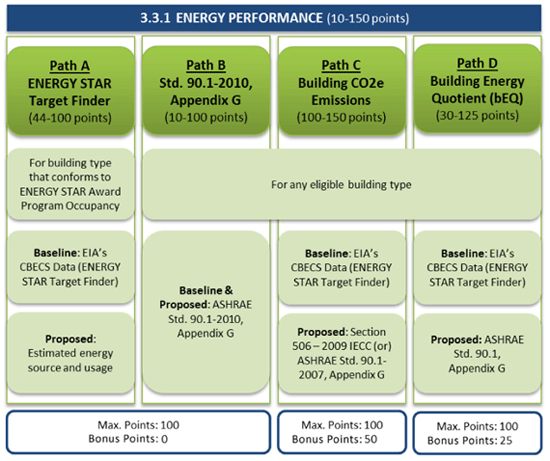
Green-Globes-NC-Building-Energy-Performance-Paths-chart

LEED and Green Globes approved as third party certification programs for federal facilities.

Duane Tilden‘s insight:

>In its recommendation to DOE, GSA recommended the Green Building Initiative’s Green Globes 2010 and the U.S. Green Building Council’s Leadership in Energy and Environmental Design (LEED) 2009 as the third party certification systems that the federal government can use to gauge performance in its construction and renovation projects. Other certification systems were not selected because they did not align with the government’s requirements. Additionally, under this recommendation, GSA will conduct more regular reviews in order to keep up with the latest green building tools that the market has to offer.

Third party certification systems like LEED and Green Globes help in measuring reduction targets for water, energy, and greenhouse gas emissions against industry standards. Agencies can use one of the two certification systems that best meet their building portfolios, which range from office buildings, to laboratories, to hospitals, to airplane hangars.

Federal construction and modernization projects must adhere to the government’s own green building requirements by law and executive orders. No one certification system meets all of the federal government’s green building requirements. Green building certification systems are just one tool that GSA uses to cut costs and meet sustainability and economic performance goals.<

See on www.todaysfacilitymanager.com

GBI’s Green Globes Recognized by Portland’s GSA as Equivalent to LEED for Green Building

See on Scoop.itGreen Building Design – Architecture & Engineering

PORTLAND, OR–(Marketwired – Oct 29, 2013) – The Green Building Initiative (GBI) applauds the General Services Administration on its recognition of Green Globes® alongside the U.S.

Duane Tilden‘s insight:

>GBI’s growth in the market is due to its commitment to the practicality of its tools for use by building owners, designers, and facility managers as well as its commitment to open, consensus-based review of its technical criteria. In 2010, GBI was recognized for developing Green Globes for New Construction as the first ever American National Standard for a commercial building rating system. As it continues to improve its rating systems based on changes in the market, GBI remains committed to using the American National Standards Institute (ANSI) approved consensus procedures.

“GBI is the only commercial building rating system developer to vet its technical criteria through the ANSI process,” stated GBI Chairman Tonjes. “This helps to ensure that GBI’s rating systems provide the opportunity to evaluate the widest range of buildings using an open, science-based approach to building performance.”

ANSI/GBI 01-2010, also known as Green Globes for New Construction, is due for revision before the end of 2015 based on ANSI periodic maintenance requirements. According to Tonjes, GBI’s ANSI-based rating system review process will begin before the end of this year with the filing of required documents followed by reformation of the technical review committee.

GBI’s tools have a significant focus on both the reduction and efficient use of energy and water in buildings. These, along with other criteria, help reduce building operating costs and their overall impact on the environment.

“Since 2005, the Green Globes product line has evolved to include several updated and expanded tools,” stated Erin Shaffer, vice president of federal outreach at GBI.<

See on www.marketwired.com

Qualifications and Documents for Comprehensive Reserve Fund Studies

See on Scoop.itGreen Building Operations – Systems & Controls, Maintenance & Commissioning

As of May 5, 2001, the Condominium Act 1998 requires all existing and new condominium corporations to have a “Reserve Fund Study” undertaken. This article outlines some of the key aspects of Reserve Funds and the Studies.

Duane Tilden‘s insight:

>[…]The regulations to the Condominium Act stipulate the minimum liability insurance requirements; $1,000,000.

6. What Information Does The Corporation Need To Provide?

Once you have hired a consultant, he/she will require information about the condominium corporation. This will include the following:

  • As-built drawings and specifications.
  • The Declaration and Description.
  • Reciprocal cost sharing agreements.
  • Previous reserve fund studies.
  • The most recent audited financial statements.
  • What the current annual contribution to the Reserve Fund is.
  • Repairs or replacements to the common elements that have already been completed and when.
  • Similarly, scheduled future work needs to be accounted for.
  • A summary of problems being encountered by the Corporation that should be reviewed.
  • As an example, water penetration concerns.

7. What Is The Process?

The process is as follows:

  • The consultant is provided the above information. One of the most important are the drawings. They will be reviewed prior to visiting the site in order for the consultant to become familiar with the overall design and construction schemes.
  • Site inspection. In order to have an understanding on the current condition of the common elements, visual inspections are undertaken. Problem areas noted above can be reviewed. After the first study, the next study update can be completed without a site inspection. The next update must include a site inspection.
  • The report is then prepared (see next question). The drawings are used to “take-off” quantities such as roofing, exterior wall cladding, asphalt, hallway finishes etc that will assist in preparing the replacement/repair cost budgets. It is recommended that a draft report should be submitted in order for the Board and Property Manager to review it prior to it being finalized. The consultant should be available to attend a meeting to review the report.
  • Upon receiving direction from the Board of Directors, the Reserve Fund Study is finalized and submitted. […] 

See on www.maytower.ca

DIY Reserve Study Site Launched

See on Scoop.itGreen Building Operations – Systems & Controls, Maintenance & Commissioning

CALABASAS, Calif., Oct. 24, 2013 /PRNewswire-iReach/ — Association Reserves, a well-known provider of reserve study services in the United States, recently announced its decision to launch a new website dedicated to their Do-it-Yourself Reserve Study kit.

Duane Tilden‘s insight:

>According to an article written using data from Association Reserves’ 30,000 reserve studies, 70 percent of associations in the United States are “underfunded.” This puts many organizations at an increased risk of special assessments, deferred maintenance, declining property values, and board member liability. According to the company, by accounting for the ongoing cost of common area deterioration and then properly funding reserves, boards are able to responsibly prepare for their associations’ future expenses.

“Our goal is to eliminate all excuses for board members not to be aware of the current strength of their Association’s reserve fund and the funding plan necessary to perform common area repairs & replacement in a timely manner,” says Robert Nordlund, PE, RS, the company’s founder. “The path from underfunded to appropriately-funded is a journey and a Reserve Study provides the necessary road map.”<

See on www.prnewswire.com