Waste Heat Recovery using Supercritical CO2 turbines to create Electrical Power

See on Scoop.itGreen Building Design – Architecture & Engineering
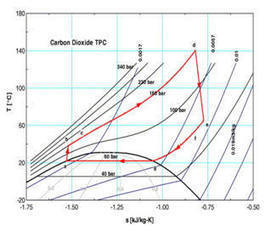
Working fluids with relatively low critical temperature and pressure can be compressed directly to their supercritical pressures and heated to their supercritical state before expansion so as to obtain a better thermal match with the heat source.

Duane Tilden‘s insight:

>Chen et al. [1-3] did a comparative study of the carbon dioxide supercritical power cycle and compared it with an organic Rankine cycle using R123 as the working fluid in a waste heat recovery application. It shows that a CO2 supercritical power cycle has higher system efficiency than an ORC when taking into account the behavior of the heat transfer between the heat source and the working fluid. The CO2 cycle shows no pinch limitation in the heat exchanger. Zhang et al.  [4-11] has also conducted research on the supercritical CO2 power cycle. Experiments revealed that the CO2 can be heated up to 187℃ and the power generation efficiency was 8.78% to 9.45% [7] and the COP for the overall outputs from the cycle was 0.548 and 0.406, respectively, on a typical summer and winter day in Japan [5].

Organic fluids like isobutene, propane, propylene, difluoromethane and R-245fa [12] have also been suggested for supercritical Rankine cycle. It was found that supercritical fluids can maximize the efficiency of the system. However, detailed studies on the use of organic working fluids in supercritical Rankine cycles have not been widely published.

There is no supercritical Rankine cycle in operation up to now. However, it is becoming a new direction due to its advantages in thermal efficiency and simplicity in configuration.<

See on www.eng.usf.edu

Robotic Technologies Applied to Solar Energy Market – Installation and Maintenance

See on Scoop.itGreen Building Design – Architecture & Engineering

Mountain View CA (SPX) Sep 20, 2013 – … robotic technologies deliver revolutionary installation and cleaning services at highly competitive prices … for building and maintenance of utility-scale solar plants..

Duane Tilden‘s insight:

>The typical installation process for utility-scale projects is similar to that of a small-scale, 20-panel, residential installation. Despite incremental improvements to the process, a 200,000-panel installation has retained many of the characteristics of a 20-panel installation.

They are both labor-intensive, and require repetitive bolt-tightening and glass-hauling. While these are minor flaws in a 20-panel system, they create significant inefficiencies in 20,000- or 200,000-panel systems.

Alion Energy has plugged the shortcomings of the current installation methods by changing the materials and design used in the mounting structure as well as by automating the installation. By combining robotic installation technology with established construction practices, Alion Energy has built a system twice as fast and 75 percent more labor-efficient that lowers solar electricity’s levelized cost of energy (LCOE) to compete with traditional energy sources.<

See on www.solardaily.com

Industrial networking expands PLC functionality – Energy Efficiency

See on Scoop.itGreen Building Operations – Systems & Controls, Maintenance & Commissioning

Combining real-time Ethernet with visualization, control, and communication capabilities allows PLCs to open the door to a new level of visibility and control for manufacturers.

Duane Tilden‘s insight:

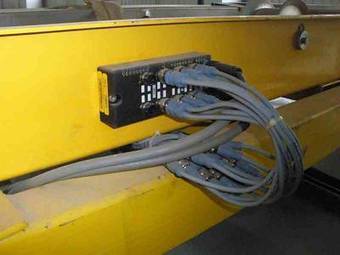
>The days when workers served as the brain and brawn in manufacturing are long gone, while human-machine interaction has become commonplace on the factory floor. A prime example of this is the PLC, which has been the workhorse in automation and manufacturing industries across the board for many years. By interfacing with everything from sensors and machine guards to motion control and advanced identification devices, PLCs ensure operations run smoothly (see Figure 1). Through the flexibility offered with PLCs, manufacturers can manage multiple machines at once—achieving a higher level of integration and process automation machines and improving production quality and cost of operation.

The benefits of the PLC are well known. Their contributions toward efficiency enhancement and the behind-the-scenes support of industrial Ethernet make this heightened control possible. Together, these technologies make communication between humans and machine a seamless, profitable combination. Consisting of various protocols, industrial Ethernet was developed with deterministic capabilities to provide a cost-effective alternative to legacy automation systems.

With advanced capabilities, sophisticated functionality, and simplified installation, the PLC is a cornerstone of modern manufacturing. However, to effectively use these devices, users must understand the crucial role networking plays and the individual requirements that must be considered for an effective solution.  […]<

See on www.plantengineering.com