The China Water Crisis: A Global Catastrophe or Wasteful Use?

See on Scoop.itGreen & Sustainable News

Learn how the China water crisis will have significant impact on the balance of the world if not reversed, and how you can help, in this WaterFilters.NET post.

Duane Tilden‘s insight:

>The New York Times reports:

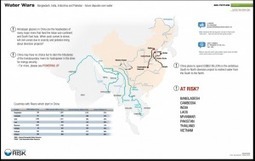
Beijing has placed its faith in monumental feats of engineering to slake the north’s growing thirst. The South-North Water Transfer eventually aims to pipe 45 cubic kilometers of water annually northward along three routes in eastern, central and western China. All three pose enormous technical challenges: The eastern and central routes will be channeled under the Yellow River, while the western route entails pumping water over part of the Himalayan mountain range.

The estimated cost of $65 billion is almost certainly too low, and doesn’t include social and ecological impacts. Construction has already displaced hundreds of thousands, and issues the like possible increases in transmission of water-borne diseases have not been properly studied. But Beijing’s calculus is political: It is easier to increase the quantity of water resources, at whatever cost, rather than allocate a limited supply between competing interests.  […]

A recent article by The Economist states:

“The Chinese government would do better to focus on demand, reducing consumption of water in order to make better use of limited supplies. Water is too cheap in most cities, usually costing a tenth of prices in Europe. Such mispricing results in extravagance. Industry recycles too little water; agriculture wastes too much. Higher water prices would raise costs for farms and factories, but that would be better than spending billions on shipping water round the country.”

Economically supporting Chinese regions and corporations that commit to better water usage and sustainability practices may help to change the mindset of many within this nation’s government or industries.  In turn, this could lead them towards exploring more realistic initiatives experiencing success in other parts of the world.<

See on blog.waterfilters.net

GE seeks to Clean up Fracking’s Dirty Water Problem

See on Scoop.itGreen & Sustainable News

GE has demonstrated technology aimed at addressing one of the biggest challenges with fracking: water pollution.

Duane Tilden‘s insight:

>Concerns about water pollution and other environmental issues related to fracking have led some places, including France and New York State, to block the process. As fracking increases in dry areas and places that lack adequate treatment and disposal options, pressure to block it could grow.

“Water-treatment technology is going to become more and more critical as the industry moves forward,” says Amy Myers Jaffe, executive director of energy and sustainability at the University of California at Davis, and a new member of a GE environmental advisory board. She says the continued use of fracking depends on the “industry getting its act together to do it in an environmentally sustainable way.”

Better water-treatment options could change the way oil and gas producers operate by making it economical to treat water at fracking sites instead of trucking it long distances to large water-treatment facilities or disposal wells. The technology is specifically targeted to places such as the Marcellus shale, one of the largest sources of shale gas in the U.S., where wastewater is far too salty for existing on-site treatment options (see “Can Fracking Be Cleaned Up?” and “Using Ozone to Clean Up Fracking”).

Each fracking well can require two to five million gallons of fresh water, which is pumped underground at high pressure to fracture rock and release trapped oil and gas. Much of that water flows back out, carrying with it the toxic chemicals used to aid the fracking process, as well as toxic materials flushed from the fractured rock.

Producers currently reuse much of that water, but that involves first storing it in artificial ponds, which can leak, and then diluting it, a step that consumes millions of gallons of fresh water. Eventually they can’t reuse the water any more so they need to ship it, often over long distances, to specialized treatment and disposal locations. Transporting the wastewater is expensive, and it comes with a risk of spills. At disposal sites, the wastewater is injected deep underground in a process that can cause earthquakes.

The new technology would make it unnecessary to dilute the wastewater, or transport it for treatment or disposal. […]<

See on www.technologyreview.com

BP battles for billions in latest Gulf Oil Spill pollution trial

See on Scoop.itGreen & Sustainable News

HOUSTON/LONDON (Reuters) – BP will battle to hold down fines that could hit $18 billion in a new phase of the Gulf of Mexico trial that will rule on how much oil it spilled in 2010 and judge its efforts…

Duane Tilden‘s insight:

>POLLUTION FINES

BP says 3.26 million barrels leaked from the well during the nearly three months it took to cap the blowout at the Deepwater Horizon rig; the U.S. government says it was 4.9 million. Both those totals include 810,000 barrels that were collected during clean-up and which Barbier has agreed to exclude.

This month, BP’s lawyers questioned the government’s figure. “United States experts employ unproven methods that require significant assumptions and extrapolations in lieu of … available data and other evidence,” they said in a filing.

They have also sought to convince Barbier that if the company is to be found guilty, it should amount to only “negligence” and not “gross negligence” – a crucial distinction since the latter carries much higher maximum penalties.

Under the Clean Water Act, negligence can be punished with a maximum fine of $1,100 for each barrel of oil spilled; a gross negligence verdict carries a potential $4,300 per barrel fine.

If the court judged the spill to have been 4.09 million barrels – the government estimate less oil recovered – the price of negligence could reach $4.5 billion. Gross negligence, in the costliest scenario, could run to $17.6 billion.<

See on www.reuters.com

Ex-Halliburton Official Charged With Destroying Evidence In Gulf Oil Spill Disaster

See on Scoop.itGreen & Sustainable News

The the latest twist in an ongoing legal battle following the explosion that killed 11 people and resulted in the largest oil spill in U.S. history.

Duane Tilden‘s insight:

>Attorney General Eric Holder said in a statement: “Halliburton and one of its managers have now been held criminally accountable for their misconduct, underscoring our continued commitment to ensuring that the victims of this tragedy obtain justice, and to safeguarding the integrity of relevant evidence.”

U.S. District Judge Jane Triche Milazzo of the Eastern District of Louisiana also noted that Halliburton self-reported the misconduct and cooperated with the investigation. Badalamenti was charged with a “bill of information,” which often means that the defendant is cooperating with prosecutors.

Rig owner Transocean and BP were both criminally charged for the disaster, but Halliburton was not — these charges are just related to the post-spill review.

Even though the spill happened more than three years ago, residents in the area still feel the effects. The 170,000 workers hired to help clean up the oil spill are at an increased risk of getting cancer, leukemia, and other serious illnesses. And on Thursday, BP sued the state of Louisiana to block its order to remove abandoned anchors the company used to deploy oil spill booms during cleanup efforts.<

See on thinkprogress.org

Japan to Switch Off Nuclear Power, With No Firm Date for Re-Start: Sci Am

See on Scoop.itGreen & Sustainable News

Japan is set to be nuclear power-free, for just the third time in more than four decades, and with no firm date for re-starting an energy source that has provided about 30 percent of electricity to the world’s third-largest economy.

Duane Tilden‘s insight:

>Kansai Electric Power Co’s 1,180 MW Ohi No.4 reactor is scheduled to be disconnected from the power grid late on Sunday and then shut for planned maintenance. It is the only one of Japan’s 50 reactors in operation after the nuclear industry came to a virtual halt following the March 2011 Fukushima disaster.

Japan last went without nuclear power in May-June 2012 – the first shutdown since 1970 – a year after a massive earthquake and tsunami triggered reactor meltdowns and radiation leaks at the Fukushima facility. The country’s nuclear reactors provided close to a third of the electricity to keep the $5 trillion economy going before the Fukushima disaster, and utilities have had to spend billions of dollars importing oil, gas and coal to make up for the shortfall. […]


IMPORT BILL

Japan consumes about a third of the world’s liquefied natural gas (LNG) production, and will likely boost LNG demand to record levels over the next couple of years. LNG imports rose 4.4 percent in volume to a record 86.87 million tonnes, and 14.9 percent in value to a record 6.21 trillion yen ($62.1 billion) in the year through March.

Imports are likely to rise to around 88 million tonnes this year and around 90 million tonnes in the year to March 2015, according to projections by the Institute of Energy Economics Japan based on a mid-scenario that 16 reactors will be back on-line by March 2015.<

See on www.scientificamerican.com

U.S. Nuclear Power waning: A history of Failures

See on Scoop.itGreen & Sustainable News

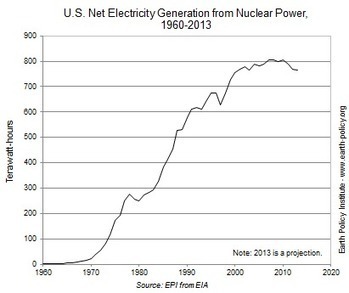
By J. Matthew RoneyNuclear power generation in the United States is falling. After increasing rapidly since the 1970s, electricity generation at U.S. nuclear plants began to grow more slowly in the…

Duane Tilden‘s insight:

>Of the 253 reactors that were ordered by 1978, 121 were canceled either before or during construction, according to the Union of Concerned Scientists’ David Lochbaum. Nearly half of these were dropped by 1978. The reactors that were completed—the last of which came online in 1996—were over budget three-fold on average.

By the late 1990s, 28 reactors had permanently closed before their 40-year operating licenses expired. […]

In 2012, the U.S. Nuclear Regulatory Commission (NRC) approved four new reactors for construction, two each at the Vogtle plant in Georgia and the Summer plant in South Carolina. These reactors are all of the same commercially untested design, purportedly quicker to build than previous plants. Both projects benefit from fairly new state laws that shift the economic risk to ratepayers. These “advanced cost recovery” laws, also passed in Florida and North Carolina, allow utilities to raise their customers’ rates to pay for new nuclear plants during and even before construction—regardless of whether the reactors are ever finished.

Construction at both sites began in March 2013. Even as the first concrete was poured at the $14-billion Vogtle project, it was reportedly 19 months behind schedule and more than $1 billion over budget. The Summer project, a $10 billion endeavor, also quickly ran into problems. […] With these delays, the earliest projected completion date for any of these reactors is some time in late 2017. […]

This year has also already witnessed the permanent shutdown of four reactors totaling 3.6 gigawatts of capacity. The first to fall was Duke’s Crystal River reactor in Florida. Although the plant was licensed to run until 2016, Duke decided to close it rather than pay for needed repairs. Then Dominion Energy’s 39-year-old Kewaunee reactor in Wisconsin closed, citing competition from low gas prices. It had recently been approved to operate through 2033. And in June, Southern California Edison shuttered its two San Onofre reactors after 18 months of being offline due to a leak in a brand new steam generator. These retirements leave the United States with 100 reactors, averaging 32 years in operation. (France is second, with 58 reactors.)

More closures will soon follow, particularly among the roughly half of U.S. reactors in so-called merchant areas […]

Dealing with nuclear waste is another expensive proposition. Over the past 30 years, the U.S. government has spent some $15 billion trying to approve a central repository for nuclear waste, and for most of that time the only site under consideration has been Nevada’s Yucca Mountain. Amid concerns about the site’s safety and its extreme unpopularity in Nevada, the Obama administration has moved to abandon the project entirely and explore other options.

A federal appeals court ruled in August 2013 that the NRC must resume reviewing the site’s suitability. In the meantime, the waste keeps accumulating. The 75,000 tons of waste now stored at 80 temporary sites in 35 states is projected to double by 2055. […]

See on grist.org

Fukushima leaks will keep fisheries closed indefinately

See on Scoop.itGreen & Sustainable News

Some Japanese fisheries face a long-term threat from the steady trickle of radioactive water from the stricken Fukushima Daiichi nuclear plant

Duane Tilden‘s insight:

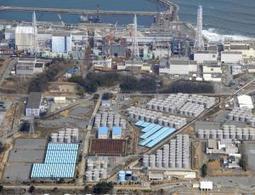
>Last month the plant’s owner, Tepco, finally admitted what many had suspected – that the plant was leaking. Now Japan’s Nuclear Regulatory Authority is calling the situation an emergency, and says Tepco’s plans to stop the leak are unlikely to work.

The problem is that groundwater is entering the damaged reactor buildings, picking up radioactive elements like caesium and seeping out to sea. Tepco has spent months pumping the water to the surface and storing it in tanks, and sinking wells to lower the water table.

[…] Given that Tepco is unlikely to stem the leaks from Fukushima any time soon, the fishing ban could continue for a long time. “People ask when will it be safe, and we can’t answer that,” says Buesseler. “The only thing you can do is stop the source, and that’s a huge engineering challenge.”<

See on www.newscientist.com

Gas Drilling, North Dakota : Image of the Day

See on Scoop.itGreen & Sustainable News

Cities and people are scarce in northwestern North Dakota, but nighttime satellite imagery shows the Bakken Formation aglow with brightly-lit drilling equipment.

Duane Tilden‘s insight:

Northwestern North Dakota is one of the least-densely populated parts of the United States. Cities and people are scarce, but satellite imagery shows the area has been aglow at night in recent years. The reason: the area is home to the Bakken shale formation, a site where gas and oil production are booming.

On November 12, 2012, the Visible Infrared Imaging Radiometer Suite (VIIRS) on the Suomi NPP satellite captured this nighttime view of widespread drilling throughout the area. Most of the bright specks are lights associated with drilling equipment and temporary housing near drilling sites, though a few are evidence of gas flaring. Some of the brighter areas correspond to towns and cities including Williston, Minot, and Dickinson. …

See on earthobservatory.nasa.gov