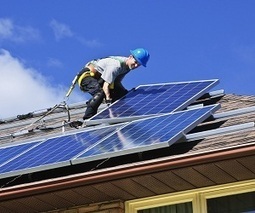
Sol Voltaics uses nanotechnology to make solar energy 25 percent more efficient

See on Scoop.itGreen Energy Technologies & Development

Swedish company with Silicon Valley talent has raised $11 million to make solar power more efficient.

Duane Tilden‘s insight:

Two advances make it possible. The team, led by founder Lars Samuelson (a Lund University professor), created a technology known as Aerotaxy, which makes it cheaper to make nanomaterials. With that, they are creating gallium arsenide nanowires that can serve as solar collectors and that they can integrate directly into solar wafers, known as solar cells. The smarts happens at the atomic level.

[…] manufacturers don’t have many options for bringing down the costs of solar. […] The cells themselves must become more efficient to lower costs.

See on venturebeat.com

SolarReserve Completes Molten Salt Receiver Panel Assembly on Crescent Dunes Solar Energy Plant Tower

See on Scoop.itGreen Energy Technologies & Development

SolarReserve, a U.S. developer of large-scale solar power projects, today announced completion of the assembly of the molten salt receiver panels that sits on top of the 540 foot solar power tower for its 110 megawatt (MW) Crescent Dunes Solar…

Duane Tilden‘s insight:

The project will utilize technology […] to capture and store the sun’s energy in order to deliver a firm electricity supply to Nevada, day or night, without the need to burn fossil fuels. The molten salt “receiver” is actually comprised of panels formed by hundreds of special alloy tubes which will be flowing with molten salt for energy absorption and storage. Once complete, the project will be capable of storing 10 hours of full load electricity production, enough to power 75,000 homes at peak electric demand periods, even after dark.

The project closed financing and initiated construction in September of 2011 and is scheduled to complete construction and start plant commissioning at the end of 2013, including first electricity production by the end of the year. The Crescent Dunes project has secured a 25-year power purchase agreement with NV Energy to sell 100 percent of the electricity output of the facility to serve homes across Nevada.  […]

“The energy storage capability of this technology solves the problem of intermittency typical of other renewable energy sources. Additionally, because of it high efficiency, this technology can generate almost twice as much energy as a comparably sized solar facility, including facilities powered by photovoltaic panels or by a direct steam tower.” said Kevin Smith, CEO of SolarReserve.

See on www.azocleantech.com

German village delivers great green energy blueprint

See on Scoop.itGreen Energy Technologies & Development

Nations as diverse as North Korea and the United States have sent personnel to a tiny village in the east of Germany in a bid to understand its successful energy transformation.

Duane Tilden‘s insight:

…Feldheim is powered by a mix of 43 wind turbines, a woodchip-fired heating plant and a biogas plant that uses cattle and pig slurry as well as maize silage.

Local energy costs of 16.6 euro cents per kilowatt hour (kWh) are just a little more than half of the 27-30 cents Germans pay on average …

Feldheim’s rates are not far off those in Poland, which generates nearly all its electricity from carbon-intensive coal-fired plants.  Households there paid on average 14 cents per kWh in 2012, while those in the Czech Republic, which relies on nuclear for about a third of its power generation, paid about 15 cents per kWh.

DT:  Current electricity pricing in Canada is 6.3 to 11.8 cents/kWh (US$) & United States is 8 to 17 cents/kWh (US$) ~ wiki

See on www.businessspectator.com.au

Renewable energy now cheaper than new fossil fuels in Australia | Bloomberg New Energy Finance

See on Scoop.itGreen & Sustainable News

Sydney, 7 February 2013 – Unsubsidised renewable energy is now cheaper than electricity from new-build coal- and gas-fired power stations in Australia, according to new analysis from research firm Bloomberg New Energy Finance.

Duane Tilden‘s insight:

[…] research on Australia shows that since 2011, the cost of wind generation has fallen by 10% and the cost of solar photovoltaics by 29%. In contrast, the cost of energy from new fossil-fuelled plants is high and rising. New coal is made expensive by high financing costs. […] New gas-fired generation is expensive as the massive expansion of Australia’s liquefied natural gas (LNG) export market forces local prices upwards. […]

[…] Australia’s fleet of coal-fired power stations built by state governments in the 1970s and 1980s can still produce power at lower cost than renewables, because their original construction cost has now been depreciated.

“New wind is cheaper than building new coal and gas, but cannot compete with old assets that have already been paid off,” Bhavnagri said. “For that reason policy support is still needed to put megawatts in the ground today and build up the skills and experience to de-carbonise the energy system in the long-term.”

See on about.bnef.com

Photovoltaics vs. Biofuel

See on Scoop.itGreen Energy Technologies & Development

As facility managers and building owners prepare for another year of green pushes and renewable energy options, has research determined a winner in the photovoltaic vs. biofuel energy battle?

Duane Tilden‘s insight:

[…] in a paper titled “Spatially Explicit Life Cycle Assessment of Sun-to-Wheels Transportation Pathways in the U.S.” and published in the Dec. 26 issue of the journal Environmental Science & Technology, showed photovoltaics (PV) to be much more efficient than biomass at turning sunlight into energyto fuel a car.

“PV is orders of magnitude more efficient than biofuels pathways in terms of land use – 30, 50, even 200 times more efficient – depending on the specific crop and local conditions,” says Geyer. “You get the same amount of energy using much less land, and PV doesn’t require farm land.”

The researchers examined three ways of using sunlight to power cars: a) the traditional method of converting corn or other plants to ethanol; b) converting energy crops into electricity for BEVs rather than producing ethanol; and C) using PVs to convert sunlight directly into electricity for BEVs.

… “The cost of solar power is dropping, and our quick calculations suggests that with the federal tax credit, electric vehicles are already competitive.”

What does this mean for the future?

“What it says to me is that by continuing to throw money into biofuels, we’re barking up the wrong tree,” Geyer explains. …

See on www.buildings.com