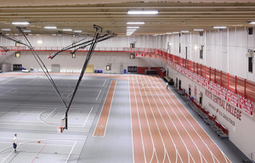
College LED Lighting Retrofit for Energy Efficiency Savings

The college replaced metal halide, fluorescent and incandescent lighting fixtures in these facilities with LED lighting. The new fixtures will reduce annual energy consumption by an estimated 448,271 kWh and save the college an estimated $35,000 per year.

Source: www.energymanagertoday.com

>"

North Central College in Naperville, Ill., has completed a $200,000 lighting retrofit in its residence hall/recreation center and activities center.  […]

The LED fixtures are computer controlled and include occupancy sensors and dimming features. They are cooler and do not generate the consistent humming sound that the previous halogen lighting generated.

The projects are supported by a $67,989 grant from the Illinois Clean Energy Community Foundation’s Energy Efficiency Lighting Upgrade Program.

With the latest projects, North Central College has invested nearly $250,000 of its endowment to replace old lighting with energy-efficient LED technology. Other areas in which old fixtures had already been replaced with LED lighting include the pool and basketball arena in Merner Field House."<

See on Scoop.itGreen Building Operations – Systems & Controls, Maintenance & Commissioning
11 Energy Storage Project Developers To Watch

Competition in the young energy storage market is heating up nicely. SunEdison’s announcement today of its purchase of an energy storage startup is the latest example of that. This is a good time to look at who are the other developers in this market, which is driven by a federal rule […]

Source: www.forbes.com

See on Scoop.itGreen Energy Technologies & Development

Sub-micrometer carbon spheres reduce engine friction as oil additive

Tiny, perfectly smooth carbon spheres added to motor oil have been shown to reduce friction and wear typically seen in engines by as much as 25%, suggesting a similar enhancement in fuel economy. The researchers also have shown how to potentially mass-produce the spheres, making them hundreds of times faster than previously possible using ultrasound to speed chemical reactions in manufacturing.

Source: www.rdmag.com

See on Scoop.itGreen Energy Technologies & Development

Three Common Mistakes in Wireless Systems Design for Buildings

Although cellular and WiFi networks are not required by code, they are crucial for communication. More than 400,000 wireless E-911 calls are made every day…


Image Source:  http://bit.ly/1EqvCDv

Source: www.facilitiesnet.com

>” MISTAKE 1: Thinking it’s someone else’s problem.

Don’t let your architect avoid the issue. Design a building with adequate wireless coverage for public safety, cellular, and WiFi. […] WiFi networks are also widely used for Internet traffic and to support building management systems (BMS), Smart Grid, point of sales, audio visual, security, and more. The impact of wireless devices is only expected to increase. Mobile devices are expected to account for 61 percent of worldwide Internet traffic by 2018, compared to 39 percent from wired devices, according toCisco.

MISTAKE 2: Confusion.

Confusing the types of wireless technologies available and/or facility requirements is another pitfall. You don’t want to plan for one type and learn later that technology for common functions is missing. Technologies have different requirements for power, spacing between devices, type of cables, head-end requirements, etc. Therefore, a key factor is to understand each technology thoroughly so it can be planned and implemented properly.

To put it briefly, there are two major wireless technologies — WSP, which are your wireless carriers networks (AT&T, T-mobile ,Verizon, etc.), and WiFi technology, which is a wireless local area network (WLAN) based on Institute of Electrical and Electronics Engineers (IEEE) 802.11 standards.

Both of these transmit via radio frequencies. WiFi (WLAN), however, uses an unlicensed spectrum that transmits at frequencies 2.4GHz and 5 GHz, which are considerably higher frequencies than used for cellular service, which is on a licensed spectrum transmitting within 698MHz-2.7GHz.

MISTAKE 3: Bad budgeting.

Often, contractors develop their budget based on square footage, but wireless isn’t so simple. The price can vary significantly based on the complexity of the needs, the supporting frequencies, coverage area, number of users, and more. By developing preliminary wireless design, IT consultants can provide the owner/operators with a more accurate cost.

Regardless of the facility, it’s no longer a matter of if wireless will be required, just a question of whether you want to plan early before you build, or pay a premium later. IT consultants can help facility managers plan, select the best wireless options to meet end-user needs, and stay to up-to-date with local codes (where required). Furthermore, an IT consultant can better develop a realistic wireless budget for the owner and provide the architect-engineer-construction team with infrastructure requirements, such as pathways, telecom room sizes and locations, power, and cooling, without sacrificing the architect’s vision. Generically speaking, the fee for an IT consultant is insignificant to the overall project cost, and may ultimately save the owner money and headache. Be prepared for what’s to come. Overlooking this need early can often cause a major regret later.

Gislene D. Weig, electrical engineer, RCDD, is a senior consultant at PlanNet Consulting, where her core business involves U.S. and Latin American markets focused on large-scale projects that include voice/data, wired and wireless communication systems, and data network design. She can be reached at gweig@plannet.net.”<

See on Scoop.itGreen Building Operations – Systems & Controls, Maintenance & Commissioning

Microsoft Uses Big Data To Manage Buildings and Facilities

MicrosoftCampus

“My initial expectation was that we would see the return on investment in terms of driving down our energy costs, and we have seen that,” says Pittenger, to whom Smith reports. “What wasn’t part of my expectations was the gains we would have in operational efficiencies and our abilities to do repairs and maintenance much, much better and much, much smarter.”

Source: www.facilitiesnet.com

Image:  http://news.microsoft.com/2009/11/23/california-coding-microsoft-campus-in-silicon-valley-turns-10/

>” […] Over those 125 buildings on the main Microsoft campus, there are more than 30,000 building systems components — assets, in Smith’s terms — and more than 2 million points where building systems ranging from HVAC to lighting to power monitoring are connected to sensors. In a 24-hour period, those systems produce half a billion data transactions. Each one is small, but when you’re talking about half a billion of something, all those 1s and 0s add up pretty quickly.

But what’s important is being able to do something with those 1s and 0s, which Microsoft could not do until recently because of the mess of systems involved, says Jim Sinopoli, managing principal, Smart Buildings, who helped set up the software pilot program.

“You have an opportunity, if you’re building a new campus or a new building, to really start with a clean slate,” he says. “But you go in these existing buildings and you generally will come upon some unforeseen obstacles.”

The project turned out to be a relatively easy sell. First, Pittenger’s background is financial, so being able to show a strong ROI was a definite plus for Smith, because his boss understands exactly what that means when it comes time to ask for funding. Second, facilities management at Microsoft benefits from a company culture that considers every department to be a key player.

“(CEO) Steve Ballmer likes to say, ‘There are no support organizations at Microsoft,'” Pittenger says. “Everybody is fundamental to the core mission of the company. And we feel that way.”

After gaining approval, the first step was deciding how those obstacles would be overcome. Smith and his team began by writing out 195 requirements for the new way of operating and what their ultimate tool would be able to do. Then they proceeded to look around for an off-the-shelf solution that would be able to do all those things — and failed to find one. So, they built it.

More specifically, they worked with three vendors in a pilot program, encompassing 2.6 million square feet, to build an “analytics blanket” of fault detection algorithms that is layered on top of the different building management systems and reports back to the operations center. If Building 17 and Building 33 have different building management systems, those systems may not be able to talk to each other or provide data to a single reporting system in the operations center. But they can talk to the analytics blanket, which can take the information from every building and combine it into a single output in the operations center. It’s not a replacement for the BMS; instead, it’s adding on functionality that enhances the benefits of the existing BMS.”<

See on Scoop.itGreen Building Operations – Systems & Controls, Maintenance & Commissioning

BC LNG Project Final Decision Stalled to June

Malaysia’s Petronas expects to make a final investment decision on an US $11-billion liquefied natural gas (LNG) export terminal in British Columbia by the end of June, after postponing the decision…

Source: business.financialpost.com

See on Scoop.itGreen & Sustainable News

Vancouver Gas Prices are Highest in North America

Vancouver gas prices topped $1.30 per litre Tuesday, more than $0.15 higher than next most expensive city.

Source: bc.ctvnews.ca

>” […]

After dipping below a dollar per litre earlier this year, gas prices in Vancouver are now the highest in North America.

Fuel costs tipped the scales at more than $1.30 per litre Tuesday morning, nearly 16 cents per litre higher than Quebec City, the second-most expensive Canadian city for gas, according to GasBuddy.com.

Since then, a shortage of gasoline coupled with higher demand has contributed to the spike.

Last month, an Exxon Mobile oil refinery in California exploded, while Shell’s Puget Sound refinery in Washington State went down for maintenance.

Experts say brutal winter weather has also increased demand for gasoline in eastern Canada and the U.S.

CTV News spoke with some Vancouver drivers who say they’re exhausted from the up-and-down costs.

“We pay the most for gas, we pay the most for houses, we pay the most taxes. What’s up?” asked Jeremy Wilson. “I pity the people in the Mercedes and the Beamers, how can they afford it?”

Josh Sharber, who uses his truck for work, said it now costs him around $130 to fill up his tank.

“I basically work two days a week just to keep my truck running,” he said. “It’s pretty much all you can do. No gas, can’t get to work.”

Elsewhere in the Lower Mainland Tuesday, gas prices in Abbotsford topped $1.19 per litre, while Chilliwack, where prices are traditionally low, hovered around $1.21 per litre.

That’s still higher than other major North American cities, including Toronto ($1.07 per litre), Los Angeles ($0.93 USD per litre) and Edmonton ($0.91 per litre).”<

See on Scoop.itGreen & Sustainable News

Climate Change, Pole Shift & Solar Weather

Scientists tell us that our magnetic poles have reversed in the past, and that they will again. The last one occurred 780,000 years ago. The average time period between reversals is 450,000 years, but there isn’t really any pattern, it is random. We are overdue by average only.

Source: poleshift.com

>” […] Accelerating

This is indisputable – the speed at which the magnetic north pole is moving (not necessarily in the same direction) has recently become much faster. Because this is the entirety of our studies, we don’t know what was normal prior to the 1500s… […]

Not only are the poles moving rapidly – the strength of our magnetic field is diminishing as well:

Rapid changes in the churning movement of Earth’s liquid outer core are weakening the magnetic field in some regions of the planet’s surface, a new study says.

“What is so surprising is that rapid, almost sudden, changes take place in the Earth’s magnetic field,” said study co-author Nils Olsen, a geophysicist at the Danish National Space Center in Copenhagen.

…The changes “may suggest the possibility of an upcoming reversal of the geomagnetic field,” said study co-author Mioara Mandea, a scientist at the German Research Centre for Geosciences in Potsdam. [National Geographic]

[…] Possible Triggers

Scientists have not yet worked out what causes a magnetic reversal, but recent studies of Mercury suggest that the solar wind and particles from the Sun have an effect on planetary cores. My interpretation is that a massive solar storm could be thestraw that breaks the camel’s back and trigger a reversal if the Earth is ready for one. The Electric Universe folk have also suggested that a highly-charged comet passing by could also do the trick. Or perhaps ocean currents, after being affected by climate change, are the trigger? And if climate change is caused by the Sun, then that ties in nicely with the first theory.

Another theory comes from  Rich Muller:

where “lighter components, like oxygen, sulfur, and silicon . . . rise toward the core-mantle boundary (CMB).” Accumulating like sediment on the floor of the ocean, these “fall” upward from the core onto the surface of the mantle, which is uneven like the topography of the Earth’s surface. When enough sediment collects, it tumbles like an avalanche, into the outer core, thereby cooling it.

Rare events could trigger really big avalanches at the CMB, however. When a massive asteroid or comet slammed into Earth’s surface at an oblique angle, the lower mantle would jerk sideways, shearing off whole mountains of sediment. As the sediments slide up, a downward-sinking mass of cool iron could completely disrupt large convection cells. Although variously oriented local fields within the core would remain strong, at the surface Earth’s dipole magnetic field would collapse.

And according to Gary Glatzmaier reversals are rooted in chaos theory:

The resulting three-dimensional numerical simulation of the geodynamo, run on parallel supercomputers at the Pittsburgh Supercomputing Center and the Los Alamos National Laboratory, now spans more than 300,000 years.

Our solution shows how convection in the fluid outer core is continually trying to reverse the field but that the solid inner core inhibits magnetic reversals because the field in the inner core can only change on the much longer time scale of diffusion. Only once in many attempts is a reversal successful, which is probably the reason why the times between reversals of the Earth’s field are long and randomly distributed.

[…]”<

See on Scoop.itGreen Energy Technologies & Development

Aluminum Superatoms – High Temperature Superconducting Materials

Superconductors can carry electricity with no resistance and are used for specialized applications like MRIs, maglev trains and particle accelerators. Superconductor-based electronics would be extremely efficient because they would generate no waste heat, but he fact that they would only work at temperatures close to absolute zero makes them impractical.

Source: www.gizmag.com

>” […]

Scientists at the University of Southern California (USC) have made steps toward discovering a new family of superconductor materials that work at relatively high temperatures, with possible applications in physics research, medical imaging and high-performance electronics.

As electrons travel through an integrated circuit, they regularly bump into microscopic imperfections within the conductive wire and veer off course, creating electrical resistance and releasing waste energy as heat. Waste heat is a big inconvenience to both designers and end-users of electronics, but it simply can’t be avoided using the materials currently at our disposal.

[…] Thirty years ago, a new class of so-called “high-temperature superconductors” was discovered, although the name can be deceiving because these still require temperatures below 135 K (-135 °C or -210 °F) to operate, which still makes them impractical for use in electronics.

Now the USC team led by professor Vitaly Kresin has discovered hints of yet another family of superconductors which work at relatively high temperatures. Specifically, they found out that while single atoms of aluminum only turn superconductive at very low temperatures (around 1 K), so-called “superatoms” (clusters of evenly spaced atoms that behave as a single atom) of aluminum turn superconductive at much higher temperatures, around 100 K.

Superconductivity takes place when so-called Cooper pairs form within a material. These are pairs of electrons that are very faintly attracted to each other and activate a mechanism whereby the electrons don’t veer off course, and therefore lose heat, whenever they bump into an imperfection within the material. Because the attractive force between the electrons, which happens only under certain conditions, is so weak (two electrons would normally repel each other), even a small amount of external energy (which could be given off in the form of heat) can upset this equilibrium. This is why superconductors only work at very low temperatures.

Kresin and team built a series of aluminum superatoms between 32 and 95 atoms large. For superatoms containing 37, 44, 66 and 68 aluminum atoms, the scientists found evidence that Cooper pairings were taking place, turning the material into a superconductor.

The researchers suggest that creating superatoms of different metals could lead to the discovery of similar superconductors that work at relatively high temperatures. While the threshold temperature was 100 K (-280 °F, -173 °C) for an aluminum superatom, different materials are likely to turn superconductive at different (hopefully much higher) temperatures.

“One-hundred Kelvin might not be the upper-temperature barrier,” says Kresin. “It might just be the beginning.”

Should one of these materials operate as a superconductor at room temperature, it would likely have huge impact on the worlds of electronics, medical imaging, microscopy and electric motors, just to name a few. ”

A paper describing the advance appears on the journal Nano Letters.

Source: University of Southern California

See on Scoop.itGreen Energy Technologies & Development

Net Zero Case Study: Bullitt Center – Green Materials

The Bullitt Center in Seattle, Washington, is one of the most self-sufficient buildings on the planet.  It is net zero energy and, after the water reuse system is approved by city authorities, net zero water.  Net zero means that the building uses the same amount as it creates or generates – it is self-sufficient.

Source: greenbuildingelements.com

>”[…]

Healthy Green Materials

The Living Building Challenge requires projects to avoid as many of the chemicals and substances that are found on the Red List as possible.  These substances have been recognized by government agencies, such as the US Environmental Protection Agency, the European Union Commission, and the State of California, as potentially harmful to human or animal life on Earth.  Not all of the substances can be avoided, though, due to the lack of availability of materials that do not contain them.

The Bullitt Center team avoided over 360 known chemicals on this list.  Some were easy to avoid, as alternatives were readily available.  The team also worked with suppliers to create products that met their requirements, changing the way the products were made and making them available to others.

Most plumbing valves, even those made of brass and bronze, contain up to 7% lead.  Lead free valves, with an allowable lead content of only 0.25%, were used in both the potable and non-potable water systems, including fire sprinklers.Phthalates are commonly used in PVC and other plastic products.  A high-performance water barrier company performed 6 months of research to develop a product that did not contain phthalates, just for the Bullitt Center project.  The new product has now replaced the original version going forward.  Dioxins are a by-product of the manufacture, combustion, and disposal of products containing chlorine, most notably PVC products.  Couplings for no-hub ductile iron pipe are commonly made with neoprene, which contains chlorine.  The team worked with the manufacturer to special order couplings made of EPDM (ethylene propylene diene monomer) rubber.  The electrician was able to find electrical wire not coated in PVC that met code standards.  The fiberglass insulation in the project is held together by a plant-based polymer, not the usual one that contains formaldehyde.

Certified Wood

The Bullitt Center is a wood-framed structure.  Because of its location and the importance of the timber industry in the Pacific Northwest, the project team decided this was the best choice for the project.  100% of the lumber in the building has been harvested from anForest Stewardship Council (FSC) certified source.  The project was also recognized as the only commercial project to receive the Forest Stewardship Council Project Certification, in recognition of responsible forest products use throughout the building.

Local Sourcing

Perhaps the greatest story about green materials and the Bullitt Center involves the curtain wall (window) system.  Due to the high performance needs of the project, only one product could be used, and it was only manufactured in Europe.  A Washington company partnered with the European manufacturer to gain the knowledge to manufacture and install the system in the US.   The Washington company flew their employees over to find out how to make and install the system, and a licensing agreement was reached.  Now this high performance system is available in the US for future projects to use.

[…]”<

See on Scoop.itGreen Building Design – Architecture & Engineering