Supercritical CO2 Used For Solar Battery Power System

“GE has announced it is working on a way to use CO2 pollution to make new types of solar batteries that could each power up to 100,000 homes. CO2 is the main contributor to climate change, and is released into the atmosphere when coal is processed at power plants. Currently environmental procedures mean that some CO2 from these plants is captured and stored, so it’s not released back into the atmosphere. But the question has always been: What do you do with the stored gas?” (1)


dodge-sco23 supercritical CO2 turbine

Figure #1:  Comparison of 10 MWe Turbines (2)

What are the Benefits of Supercritical CO2?  With the transition from steam generation to using Supercritical CO2 as a working fluid, we seen large gains in energy efficiency conversion, coupled with significant size (footprint) reduction of turbomachines.  Other benefits include sequestering CO2 from the environment and reducing GHG emissions.   Also, this system can be utilized to capture energy from other heat sources including waste heat streams and co-generation applications. 

Supercritical CO2 image comparison

Figure 2:  Relative size  comparison of steam, helium and supercritical CO2 turbomachinery for Generation IV Nuclear Reactors (3)

What is Supercritical CO2?  “[…] Supercritical CO2 is a fluid state of carbon dioxide where it is held above its critical pressure and critical temperature which causes the gas to go beyond liquid or gas into a phase where it acts as both simultaneously. Many fluids can achieve supercritical states and supercritical steam has been used in power generation for decades. Supercritical CO2 has many unique properties that allow it to dissolve materials like a liquid but also flow like a gas. sCO2 is non-toxic and non-flammable and is used as an environmentally-friendly solvent for decaffeinating coffee and dry-cleaning clothes.

dodge-sco211 supercritical CO2 2

Figure 3:  CO2 phase diagram illustrating supercritical region. (4)

The use of sCO2 in power turbines has been an active area of research for a number of years, and now multiple companies are bringing early stage commercial products to market. The attraction to using sCO2 in turbines is based on its favorable thermal stability compared to steam which allows for much higher power outputs in a much smaller package than comparable steam cycles. CO2 reaches its supercritical state at moderate conditions and has excellent fluid density and stability while being less corrosive than steam.  The challenges in using sCO2 are tied to identifying the best materials that can handle the elevated temperatures and pressures, manufacturing turbo machinery, valves, seals, and of course, costs. […] ”  (2)

How will this work?

“[…] The design has two main parts. The first one collects heat energy from the sun and stores it in a liquid of molten salt. “This is the hot side of the solution,” Sanborn says. The other component uses surplus electricity from the grid to cool a pool of liquid CO2 so that it becomes dry ice.

During power generation, the salt releases the heat to expand the cold CO2 into a supercritical fluid, a state of matter where it no longer has specific liquid and gas phases. It allows engineers to make the system more efficient.

The supercritical fluid will flow into an innovative CO2 turbine called the sunrotor, which is based on a GE steam turbine design. Although the turbine can fit on an office shelf (see image above) it can generate as much as 100 megawatts of “fast electricity” per installed unit—enough to power 100,000 U.S. homes.

Sanborn believes that a large-scale deployment of the design would be able to store “significant amounts” of power —— and deliver it back to the grid when needed. “We’re not talking about three car batteries here,” he says. “The result is a high-efficiency, high-performance renewable energy system that will reduce the use of fossil fuels for power generation.”

He says the system could be easily connected to a solar power system or a typical gas turbine. The tanks and generators could fit on trailers. His goal is to bring the cost to $100 per megawatt-hour, way down from the $250 it costs to produce the same amount in a gas-fired power plant. “It is so cheap because you are not making the energy, you are taking the energy from the sun or the turbine exhaust, storing it and transferring it,” says Sanborn.

The process is also highly efficient, Sanborn says, yielding as much as 68 percent of the stored energy back to the grid. The most efficient gas power plants yield 61 percent. The team is now building a conceptual design, which Sanborn believes could take five to 10 years to get from concept to market. […]” (5)

Read more at:

1.  https://duanetilden.com/2013/10/29/supercritical-co2-refines-cogeneration-for-industry/

2. https://duanetilden.com/2013/10/29/supercritical-co2-turbine-for-power-production-waste-heat-energy-recovery/

3. https://duanetilden.com/2013/10/29/waste-heat-recovery-using-supercritical-co2-turbines-to-create-electrical-power/

4. https://duanetilden.com/2015/04/23/doe-invests-in-super-critical-carbon-dioxide-turbine-research-to-replace-steam-for-electric-power-generators/


References:

  1. http://www.fastcompany.com/3057630/fast-feed/ge-is-working-on-a-way-to-turn-co2-pollution-into-solar-batteries
  2. http://breakingenergy.com/2014/11/24/supercritical-carbon-dioxide-power-cycles-starting-to-hit-the-market/
  3. http://large.stanford.edu/courses/2014/ph241/dunham1/
  4. https://commons.wikimedia.org/wiki/File:Carbon_dioxide_pressure-temperature_phase_diagram.svg
  5. http://www.vanguardngr.com/2016/03/ge-report-this-scientist-has-turned-the-tables-on-greenhouse-gas-using-co2-to-generate-clean-electricity/


Top Ten Most Viewed Articles of 2015

Water Vortex

Photo:  Top Viewed Article of the year on Water Vortex Hydro-Electric Power Plant Designs

This is going to be a fun post to write, as I get to review the statistics for 2015 and pick out the ten most viewed posts on my blog for the year.  I am looking forward to performing this review, as I get to find out what works and what does not.  The idea being to give me a chance to refine my techniques and improve my blog posts.

I am listing them in reverse order as we want to heighten the suspense, leading up to the most viewed article.  Each post will also have the posting date and number of views for comparison.  I know this technique is not perfect as some posts will have a longer opportunity to be seen than those written later in the year.  Such discrepancies will be left to discussed in a future article.

10.  Climate Change, Pole Shift & Solar Weather

Magnetic pole shift

This post discusses Earth’s wandering magnetic poles, the fluctuating field strengths and links to solar weather and climate change.  Some rather eccentric, yet plausible explanations based on historical data that pole shifts are possible and have happened, at unpredictable, largely spaced intervals of hundreds of thousands to millions of years, the average being 450,000 years.

Posted on March 3, 2015 and received 44 views.

9.  Leaked HSBC Files from Swiss Bank lead to Tax Evasion and Money Laundering charges

HSBC Scandal

Headline tells it all.  Large bank caught helping clients evade taxes and launder illegally obtained money through bank accounts.

Posted on February 9, 2015 and received 48 views.

8.  Michigan’s Consumers Energy to retire 9 coal plants by 2016

Michigan Coal Plant

Coal is unclean to burn and becoming costly to do operate due to emissions, resulting in coal fired plant closures, 9 by one Michigan utility.

Posted on February 10, 2015 and received 50 views.

7.  Life-Cycle Cost Analysis (LCCA) | Whole Building Design Guide

lcca_2

This article simply reprises, in part, the LCCA (Life-Cycle Cost Analyisis) procedure used for buildings as originally posted by WBDG.

Posted on February 15, 2015 and received 57 views.

6.  Energy Efficiency Development and Adoption in the United States for 2015

energy efficiency adoption

The article discusses the role of large scale energy efficiency programs as an investment and means to achieve certain goals when viewed as the “cheapest” fuel.  The graphic depicts a hierarchy of waste minimization correlating to cost and energy usage and effects with the environmental resources.

Posted on January 8, 2015 and received 59 views.

5.  Renewable Energy Provides Half of New US Generating Capacity in 2014

Renewable Energy

According to the latest “Energy Infrastructure Update” report from the Federal Energy Regulatory Commission’s (FERC) Office of Energy Projects, renewable energy sources (i.e., biomass, geothermal, hydroelectric, solar, wind) provided nearly half (49.81 percent – 7,663 MW) of new electrical generation brought into service during 2014 while natural gas accounted for 48.65 percent (7,485 MW).

Posted on February 4, 2015 and received 62 views.

4.  Cover-up: Fukushima Nuclear Meltdown a Time Bomb Which Cannot be Defused

260px-Fukushima_I_by_Digital_Globe

Tens of thousands of Fukushima residents remain in temporary housing more than four years after the horrific disaster of March 2011. Some areas on the outskirts of Fukushima have officially reopened to former residents, but many of those former residents are reluctant to return home because of widespread distrust of government claims that it is okay and safe.

Posted on July 22, 2015 and received 65 views.

3.  Apple to Invest $2 Billion in Solar Farm Powered Data Center Renovation in Arizona

Apple

The company plans to employ 150 full-time Apple staff at the Mesa, Arizona, facility… In addition to the investment for the data center,  Apple plans to build a solar farm capable of producing 70-megawatts of energy to power the facility.  […] Apple said it expects to start construction in 2016 after GT Advanced Technologies Inc., the company’s sapphire manufacturing partner, clears out of the 1.3 million square foot site.

Posted on February 11, 2015 and received 73 views.

2.  Determining the True Cost (LCOE) of Battery Energy Storage

Energy Storage

With regard to [battery] energy storage systems, many people erroneously think that the only cost they should consider is the initial – that is, the cost of generating electricity per kilowatt-hour. However, they are not aware of another very important factor.  This is the so-called LCOE,  levelized cost of energy (also known as cost of electricity by source), which helps calculate the price of the electricity generated by a specific source.

Posted on January 27, 2015 and received 109 views.

1. Water Vortex Hydro-Electric Power Plant Designs

Water Vortex

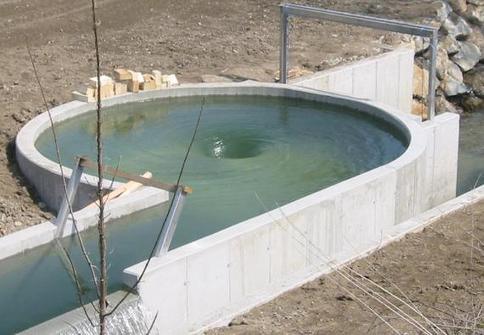
Austrian engineer Franz Zotlöterer has constructed a low-head power plant that makes use of the kinetic energy inherent in an artificially induced vortex. The water’s vortex energy is collected by a slow moving, large-surface water wheel, making the power station transparent to fish – there are no large pressure differences built up, as happens in normal turbines.

Posted on June 11, 2015 and received 109 views.


Alberta Energy Production And A Renewable Future

Author:  Duane M. Tilden, P.Eng  (January 14th, 2016)

Abstract:  Energy sources and pricing are hot topics world-wide with the Climate Change agenda leading the way.  Last year at the 2015 Paris Climate Conference long-term goal of emissions neutrality was established to be by as soon as 2050.  Alberta currently produces more atmospheric carbon emissions and other pollutants than any other Province in Canada, and in order to meet clean air objectives the energy sectors which consume & mine the natural resources of the Province will have to shift to non-polluting & renewable energy sources and be more efficient in energy utilization.  To achieve these goals new infrastructure will have to be built which will have the likely consequences of raising energy pricing as well as alter consumption rates and patterns.

Transportation

Transportation is a vital link in modern society, and often a personal vehicle is chosen as the main mode of mobility to work, leisure, & social purposes.  Cars and trucks also provide means of work and commerce & are essential to our way of life.  Most of these vehicles are fueled by gasoline, some by diesel, propane, and more recently the electric vehicle (EV) and hybrids.


GraphData Gas Price Comparison Canada

Graph #1:  Average Cost Comparison of Gasoline in Major Canadian Cities

In Alberta, using Calgary as a basis for comparison, it is apparent that pricing to consumers for gasoline is below nation-wide market averages when measured Province by Province, as demonstrated in Graph #1 (1). While if you live in Vancouver the cost is considerably higher, due to included carbon taxes and a transit levy among additional charges.  Additional means of moving growing populations efficiently have been seen by the development of LRT mass transit for the rapid movement of citizens to work, school, or social events.

Rapidly moving the large segments of the population in a cost effective manner is important to growth.  Buses are an important link in this mix as are cycling routes, green-ways and parks.  Changes in fuels for trucks, buses and trains by converting from diesel fuel to LNG will also provide for reductions in emissions while providing economic opportunity for utilization of the existing plentiful resource.  While EV’s show promise, the battery technologies for energy storage need further development.

Alberta Electricity Production

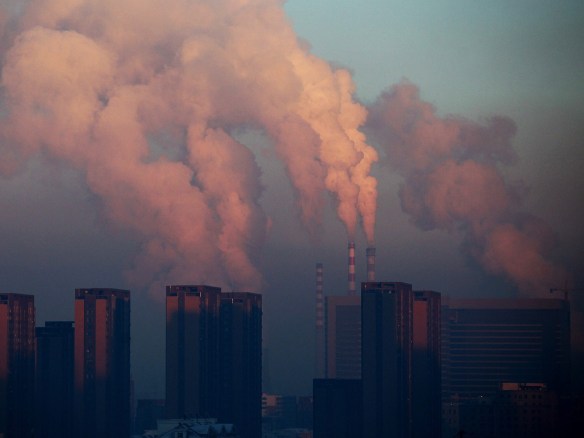
Alberta still relies on out-dated coal plants to generate electricity.  According to a CBC article coal provides power to 55% of homes in Alberta, and is the second largest contributor to emissions (2) and GHG’s to the Oil Sands projects.  However, it has been noted that the utility is reluctant to decommission recently constructed coal plants, until they have earned back (or are compensated for) their investment in capital costs.

local-input-wabamun-alberta-march-21-2014-a-giant-drag1

Photo #1:  Highvale coal mine to feed the nearby Sundance power plant (3)  

Photo credit:  John Lucas / Edmonton Journal

There are power purchase agreements in place, which may extend 50 to 60 years from the construction date of the plant (2).  It may be possible that the coal fired power plants could be converted to burn natural gas, which Alberta has in abundance, rather than be decommissioned.  However, this would still require the closure of the coal mines and mining operations currently supplying the existing power plants.  Also, combustion of natural gas will still release GHG’s into the atmosphere, while less than coal, they are not a total elimination of emissions.

Residential Energy Consumption

When comparing monthly residential electrical energy costs across Canada, using data obtained from a survey performed by Manitoba Hydro, we see that Edmonton and Calgary are in the lower middle range of pricing (4).  Variances in all regions will occur based on average home size, building codes and insulation requirements, heating system types and other factors.  Some homes may be heated with electric baseboard which will result in a higher electric bill while other homes may be heated using natural gas as a fuel.  Also household hot water generation can be by electric or gas-fired heater, so consumption of natural gas must be considered with electrical power usage to get a complete picture of energy consumption.

residential_1000kWhresidential_2000kWh

Charts #1 & 2:  Average Monthly Cost For Residential Electricity in Major Canadian Cities For Equivalent Usage in kWh (4)

Inspecting these charts it is proposed that a price increase of 10 to 20% to Alberta electrical energy consumers by a separate tax or fee to pay for a shift in technology would be reasonable when compared to other Canadian Cities.   Additional tariffs on natural gas consumption would also be recommended.  Such an increase would likely have a secondary benefit of creating an incentive for energy efficiency upgrades by home owners such as increased insulation, better windows and heating system upgrades. Such improvements would in turn lead to reduced demand at the source and thus to lower GHG & particulate emissions to the atmosphere.

Climate and the Proposed Energy Code

Energy consumption in populations is normalized in a number of ways, generally defined by habits and patterns.  We observe that in traffic as volumes increase early in the morning as commuters travel to work, and in the opposite direction as they head home in the evening.  Often people will attempt to “beat the traffic”.  This is an admirable goal in energy usage as well, for consumption of electricity will follow other such predictable patterns as people eat meals, shower, and perform other rituals that interface with electrical,  heating,  ventilating, elevators, water supply and disposal systems that form infrastructure and services provided by municipalities and utilities.

As these systems need to be energized and maintained, it is desirable to be able to predict and control the consumption and distribution of resources.  The greater of these is the electrical generation and distribution system.   Also, emerging technological advancements in energy efficiency such as CFL, LCD displays, computers, refrigeration, energy storage and more.  Advancements in co-generation, district energy systems, and other end use distribution of energy which provide economies of scale are also possible as strategies to obtain goals.Heating Degree Days - Lower Western Canada

Map #1:  Partial Map of Heating Degree Days for South-Western Canada (5)

Opportunities will exist for building mechanical system enhancements and upgrades as they may provide energy savings and cost reductions to users often calculated with a minimum nominal payback period of 5 to 7 years (and should be determined in every case).   The HDD map can provide a source of information which is used in energy models to determine predicted building energy costs when calculating payback periods to justify system upgrades or design decisions.  Obtaining and monitoring building energy consumption rates and year over year changes are important resources in determining where systems are running at below optimal rates and require replacement.

In new building construction the National Energy Code for Buildings 2011 (NECB) (6) has been adopted by Alberta (7) for all municipalities.  As there are higher HDD values attributed to Calgary and Edmonton as seen in the HDD Map of Western Canada, a requirement for stringent construction methods and materials to higher standards ensure new buildings meet carbon emissions reduction goals.

026

Photo #2:  Construction of Towers in Calgary with High Window to Wall Ratios 

Photo Credit: Duane Tilden P.Eng

Increased requirements in glass U-values and shading coefficients, maximum window to wall ratios (WWR) to reduce undesirable solar heat gain and heat losses, energy consumption and improve occupant comfort.  Buildings with excessive glazing are difficult to heat and cool, requiring sophisticated mechanical systems to offset poor performance by the building envelope.

Code mandated higher insulation values & better materials; moisture and heat control of the envelope through better design.  Higher efficiency requirements for mechanical systems; (fans & ducts, pumps & pipes, and wires & motors), lighting, controls, and other components of the building and it’s envelope.  Energy modeling should be performed of larger significant buildings to optimize operations in the design phase.  Commissioning of the building is integral to ensuring compliance throughout the project to it’s final phases at substantial completion and occupancy.

Renewable Energy

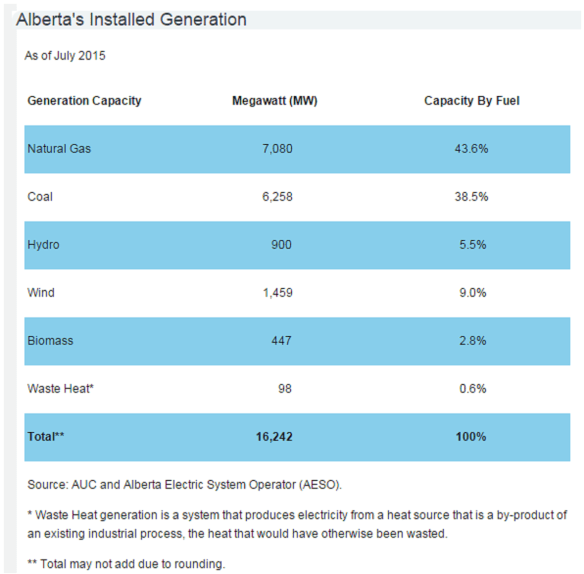
Renewable energy technologies including solar power and wind generation  have been gaining rapid adoption elsewhere in the world, while in Alberta (8) carbon based fuels currently provide over 80% of electrical power generation.   This has not been for a lack of wind and solar resources in Alberta but to be attributed to the large capital investments in fossil fuel resource extraction.  Other renewable technologies such as bio-mass, hydro, and geothermal may also be employed and should be investigated as alternatives to existing thermo-electric power plants.
Alberta Energy Sources - 2015

Table #1:  Installed Electrical Generating Capacity by Fuel Source in Alberta (8)

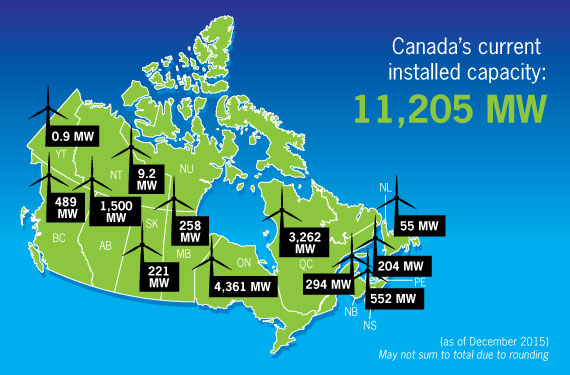
Currently, Alberta has the third highest installed wind power capacity in Canada behind Ontario and Quebec.  Wind energy not only represents a means to green the power production, it also will contribute jobs and income to the economy.  As one source of electricity and revenues is removed another source will fill the void.
installed_capacity_e-4

Map #2:  Installed Wind Power Capacity by Province in Canada (9)

While significant inroads have been made in Alberta for wind power which is already established as a major power source for the future, there is unrealized potential for the installation of solar power production.  It has been noted that a photo-voltaic installation in Calgary is 52% more efficient than one installed in Berlin, Germany.  Meanwhile, Germany has 18,000 times more solar power generation capacity than installed in Alberta (10).

alberta-germanytiltweb

Map #4:  Solar Resource Comparison for Alberta & Germany (10)

Alberta has significant solar resources, even during the winter when daylight hours are shorter. Lower temperatures improve PV efficiency, and properly tilted south facing panels optimize light capture, while the flat terrain of the prairies provide unobstructed maximum daylight.  Light reflection by snow on the ground would further enhance light intensity during the colder months.  Thus solar represents a relatively untapped potential source of significant electrical power for Alberta and an unrealized economic opportunity for consumers and industry.
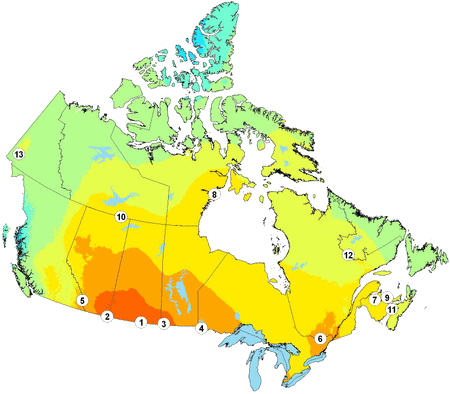
hotspots_13

hotspots_leg

Map #5:  Solar Resource Map for Canada With Hotspots (11)

Energy Efficiency, Smart Grid & Technological Advancements

Renewable energy produces electricity from natural resources without generating carbon and particulate emissions.  Another method of controlling emissions is to reduce the amount of energy consumed by being more efficient with the energy we already produce.   We can achieve this by using higher efficiency equipment, changing consumer patterns of use to non-peak periods, use of Smart Meter’s to monitor consumer usage and to alert homeowners when there is a problem with high consumption which could result in higher bills than normal if the problem remained unreported.

There are other advancements in the electrical grid system which are on the horizon which will enable a utility maximize resources by such means as energy storage, micro-grids, demand response to name a few.  Also, property owners and businesses could be able to grid-tie private solar panel (PV) and storage systems to supplement the utilities electrical system with additional power during the day.

Summary

In order to meet the goal of atmospheric emissions neutrality as agreed to at the 2015 Paris Climate Conference Alberta is posed with making decisions on how electricity is to be produced in the future.  Eliminating coal power plants and replacing them with Renewable Energy power sources such as solar and wind power are proven methods to reducing GHG and particulate emissions as these power sources do not involve combustion and discharge of waste gases formed during the combustion process.  Coal combustion is well documented as a major contributor of GHG’s to the atmosphere.

To make the transition will require capital for financing to build new infrastructure.  Funding of these projects should be raised proportionally charged to users with increased rates.  These rate increases will provide further incentives to reducing energy consumption and thus air emissions.  Jobs will shift and employment will be created in new forms as the old is phased out and replaced with new technology.  These new systems will have to be designed, built and maintained while the workforce will require training in new methods.  There will be many new opportunities for growth and advancement resulting from the implementation of these changes to meet Canada’s International commitments.

References:

  1. http://www.nrcan.gc.ca/energy/fuel-prices/4593
  2. http://www.cbc.ca/news/business/coal-compensation-power-alberta-1.3321467
  3. http://edmontonjournal.com/business/local-business/albertas-commitment-to-phase-out-coal-fired-power-sparks-fears-of-job-losses
  4. https://www.hydro.mb.ca/regulatory_affairs/energy_rates/electricity/utility_rate_comp.shtml
  5. http://ftp2.cits.rncan.gc.ca/pub/geott/atlas/archives/english/5thedition/environment/climate/mcr4033.jpg
  6. http://www.nrc-cnrc.gc.ca/eng/publications/codes_centre/necb_2011_adaptation_guidelines.html
  7. http://www.municipalaffairs.alberta.ca/CP_Energy_Codes_Information
  8. http://www.energy.alberta.ca/electricity/682.asp
  9. http://canwea.ca/wind-energy/installed-capacity/
  10. http://www.greenenergyfutures.ca/blog/sunny-days-ahead-solar-alberta
  11. http://pv.nrcan.gc.ca/index.php?lang=e&m=r


Closed Loop Cooling Saves Millions of Gallons of Water in Texas Combined Cycle Natural Gas Power Plant

Source: gereports.ca

>” […] Instead of water, each of the two plants will use two powerful air-cooled “Harriet” gas turbines and one air-cooled steam turbine developed by GE. “The technology uses the same cooling principle as the radiator in your car,” Harris says. “You blow in the air and it cools the medium flowing in closed loops around the turbines.”

The power plants, which are expected to open next year, will be using a so-called combined cycle design (see image below) and produce power in two steps. First, the two gas turbines (in the center with exhaust stacks) extract energy from burning natural gas and use it to spin electricity generators. But they also produce waste heat.

The system sends the waste heat to a boiler filled with water, which produces steam that drives a steam turbine to extract more energy and generate more power.

But that’s easier said than done. The steam inside the steamturbine moves in a closed loop and needs to be cooled down back to water so it could be heated up again in the boiler. “Normally, we cool this steam with water, which evaporates and cools down in huge mechanical cooling towers,” says GE engineer Thomas Dreisbach. “A lot of the cooling water escapes in those huge white clouds you sometimes see rising from towers next to power plants.” The Exelon design is using a row of powerful fans and air condensers (rear right) to do the trick and save water.

Similar to the steam turbines, GE’s Harriet gas turbines also use air to chill a closed loop filled with the coolant glycol and reduce the temperature inside the turbine. The combined efficiency of the plant will approach 61 percent, which in the power-generation industry is like running a sub 4-minute mile. […]”<


See on Scoop.itGreen Energy Technologies & Development

UK Green Investment Bank Raises £463m on its planned £1bn Offshore Wind Farm Fund

The UK Green Investment Bank plc (GIB) has announced that its FCA regulated subsidiary, UK Green Investment Bank Financial Services Limited (GIBFS), has reached first close on commitments of £463m on its planned £1bn fund to invest in operating offshore wind farms in the UK.

Source: www.greeninvestmentbank.com

>” […] £463m of capital raised at first close, to be invested in UK offshore wind projects.Investors include UK pension funds and a sovereign wealth fund.Innovative transaction creating the world’s first dedicated offshore wind fund.This is the first fund raised by the GIB group, a first move into asset management and the first time it has managed private capital since its formation.This announcement marks the end of GIB’s financial year. It committed £723m to 22 green energy projects across the UK in 2014/15. GIB has now backed 46 UK projects with a total value of almost £7bn.

The UK Green Investment Bank plc (GIB) has announced that its FCA regulated subsidiary, UK Green Investment Bank Financial Services Limited (GIBFS), has reached first close on commitments of £463m on its planned £1bn fund to invest in operating offshore wind farms in the UK.

First close marks the completion of the first stage of fundraising and is triggered by the commitment of an initial group of investors.

The initial investors comprise UK-based pension funds and a major sovereign wealth fund. GIB is also investing £200m in the fund. Fundraising continues and GIBFS expects to raise additional funds from other investors to reach the £1bn target.

In addition to the £463m of fund commitments raised, an additional significant amount of investor capital is available to co-invest into projects alongside the fund.

The fund is an innovative, first-of-a-kind transaction. It is the world’s first fund dedicated to investments in offshore wind power generation and, once fully subscribed, will be the largest renewables fund in the UK. The fund has an expected life of 25 years, allowing a new class of long-term investor to enter the sector.

This is the first fund raised by the GIB group and its first step into asset management. It is also the first private capital to be managed by the GIB group. It will be managed by a new FCA-regulated and authorised subsidiary called UK Green Investment Bank Financial Services Limited which is staffed by a dedicated team.

GIB has now transferred its investments in two operating assets into the fund, which will produce immediate cash yield for investors. They include:

Rhyl Flats. A 90 MW, 25 turbine wind farm operated by RWE Innogy UK off the coast of North Wales. It has been operational since December 2009. GIB has sold its full 24.95% equity stake in the project to the Fund.Sheringham Shoal. A 317 MW, 88 turbine wind farm operated by Statkraft and located in the Greater Wash area off the coast of Norfolk. It has been operational since October 2012. GIB has sold its full 20% equity stake in the project to the fund.

These two offshore wind farms are able to produce 1,290 GWh of renewable energy annually, enough to power 305,000 UK homes. The fund also has a strong pipeline of future investment opportunities.

Evercore Private Funds Group is acting as advisor and exclusive global placement agent for the fundraise and King & Wood Mallesons is acting as legal counsel to the fund. […]”<

See on Scoop.itGreen & Sustainable News

Smart Grid Testbed For Industrial Electrical Grid Innovation

Industrial Internet Consortium announces first energy-focused testbed.

Source: www.cbronline.com

The Communication and Control Testbed for Microgrid Applications, the first energy-focused testbed, was today [Mar 27/2015] announced by the Industrial Internet Consortium.

Member organisations including Real-Time Innovations (RTI), National Instruments, and Cisco, will collaborate on the project, working with power utility firms CPS Energy and Southern California Edison. Additionally, Duke Energy and power industry organisation Smart Grid Interoperability Panel (SGIP) will be also involved.

In order to put an end to renewable energy waste in neighbourhoods or businesses, a new architectural innovation was found to be needed.

Today’s power grid relies on a central-station architecture, which is not designed to interconnect distributed and renewable power sources such as roof-top solar and wind turbines. The system must over-generate power to compensate for rapid variation in power generation or demands.

The Communication and Control Testbed will introduce the flexibility of real-time analytics and control to increase efficiencies, ensuring that power is generated more accurately and reliably to match demand.

The solution proposes re-architecting electric power grids to include a series of distributed microgrids which will control smaller areas of demand with distributed generation and storage capacity.

These microgrids will operate independently from the main electric power grid, but will still interact and be coordinated with the existing infrastructure.

In order to ensure a coordinated, accepted architecture based on modern, cross-industry industrial internet technologies, companies taking part in the venture will work with Duke Energy and SGIP.

The Communications and Control framework will be developed in three phases, with initial developments being tested in Southern California Edison’s Controls Lab in Westminster, CA.

The final stage of the project will culminate in a field deployment that will take place at CPS Energy’s “Grid-of-the-Future” microgrid test area in San Antonio, Texas.

Stan Schneider, RTI’s CEO and IIC Steering Committee member, said: “The smart grid is a critical infrastructure component of the Industrial Internet of Things.

“The IIoT will span industries, sensor to cloud, power to factory, and road to hospital. This key first step will address a significant barrier to the efficient use of green energy.” […]”<

See on Scoop.itGreen Energy Technologies & Development

The 50 Year Underground Coal Mine Fire

By the early 1980s, the mine fire in Centralia, Pennsylvania was growing worse and increasingly threatening the people who lived there. GAI, Inc., a private geotechnical engineering company, was hired to review the situation and propose a solution to finally contain the fire. What they eventually came up with was so drastic, it might easily have been called Centralia’s “Nuclear Option.”

Source: www.centraliapa.org

Additional Information:  Zip Code 00000 (Washington Post) http://wapo.st/1eMhdGq

>” […]

GAI’s review and associated containment plan took months to complete. It analyzed mountains of data about Centralia PA, its abandoned mines, and the geology of the surrounding area. GAI also explored the beginnings of the fire, the current location of the burn, and the previous, failed attempts to stop it.

Finally on July 12, 1983 the findings were announced to the public. At that time, the mine fire was determined to be under 195 acres and burning in the Skidmore, Seven Foot, and Buck Leader coal veins. It was suggested that the fire could eventually grow to a maximum size of 3,700 acres of land.

GAI’s report made it clear that containing the Centralia mine fire would neither be easy nor cheap. The plan to contain the fire would require excavating a trench of massive proportions. This would need to be 3,700 feet long and 450 feet in depth – deep enough to hold a 45 story office building!

Worse yet, the trench would cut through the middle of the town. Although it would eventually be filled in with incombustible material to prevent the mine fire from moving further west, half of the borough of Centralia Pennsylvania would be destroyed while excavating it. The whole project would take years to complete.

If the damage caused by GAI’s plan wasn’t “nuclear” enough, there was always the price tag. GAI estimated it would cost a jaw-dropping $660 million to complete the project. This was over 100 times more expensive than the 1965 rejected plan to contain the mine fire. According to the Bureau of Labor and Statistics, $660 million in 1983 is roughly equivalent to $1.5 billion in 2015. Today these cost estimates are still shocking.

It is no wonder that in August of 1983 the majority of Centralia PA’s residents voted to be relocated. After years of struggling with the mine fire, the “nuclear option” proposed by GAI to stop the fire and level half of the town was more than most could bear.”<


See on Scoop.itGreen & Sustainable News

China’s Capital City to Shut Major Coal Power Plants due to Excessive Pollution

(Bloomberg) — Beijing, where pollution averaged more than twice China’s national standard last year, will close the last of its four major coal-fired power plants next year.

Source: www.bloomberg.com

>” […]

The capital city will shutter China Huaneng Group Corp.’s 845-megawatt power plant in 2016, after last week closing plants owned by Guohua Electric Power Corp. and Beijing Energy Investment Holding Co., according to a statement Monday on the website of the city’s economic planning agency. A fourth major power plant, owned by China Datang Corp., was shut last year.

The facilities will be replaced by four gas-fired stations with capacity to supply 2.6 times more electricity than the coal plants.

The closures are part of a broader trend in China, which is the world’s biggest carbon emitter. Facing pressure at home and abroad, policy makers are racing to address the environmental damage seen as a byproduct of breakneck economic growth. Beijing plans to cut annual coal consumption by 13 million metric tons by 2017 from the 2012 level in a bid to slash the concentration of pollutants.

Shutting all the major coal power plants in the city, equivalent to reducing annual coal use by 9.2 million metric tons, is estimated to cut carbon emissions of about 30 million tons, said Tian Miao, a Beijing-based analyst at North Square Blue Oak Ltd., a London-based research company with a focus on China.  […]

Closing coal-fired power plants is seen as a critical step in addressing pollution in China, which gets about 64 percent of the primary energy it uses from the fossil fuel. Coal accounts for about 30 percent of the U.S.’s electricity mix, while gas comprises 42 percent, according to Bloomberg New Energy Finance data.  […]

Air pollution has attracted more public attention in the past few years as heavy smog envelops swathes of the nation including Beijing and Shanghai. About 90 percent of the 161 cities whose air quality was monitored in 2014 failed to meet official standards, according to a report by China’s National Bureau of Statistics earlier this month.

The level of PM2.5, the small particles that pose the greatest risk to human health, averaged 85.9 micrograms per cubic meter last year in the capital, compared with the national standard of 35.

The city also aims to take other measures such as closing polluted companies and cutting cement production capacity to clear the air this year, according to the Municipal Environmental Protection Bureau. […]”<


See on Scoop.itGreen & Sustainable News

Global Distributed Energy Storage Capacity Expected to Increase Nearly 10-Fold

The worldwide capacity of distributed energy storage systems is expected to increase nearly 10-fold over the next 3 years, according to a new report from Navigant Research, which analyzed the global market for distributed energy storage systems through 2024.

Source: cleantechnica.com

>” […] The primary conclusion of the report is that distributed storage is one of the fastest-growing markets for energy storage globally, thanks to the focus of rapid innovation and intense competition, causing the market to greatly exceed market expectations. This growth and subsequent demand has led to grid operators, utilities, and governments looking to encourage storage installations that are physically situated closer to the retail electrical customer.

According to the report from Navigant Research, worldwide capacity of distributed energy storage systems (DESSs) is expected to grow from its current 276 MW, to nearly 2,400 MW in 2018.

“Distributed storage is among the fastest-growing markets for energy storage globally,” says Anissa Dehamna, senior research analyst with Navigant Research. “In particular, residential and commercial energy storage are expected to be the focus of technological advances and market activity in the coming years.” […]

Two specific types of DESS are classified in the report: Community energy storage refers to systems installed at the distribution transformer level; Residential and commercial storage, on the other hand, refer to “two behind-the-meter applications targeted at either homeowners or commercial and industrial customers.” Together, these two technologies include lithium ion (Li-ion), flow batteries, advanced lead-acid, and other next-generation chemistries, such as sodium metal halide, ultracapacitors, and aqueous hybrid ion.

Similarly, the two categories of DESS each have specific market drivers. Community energy storage is being driven by the improved reliability yielded in case of outages, load leveling and peak shifting, and improved power quality. Almost as importantly, community energy storage systems can communicate with a grid operator’s operating system, allowing the operator to mitigate disruptions to the grid.

Given its primary use as an energy cost management solution, the prime driver behind commercial storage systems is the rate structure for customers. “<

See on Scoop.itGreen Energy Technologies & Development

Are Virtual Power Plants the Next Generation in Electrical Utilities?

Germany’s energy giants are lumbering behind the rapid advance of renewable energy. They might stay afloat for a while, but they don’t seem flexible enough to achieve a turnaround, says DW’s Henrik Böhme.

Source: www.dw.de

>” […]  Decentralization is the buzzword. And the power required elsewhere, say, for street lights, electric motors, or the bakery nearby will be largely generated through renewables. Even large industrial compounds will be in a position to generate enough electricity for their own needs.

Nuclear power stations will all have been switched off by then, with only a few coal-fired or gas-fired plants still in operation. One way or another, Germany’s power landscape is bound to undergo dramatic changes.

That’s been obvious for a couple of years now. But the German utilities’ age-old business models don’t seem to be working anymore. All they know is big and heavy – they’re used to nuclear and coal power stations guaranteeing billions in profit, year-in year-out, and they seemed to secure their earnings without any trouble. And then they grew fat and began making mistakes.  […]

Then came the Fukushima nuclear disaster four years ago, leading to the German government’s decision to phase out nuclear energy completely by 2022. That dealt a severe blow to Eon, RWE and co. which hadn’t really understood the thrust of the country’s energy transition anyway.

The utilities in question are now frantically trying to rescue what they still can. They’re cutting away some of the fat. Costs are being cut, employees are being laid off and selected divisions are being jettisoned. The companies have rediscovered private clients by offering them networking technology.

But people don’t trust those giant, de facto monopolist firms anymore. Younger companies can do the same just as well, and often far more efficiently. Take “Next Kraftwerke”, a Cologne-based start-up. They run a virtual power station where power is collected from many smaller facilities and redistributed in the process. This is pretty close to what a future energy supply system will look like.

According to Silicon Valley researcher Peter Diamandis, 40 percent of the world’s current biggest companies will have ceased to play an important role some 10 years from now. On current performance, among those to fall will most likely be Eon, RWE and others.”<


See on Scoop.itGreen Energy Technologies & Development