Fossil Fuel Development in the Arctic is a Bad Investment

Source: www.earth-policy.org

>”Currently, about 10 percent of the world’s oil and one-quarter of its natural gas production come from the Arctic region, which has warmed by more than 2 degrees Celsius since the mid-1960s. Countries that border the Arctic Ocean are staking claims to expand their rights beyond the traditional 200-mile exclusive economic zone in anticipation of future oil and gas prospects. According to current estimates, the United States has the largest Arctic oil resources, both on and offshore. Russia comes in second for oil, but it has the most natural gas. Norway and Greenland are virtually tied for third largest combined oil and gas resources. Canada comes in fifth, with almost equal parts oil and natural gas.

In developing these resources, Russia is leading the pack. Production has started at almost all of the 43 large oil and natural gas fields that have been discovered in the Russian Arctic, both on land and offshore. Russia drew its first oil from an offshore rig in Arctic waters in December 2013. […]

[…] operating in the Arctic brings great risks. The shrinking Arctic sea iceallows waves to become more powerful. The remaining ice can be more easily broken up into ice floes that can collide with vessels or drilling platforms. Large icebergs can scour the ocean floor, bursting pipes or other buried infrastructure. Much of the onshore infrastructure is built on permafrost—frozen ground—that can shift as the ground thaws from regional warming, threatening pipe ruptures. Already, official Russian sources estimate that there have been more than 20,000 oil spills annually from pipelines across Russia in recent years.  Arctic operations are far away from major emergency response support. The freezing conditions make it unsafe for crews to be outside for extended periods of time. Even communication systems are less reliable at the far end of the Earth. Why take such risks to pursue these dirty fuels when alternatives to oil and gas are there for the taking?

Rather than searching for new ways to get oil, we can look for better ways to move people and goods. Bus rapid transit, light rail and high-speed rail can move more people for less energy than a car can. And for the cars that remain on the road, electric and plug-in hybrid electric vehicles—powered by a clean energy grid—are much more efficient than those with a traditional internal combustion engine. Encouraging bicycle use through bike lanes andbike-sharing programs gets people active and out of cars.

Natural gas, which is mainly used to produce electricity, can be replaced with power generated by wind, solar, and geothermal projects. Many countries are demonstrating what is possible with renewables. Denmark already gets one-third of its electricity from wind. Australia is now dotted with 1 million rooftop solar systems. Iceland generates enough geothermal power to meet close to 30 percent of its electricity needs. These are just a few examples of looking past the old familiar solution to a better cleaner one. The risky search under every rock and iceberg for oil and gas deposits is a costly distraction from investing in a clean energy future.”<

See on Scoop.itGreen & Sustainable News

Google invests $145 million in new 82MW Southern California solar power plant

Energy Storage Solutions for the Smart Grid

In order to ramp up clean energy production, we have to figure out how to store and transmit it effectively. Companies are experimenting with new tech to figure out the best way to progress.

Source: www.techrepublic.com

>”The smart grid energy storage sector is expected to grow to $50 billion by 2020, with an annual compound growth rate of 8%, according to a recent report from Lux Research. In 2013, renewable energy accounted for only 10% of total US energy usage and 13% of electricity generation, according to the US Energy and Information Administration.

But as renewable energy generation rises, transmission and storage advancements will be necessary. Curtailment, the act of spilling renewable energy because there’s more than enough, is one issue to tackle. By changing grid transmission lines in 2010, Texas saw the curtailment in their grid drop from 9% to 4% in 2012, according to a report by the National Renewable Energy Laboratory.

The tipping point with energy storage depends on the grid and the technology used, said Sam Jaffe, an analyst at Navigant Research. Some places in the world that have extremely high penetration rates of renewable energy don’t have major problems with wasted renewables. Denmark sends its extra wind power to Sweden and Norway, while importing hydro power from those two countries when the wind isn’t blowing. Denmark’s wind penetration is now at almost 40%.

“That’s because they are interconnected to other grids that have a lot of flexibility to offtake renewable energy,” he said.”<


See on Scoop.itGreen Energy Technologies & Development

Residential Battery Storage Nears Grid Parity in Germany

It’s very close, according to the German government and some industry observers.

Source: www.greentechmedia.com

>”It is now generally recognized that rooftop solar has reached “socket parity” — meaning that it is comparable to or cheaper than grid prices — in many countries over the last few years. The big question for consumers and utilities is when socket parity will arrive for solar and battery storage.

[…] Electricity prices are rising and solar PV prices are falling, which means that if battery storage falls to around €0.20 per kilowatt-hour (U.S. $0.27), parity will be achieved.

Australian investment firm Morgans, in an assessment of Brisbane-based battery storage developer Redflow, suggests that that company’s zinc-bromine flow battery may already be commercially economic in Germany, the country that leads the world in terms of household adoption and government support for renewables.

Morgans notes that in Germany, the cost of household grid power is around €0.30 per kilowatt-hour (U.S. $0.40) and that the government is now subsidizing residential energy storage systems that are connected to solar systems.

“Given Germany’s substantial adoption of solar PV…costs for solar power range from €0.10 to €0.15 per kilowatt-hour (half the grid price), so when energy storage costs reach €0.15 to €0.20, this will mean renewable energy costs will be at parity with grid prices,” Morgans concludes.  […]”<


See on Scoop.itGreen Energy Technologies & Development

US Company Deploys Aqueous, Lithium-Ion and Flow Batteries for Grid Storage

“Batteries must do more than just work—they have to scale.”

Source: www.greentechmedia.com

>”[…] The startup is a software developer and system integrator that has attracted investment, personnel and a growing roster of turnkey energy storage projects.

[…]

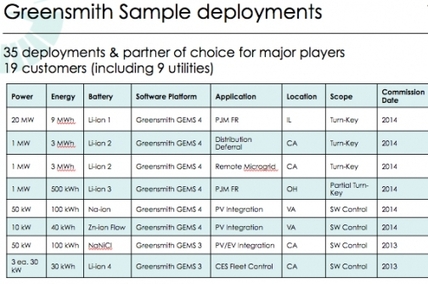
Companies like the 30-employee Greensmith are winning energy storage projects not because they are building better batteries but because they are writing software that integrates batteries with inverters and allows energy storage to work with the grid at scale. Greensmith works with a variety of battery chemistries from different vendors, as well as multiple inverters and power electronics partners.

New battery technologies and projects

Amongst other technologies, Greensmith is using Aquion Energy’s sodium-ion battery. The Pittsburgh, Penn.-based Aquion says its technology can deliver round-trip energy efficiency of 85 percent; a ten-year, 5,000-plus-cycle lifespan; energy storage capacity optimized to charge and discharge for multi-hour applications; and perhaps most notably, a price point of $250 per kilowatt-hour.

In April, Aquion closed a $55 million Series D venture capital investment, bringing total investments and grants to more than $100 million. New investors Bill Gates, Yung’s Enterprise, Nick and Joby Pritzker (through their family’s firm Tao Invest), Bright Capital, and Gentry Venture Partners joined previous investors Kleiner Perkins Caufield & Byers, Foundation Capital, and Advanced Technology Ventures in the round. Aquion is already producing its 1.5-kilowatt-hour S10 Battery Stack units, as well as an 18-kilowatt-hour system that combines twelve of its S10 units.

Greensmith is also using ViZn Energy Systems’ zinc redox flow battery energy storage technology. ViZn aims to produce a 80-kilowatt/160-kilowatt-hour system housed in a 20-foot shipping container, as well as larger systems. Other flow battery firms include American Vanadium, EnerVault, Primus Power, Imergy and ZBB Energy.

The CEO of the firm told GTM that Greensmith is developing a hybrid system using both the Aquion and ViZn storage chemistries.

Since its 2006 founding, Greensmith has deployed 30 battery energy systems for eighteen different customers, nine of them utilities, and is aiming to have 23 megawatts of systems under management by year’s end. […]”<

See on Scoop.itGreen Energy Technologies & Development

School to Combine Solar PV Modules with Battery Storage in Belgian Pilot Project

“Such an energy storage and distribution system can offer a great value, certainly for schools”, says Bert Dekeyzer of npo iD, the organization behind the ‘School of the Future’.

Source: www.solarserver.com

>'”During weekends a school consumes almost no electricity. The energy produced by the solar panels is stored in the batteries. On Monday morning there is a peak consumption: then all the computers and machines are turned on, which requires quite a lot of electricity. If the solar panels supply too little at that time, the batteries can provide the remaining energy. Moreover, a study showed that the energy consumption of a school does not stop after four o’clock in the afternoon. Schools are increasingly used in the evening for sports activities and evening classes. Also in this situation, the batteries can play their part.”

PV, storage combination offers a solution for a possible power shortage

In addition to an optimal and economic usage of solar power, the system can provide a solution for a possible power shortage in Belgium. Because of problems with the Belgian nuclear power plants, various municipalities could get disconnected from the electricity grid. In case of a power disruption, a traditional solar installation does not work anymore. The inverter of a traditional system switches off automatically because of a power failure. The owners of solar modules also have no electricity at that time, and in addition they suffer losses of the power output and any feed-in tariffs from their solar panels during the outage.

The storage system provides a solution. Such an installation combines solar modules with battery storage and intelligent software: if the grid fails, the system provides uninterrupted power for the user from the solar modules and/or batteries. […]”<


See on Scoop.itGreen Building Design – Architecture & Engineering

Renewable Geothermal Power Expands in Nevada

Geothermal energy is a growing industry, with more plants going into Nevada’s mostly untapped resource.

Source: www.ktvn.com

Geothermal energy is a growing type of clean energy, and nowhere is that more true than in Nevada. Ormat Technologies has built a geothermal plant every year since 2005.  […]

“This is what the future is going to bring,” Gawell said. “You will see more and more of this in years ahead and it is already a boom for Reno.”

The Steamboat Complex is a binary plant that takes hot water from deep underground, to produce power.

“We convert the heat that’s in the fluid to electrical energy,” Bob Sullivan, Senior Vice President of Ormat Technologies said. “Then we put all the fluids back into the ground where it gets reheated. So, it’s a sustainable cycle.”  […]

Along with electricity, these facilities create economic development, putting hundreds of people to work, drilling wells and building the plants.   About 500 people have permanent jobs with Ormat, in the United States.  Another 500 people work for the company around the world.

“It’s a job engine,” Sullivan said. “It takes a lot of maintenance. It takes a lot of people. It takes a lot of workers, a lot of subcontractors to keep one of these facilities running.”

While the cost of fossil fuels goes up and down, geothermal stays steady. The fuel cost is upfront, in the form of drilling wells. Gawell says what is lost in capital and labor costs is saved in fuel costs. […]”<

See on Scoop.itGreen Energy Technologies & Development

Sustainability and Development – Defining Relationships between Humanity, Energy and the Natural World

A new ‘Zeitgeist’ is increasingly taking hold in growing pockets of society, politics and the business world. All indications point to one direction – towards the concept of ‘sustainability’ dominating human behavior and thinking in the twenty-first century.

Source: breakingenergy.com

>”As the urbanization wave around the globe rolls on, megacities are increasingly becoming the epicenter of human life and economic activity for billions of people. Inevitably, this trend will bring about new challenges and exacerbate looming, well-known challenges such as climate change. As the World Economic Forum notes in a newly-released report on “The Competitiveness of Cities”: “Cities are especially intensive users of energy, food and water, given their concentrations of people and economic activity, and are responsible for over half of global greenhouse gas emissions. Their challenge, particularly in the developing world, is to fuse technology and markets to become much more efficient in using available resources.” Climate Actions and Economic Significance of Cities Source: Carbon Disclosure Project (CDP); data in overview from various sources Thus, global needs for clean water, sanitation and food as well as demand for energy, mobility (transportation) and for an improved standard of living will increase and put tremendous strain on existing natural resources.

The growing awareness of environmental problems – especially that without a timely, coordinated, and ‘corrective’ intervention by governments the problem of climate change will eventually become irreversible – in addition to the perception of natural resources’ finite supply brings any debate back to the fundamental question of how to sustain life on earth. What is Sustainable Development about?  The first association that comes to mind has to do with energy needs in general – and the finite fossil fuel supply amid projected future demand growth – and carbon-emissions-free energy in particular.

Renewable energy sources (solar, wind, hydro) have the potential to pick up the slack and supply a larger percentage of projected future energy demand globally. In this context, technological innovation represents one suitable solution to problems related to sustainability. However, a different angle to tackle these problems is a change in human behavior based on better information and awareness leading to energy savings by implementing simple energy efficiency measures. This point emphasizes the importance of public awareness and/or education, which can serve as a catalyst for action – i.e. a change of course. Apart from concerns about energy, the concept of sustainability includes all aspects of political, economic, and social life in so far as present actions may constrict future actions.

The so-called UN ‘Brundtland Report’ from 1987 is very instructive on this topic and defines sustainable development as follows: “Humanity has the ability to make development sustainable to ensure that it meets the needs of the present without compromising the ability of future generations to meet their own needs. The concept of sustainable development does imply limits – not absolute limits but limitations imposed by the present state of technology and social organization on environmental resources and by the ability of the biosphere to absorb the effects of human activities. But technology and social organization can be both managed and improved to make way for a new era of economic growth. […]

To date, many companies have realized the merits of modifying their products and processes to become more sustainable. (…) But, these [incremental] innovations will only get us so far. What we need are not just better products and processes, but fundamentally different business models. We need companies and industries whose underlying structures are, at worst, zero negative impact, and at best, contributing to the regeneration and restoration of natural, human and social capital.” The US utility industry will have no other choice than taking steps along the path towards more ‘value creation from sustainability’ in order to remain a viable business model for future generations.”<

See on Scoop.itGreen & Sustainable News

Development of small scale renewable landfill bio-gas electric generator in UK

ACP funds for development of small scale landfill gas engine in UK Energy Business Review ACP’s biogas partner AlphaGen Renewables, which oversee the installation and operation of a 50kW microgeneration landfill gas engine, will develop the project.

Source: biofuelsandbiomass.energy-business-review.com

>”The project is expected to generate power from the landfill gas resource at the site under a 20 year agreement with Norfolk County Council.

AlphaGen Renewables chairman Richard Tipping said: “We are delighted to be partnering with ACP on this project, which is set to deliver strong returns. Renewables such as biogas are playing a growing role in the UK’s energy production.”

Albion Ventures Renewables head David Gudgin said: “Biogas is an increasingly popular area of renewable energy and we are looking forward to working with AlphaGen both on this project and others in the future.”<

See on Scoop.itGreen Energy Technologies & Development

Province Calls for Renewable Energy Storage Systems Demonstration Projects

Most of the new systems will be able to turn on a dime, storing and releasing energy almost instantaneously to help balance out the supply and demand over the course of a day

Source: www.theglobeandmail.com

>”Ontario has embarked on a quest to find the holy grail of renewable energy – an effective means to store the power generated by intermittent wind and solar installations.

The province’s Independent Electricity System Operator (IESO) recently chose five companies who will build a dozen demonstration projects designed to capture and release energy. That would allow the electricity grid to react to fluctuations in power production, which are becoming more significant with the addition of renewables whose output varies depending on how the wind blows and sun shines.

[…]

The technologies that will be tested include advanced batteries, systems that store power in the form of hydrogen, and even flywheels that hold energy as kinetic energy in a spinning rotor.

Bruce Campbell, president of the IESO, called storage facilities a “game changer” for a grid that was designed to produce electricity at exactly the same time it is consumed. “Energy storage projects will provide more flexibility and offer more options to manage the system efficiently,” he said.

The test projects will be distributed at various locations around the province, and will be connected to different parts of the grid to see how effectively they can help balance supply, demand and other transmission issues.

Among the suppliers are Hydrogenics Corp., which will test a hydrogen storage system, and Hecate Energy and Canadian Solar Solutions Inc., which will use various battery technologies. Convergent Energy and Power LLC will test a flywheel that converts electricity to kinetic energy stored in a rotor. Dimplex North America Ltd. will install thermal systems in apartments in Hamilton, Ont., that store electricity as heat in special bricks, releasing it later when the building needs to be warmed.

Rob Harvey, director of energy storage at Hydrogenics, said his company’s test system will incorporate an advanced electrolysis system that uses electricity to split water into hydrogen and oxygen. That hydrogen can then be used in a fuel cell to generate electricity when needed. Coupling the fuel cell and the electrolyser means power can be effectively stored for any length of time and dispatched as needed.

If the tests are successful, Mr. Harvey said, this could be a significant new line of business for Hydrogenics, which now makes hydrogen-producing systems for industrial customers, as well as fuel cells, which are essentially engines that use hydrogen as fuel.”<


See on Scoop.itGreen Energy Technologies & Development