What is “Levelized Cost of Energy” or LCOE?

As a financial tool, LCOE is very valuable for the comparison of various generation options. A relatively low LCOE means that electricity is being produced at a low cost, with higher likely returns for the investor. If the cost for a renewable technology is as low as current traditional costs, it is said to have reached “Grid Parity“.

Source: www.renewable-energy-advisors.com

>”LCOE (levelized cost of energy) is one of the utility industry’s primary metrics for the cost of electricity produced by a generator. It is calculated by accounting for all of a system’s expected lifetime costs (including construction, financing, fuel, maintenance, taxes, insurance and incentives), which are then divided by the system’s lifetime expected power output (kWh). All cost and benefit estimates are adjusted for inflation and discounted to account for the time-value of money. […]

LCOE Estimates for Renewable Energy

When an electric utility plans for a conventional plant, it must consider the effects of inflation on future plant maintenance, and it must estimate the price of fuel for the plant decades into the future. As those costs rise, they are passed on to the ratepayer. A renewable energy plant is initially more expensive to build, but has very low maintenance costs, and no fuel cost, over its 20-30 year life. As the following 2012 U.S. Govt. forecast illustrates, LCOE estimates for conventional sources of power depend on very uncertain fuel cost estimates. These uncertainties must be factored into LCOE comparisons between different technologies.

LCOE estimates may or may not include the environmental costs associated with energy production. Governments around the world have begun to quantify these costs by developing various financial instruments that are granted to those who generate or purchase renewable energy. In the United States, these instruments are called Renewable Energy Certificates (RECs). To learn more about environmental costs, visit our Greenhouse Gas page.

LCOE estimates do not normally include less tangible risks that may have very large effects on a power plant’s actual cost to ratepayers. Imagine, for example, the LCOE estimates used for nuclear power plants in Japan before the Fukushima incident, compared to the eventual costs for those plants.

Location

An important determination of photovoltaic LCOE is the system’s location. The LCOE of a system built in Southern Utah, for example, is likely to be lower than that of an identical system built in Northern Utah. Although the cost of building the two systems may be similar, the system with the most access to the sun will perform better, and deliver the most value to its owner. […]”<


See on Scoop.itGreen Energy Technologies & Development

Continuous Monitoring Solution Designed for Facility and Energy Management

Verisae and Ecova partner to combine technology and service across nearly 3,000 facilities for an innovative and smart operational approach …


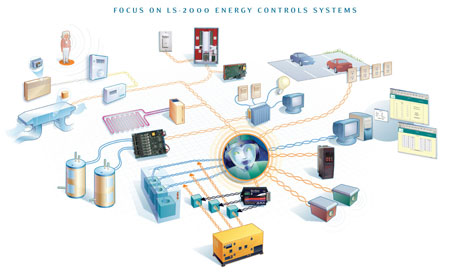
image source: http://energymanagementsystems.org/faqs-on-developing-energy-management-systems/

Source: www.virtual-strategy.com

>” Verisae, a leading global provider of SaaS solutions that drive cost reductions in maintenance, energy, mobile workforces, and environmental management, and Ecova, a total energy and sustainability management company, are pleased to announce the success of their growing partnership to help multisite companies solve their toughest energy, operations, and maintenance challenges.

The continuous monitoring solution combines Verisae’s Software-as-a-Service (SaaS) technology platform with Ecova’s Operations Control Center (OCC) to empower data-driven decision making. The solution analyses operational data in real-time, and has the capability to look for issues and anomalies to predict equipment failure and automatically identify inefficiencies causing higher energy consumption.

Ecova’s fully-staffed 24/7/365 OCC investigates inbound service calls, alarms, telemetry data, and work orders to determine the source of energy, equipment, and system faults and, where possible, corrects issues remotely before they escalate into financial, operational, or comfort problems. Trouble tickets and inbound calls are captured and tracked in the Verisae platform to provide companies with visibility into any operational issues. Combining data analytics that flag potentially troubling conditions with a service that investigates and resolves issues increases operational efficiencies and improves energy savings.

“Companies are constantly challenged to cut costs while maintaining quality, performance, and comfort,” says Jerry Dolinsky, CEO of Verisae. “Our combined solution helps clients address these challenges so they can reduce costs and improve operational efficiencies without impacting value.”

[…] “<

See on Scoop.itGreen Energy Technologies & Development

Morgan Stanley Installs Bloom Energy Fuel Cells At Purchase, NY Facility

Morgan Stanley Installs Bloom Energy Fuel Cells At Purchase, NY Facility

Source: www.bloomenergy.com

“The project will provide clean and uninterruptible power for the 750,000 Sq. Ft. Office Building

PURCHASE, NY, Nov. 14 — […] The fuel cell system, along with a solar panel field completed earlier this year, are the latest in a series of initiatives to improve the facility’s energy efficiency and resiliency.

The Bloom Energy fuel cell system produces electricity without burning fossil fuels, thus reducing emission of greenhouse gases. It will supply approximately 250 kilowatts (kW) of constant base load power to the facility, as well as grid-independent electricity to power portions of the building’s critical load during grid outages.  […]

The new solid oxide fuel cell system (SOFC) technology converts fuel into electricity through a highly efficient electrochemical process, resulting in on-site, clean and reliable power. Combined with the solar field, these new installations are expected to produce approximately 3 million kilowatt hours (kWh) of energy a year. During peak energy consumption times, they can supply approximately one megawatt, or up to 30 percent of the building’s demand.

Support for this project was provided by the New York State Energy Research and Development Authority (NYSERDA). Founded in 1975, NYSERDA is a public benefit corporation that provides information, services, programs and funding to help New Yorkers increase energy efficiency, save money, use renewable energy and reduce reliance on fossil fuels.

About Bloom Energy

Bloom Energy is a provider of breakthrough solid oxide fuel cell technology generating clean, highly-efficient on-site power from multiple fuel sources. The company was founded in 2001 with a mission to make clean, reliable energy affordable for everyone in the world. Bloom Energy Servers are currently producing power for several Fortune 500 companies including Apple, Google, Walmart, AT&T, eBay, Staples, The Coca-Cola Company, as well as notable non-profit organizations such as Caltech and Kaiser Permanente. The company is headquartered in Sunnyvale, CA. For more information, visit www.bloomenergy.com.

About Morgan Stanley

Morgan Stanley (NYSE: MS) is a leading global financial services firm providing investment banking, securities, investment management and wealth management services.  […]”<


See on Scoop.itGreen Energy Technologies & Development

$200m Demand Management Program Approved in NYC to Defer $1 billion SubStation to 2026

The NYPSC approved Con Ed of New York’s proposed $200 million Brooklyn/Queens Demand Management Program that would relieve overloads in the city.

Source: www.rtoinsider.com

>” […] Con Ed’s proposed Brooklyn/Queens Demand Management Program is consistent with the state’s “Reforming the Energy Vision” program to restructure the electricity market with greater reliance on technology and distributed resources, the commission said. “The commission is making a significant step forward toward a regulatory paradigm where utilities incorporate alternatives to traditional infrastructure investment when considering how to meet their planning and reliability needs,” the order states.

Commission Chair Audrey Zibelman added that because of the recent D.C. Circuit Court of Appeals decision striking down federal jurisdiction over demand response in wholesale markets, it’s important for state regulators to set market rules for that resource.

Con Ed said the feeders serving the Brownsville No. 1 and 2 substations began to experience overloads in 2013 and would be overloaded by 69 MW for 40 to 48 hours during the summer by 2018. A new substation, transmission subfeeders and a switching station would cost $1 billion, according to the company. The PSC accepted the company’s estimate of the DM Program’s costs and ordered a cap of $200 million.

The program would include 52 MW of non-traditional utility-side and customer-side relief, including about 41 MW of energy efficiency, demand management and distributed generation, and 11 MW of utility-side battery energy storage. This will include incentives to upgrade building “envelopes,” improve air conditioning efficiency of equipment, encourage greater use of energy controls, and establish energy storage, distributed generation or microgrids.

This will be supplemented by approximately 17 MW of traditional utility infrastructure investment, consisting of 6 MW of capacitors and 11 MW of load transfers from the affected area to other networks.  […]”<


See on Scoop.itGreen Energy Technologies & Development

Snohomish PUD’s Energy Storage Initiative

ACEEE Recommends Demand Response as a Strategy to Conquer Peak Demand for Utilities

By Steven Nadel

” … a potential emerging trend that could have a large impact on many utilities: the reduction of the traditional mid-afternoon peak, and the growth of an evening peak. (Peak is the time when demand for power is highest.)”

Source: aceee.org

>” […] In many regions, evening peaks have been growing, as more consumers install air conditioners and operate them when they get home from work. But two other factors are augmenting this trend. First and foremost is the growth in consumer-owned photovoltaic systems. These systems generate the most power on sunny afternoons, which is about when the traditional early afternoon peak occurs. But when the sun goes down, extra power is quickly needed to replace this solar power.  […]

There are many ways to address the growing evening peak, including the following:

  1. Energy efficiency, particularly measures that reduce the evening peak such as efficient lamps, water heaters, stoves and ovens.
  2. Smart controllers that minimize energy use during the evening peak. To provide just one example, a smart refrigerator would not turn on the defrost cycle during this period and might even turn off the main compressor for a few minutes.
  3. Likewise, smart charging systems for electric vehicles could be used, such as a new system recently demonstrated by the Electric Power Research Institute (EPRI), working with a consortium of utilities and auto manufacturers.
  4. Expanded use of demand-response programs to lower the new peak (and coordination of these efforts with energy efficiency programs).
  5. Time-of-use rates and/or demand charges that raise the price of power use during peak times and a lower them at off-peak times.
  6. Use of energy storage at a system, community, or end-user level. Storage able to provide power for several hours could be very useful.Fast ramp-up generation to serve the evening peak and other times when renewable energy production plummets, for example when the wind dies down. Hydro is ideal, but fast ramp-up gas units are now entering the market.

In my opinion, the time of the peak will change in many regions. The shift will be gradual in most areas, so we have time to address it. Rather than trying to stop this change by restricting photovoltaic systems, we’ll be better off figuring out how to manage it, […]”<

See on Scoop.itGreen Energy Technologies & Development

‘Demand Response’ is ‘Disruptive Technology’ Shutting Down Power Plants

FirstEnergy Corp. has a traditional view of wholesale electricity markets: They’re a competition between iron-in-the-ground facilities that can put megawatts on the grid when those megawatts are needed. Think coal plants, nuclear reactors and hydroelectric dams. Missing from the definition is a consumer’s promise to turn off the lights when the grid is stressed — so-called demand response. Instead of creating energy during peak times, demand response resources conserve it, freeing up megawatts […]

Source: powersource.post-gazette.com

>” […]The idea is not new and has been expanding in the territory of PJM Interconnection, a Valley Forge-based grid operator that manages the flow of electricity to 13 states, including Pennsylvania.

FirstEnergy, which owns power plants and utility companies across several states, wants PJM to abandon the demand response concept.

The Ohio-based energy company says demand response, which doesn’t require any kind of capital commitment, is “starving” traditional generation out of its rightful revenue in wholesale markets.

“We feel that it’s going to lead to even more premature closures of power plants,” said Doug Colafella, a spokesman for the firm.

Specifically, FirstEnergy is fighting to get demand response kicked out of PJM’s annual capacity auction, which ensures there’s enough electricity resources to meet projected power demand three years in advance. The auction establishes a single clearing price that will be paid to all successful bidders, like a retainer fee, in exchange for their promise to be available to be called upon three years from now.

During the May auction, which set capacity prices for the 2017-2018 year, the clearing price was $120 a day for each megawatt of electricity bidders committed. About 6 percent, or about 11,000 megawatts, of the capacity secured came from demand response.

FirstEnergy’s Bruce Mansfield coal-fired power plant in Beaver County failed to clear the auction. The company has since postponed upgrades to the facility, which could jeopardize its functioning beyond 2016.

Capacity payments are a stable source of revenue for baseload generation plants, Mr. Colafella said, and a price signal to the market about which way demand is headed, giving generators some indication about whether new facilities will be necessary and profitable.

Demand response distorts that dynamic, he said.

Since May, FirstEnergy has intensified its efforts to drive demand response out of PJM’s markets, having seized on a related court case involving the Federal Energy Regulatory Commission.

“FirstEnergy’s business model is that electricity consumption has been flattening, so they want to take a larger share of the market and how do you take a larger share? You bulldoze everybody out,” said Mei Shibata, CEO of The Energy Agency, a marketing and communications firm and co-author of a recent report on the market for demand response in the U.S. for GreenTech Media Research.

In May, the D.C. Circuit Court vacated a rule created by the Federal Energy Regulatory Commission in 2011 that said demand response should be treated the same way as power plants in wholesale energy markets. That meant demand response providers could offer to shut down a day in advance, when grid operators book electricity for the following day, and get the same price as megawatts from generation.

An electric power industry group sued the FERC claiming that the call to shut off electricity in exchange for payment is a retail choice and retail falls exclusively within state jurisdiction, not federal. The court agreed, setting in motion FirstEnergy’s challenge to demand response in capacity markets, which were not addressed by the court decision. If demand response is a retail product in one context, then it’s a retail product in all, the logic goes.

The same day the court issued its decision, FirstEnergy filed a lawsuit asking a judge to order PJM to recalculate the results of its May capacity auction stripping out demand response.

PJM objected. The Pennsylvania Public Utility Commission, which intervened in that case, charged FirstEnergy with “jumping the gun” on its logic and called its proposal an “unprecedented and wholly unnecessary disruption of the capacity market auction process.”

Even if demand response is excluded from the daily wholesale market as the court decision wills, the market for this resource will continue to expand, said Ms. Shibata.

If, however, FirstEnergy succeeds in kicking demand response out of the capacity market, “that would be a much bigger deal,” she said.

PJM leads the nation in demand response resources, according to Ms. Shibata’s research, and anything that happens to demand response at PJM would likely trickle down to the other grid operators around the country. […]”<

See on Scoop.itGreen Energy Technologies & Development

Ice Energy Storage Solution Awarded 16 Contracts by SCE

Santa Barbara – Ice Energy today (Nov 5, 2014) announced it has been awarded sixteen contracts from Southern California Edison (SCE) to provide 25.6 megawatts of behind-the-meter thermal energy storage using Ice Energy’s proprietary Ice Bear system.

Source: www.ice-energy.com

>” […] Ice Energy was one of 3 providers selected in the behind-the-meter energy storage category, which was part of an energy storage procurement by SCE that was significantly larger than the minimum mandated by the California Public Utility Commission (CPUC). SCE is one of the nation’s leaders in renewable energy and the primary electricity supply company for much of Southern California.

The contract resulted from an open and competitive process under SCE’s Local Capacity Requirements (LCR) RFO. The goals of the LCR RFO and California’s Storage Act Mandates are to optimize grid reliability, support renewables integration to meet the 2020 portfolio standards, and support the goal of reducing greenhouse gas emissions to 20% of 1990 levels by 2050.

“SCE’s focus on renewable energy is critical to helping meet California’s long-term goals, and Ice Energy is proud to be part of the solution with these contracts,” said Mike Hopkins, CEO of Ice Energy, the leading provider of distributed thermal energy storage technology. “Using ice for energy storage is not new, we’ve just made it distributed, efficient, and cost-effective. The direct-expansion AC technology is robust and proven, which is important because SCE and other utilities require zero risk for their customers.”

In 2013, 22 percent of the power SCE delivered came from renewable sources, compared to 15 percent for other power companies in the state. The utility is on track to meet the state’s goal of 33 percent, and procuring energy storage helps them meet those targets while maintaining a robust and reliable grid.

Ice Energy’s product, the Ice Bear, attaches to one or more standard 5-20 ton commercial AC units. The Ice Bear freezes ice at night when demand for power is low, capacity is abundant and increasingly sourced from renewables such as wind power. Then during the day, stored ice is used to provide cooling, instead of the power-intensive AC compressor. Ice Bears are deployed in smart-grid enabled, megawatt-scale fleets, and each Ice Bear can reduce harmful CO2 emissions by up to 10 tons per year. Installation is as quick as deploying a standard AC system.

“Ice Bears add peak capacity to the grid, reduce and often eliminate the need for feeder and other distribution system upgrades, improve grid reliability and reduce electricity costs,” Hopkins said. “What’s special about our patented design and engineering is the efficiency and cost. It’s energy storage at the lowest cost possible with extraordinary reliability.”

See on Scoop.itGreen Energy Technologies & Development

Thermal Energy Storage uses Ice for Cooling of Buildings – Smart Grid Technologies

Ice Energy’s proven Ice Bear system is the most cost effective and reliable distributed energy storage solution for the grid. The Ice Bear delivers up to six hours of clean, firm, non-fatiguing stored energy daily and is fully dispatchable by the utility. Ice Bear projects are job engines, creating long-term green jobs in the hosting communities.

Source: www.ice-energy.com

>” […] The Ice Bear system is an intelligent distributed energy storage solution that works in conjunction with commercial direct-expansion (DX) air-conditioning systems, specifically the refrigerant-based, 4-20 ton package rooftop systems common to most small to mid-sized commercial buildings.

The system stores energy at night, when electricity generation is cleaner, more efficient and less expensive, and delivers that energy during the peak of the day to provide cooling to the building.

Daytime energy demand from air conditioning – typically 40-50% of a building’s electricity use during peak daytime hours – can be reduced significantly by the Ice Bear. Each Ice Bear delivers an average reduction of 12 kilowatts of source equivalent peak demand for a minimum of 6 hours daily, shifting 72 kilowatt-hours of on-peak energy to off-peak hours. In addition, the Ice Bear can be configured to provide utilities with demand response on other nearby electrical loads – effectively doubling or even tripling the peak-demand reduction capacity of the Ice Bear.

When aggregated and deployed at scale, a typical utility deployment will shift the operation of thousands of commercial AC condensing units from on-peak periods to off-peak periods, reducing electric system demand, improving electric system load factor, reducing electric system costs, and improving overall electric system efficiency and power quality.

The Ice Bear is installed behind the utility-customer meter, but the Ice Bear system was designed for the utility as a grid asset, with most of the benefits flowing to the utility and grid as a whole. Therefore Ice Bear projects are typically funded either directly or indirectly by the utility.[…]

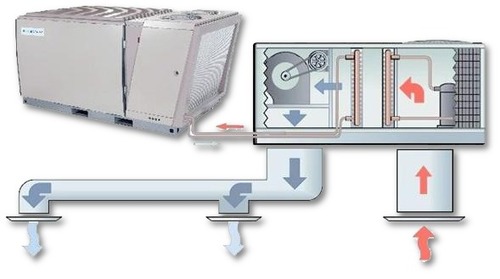
At its most basic, the Ice Bear consists of a large thermal storage tank that attaches directly to a building’s existing roof top air-conditioning system.

The unit makes ice at night, and uses that ice during the day to efficiently deliver cooling directly to the building’s existing air conditioning system.

The Ice Bear energy storage unit operates in two basic modes, Ice Cooling and Ice Charging, to store cooling energy at night, and to deliver that energy the following day.

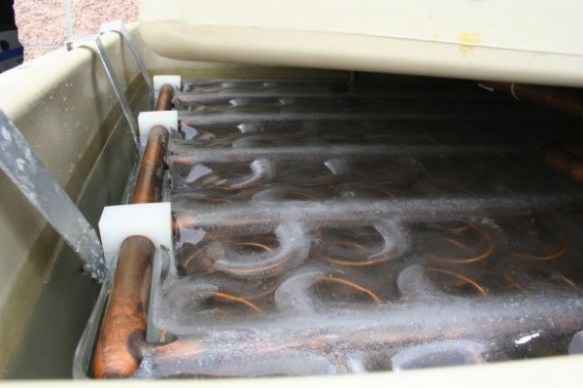
During Ice Charge mode, a self-contained charging system freezes 450 gallons of water in the Ice Bear’s insulated tank by pumping refrigerant through a configuration of copper coils within it. The water that surrounds these coils freezes and turns to ice. The condensing unit then turns off, and the ice is stored until its cooling energy is needed.

As daytime temperatures rise, the power consumption of air conditioning rises along with it, pushing the grid to peak demand levels. During this peak window, typically from noon to 6 pm, the Ice Bear unit replaces the energy intensive compressor of the building’s air conditioning unit.

[…]

The Ice Cooling cycle lasts for at least 6 hours.

Once the ice has fully melted, the Ice Bear transfers the job of cooling back to the building’s AC unit, to provide cooling, as needed, until the next day. During the cool of the night, the Ice Charge mode is activated and the entire cycle begins again. […]”<

See on Scoop.itGreen Energy Technologies & Development

California’s PG&E Takes Grid Energy Storage to the Distribution Substation

California’s utilities are building a 1.3-gigawatt energy storage system, one piece at a time.

Source: www.greentechmedia.com

>” […] PG&E’s solicitation (PDF) is one of the first rounds from the 74 megawatts of storage projects the utility is set to announce by December. That, in turn, is part of the first procurement round for the state’s 1.3-gigawatt mandate for storage by 2021, which is requiring PG&E, Southern California Edison, and San Diego Gas & Electric to sign up about 200 megawatts of cost-effective grid storage by year’s end.

[…]

Some of these projects will be aggregating distributed, behind-the-meter batteries to help solve local grid needs. But PG&E’s substation RFO is aimed strictly at utility-owned and -operated battery systems — which makes sense, because PG&E is justifying its cost by showing how much it saves by not building or upgrading new substations.

[…]

PG&E’s cost-benefit calculation for these projects is fairly straightforward — subtract the cost of upgrading the substation from the cost of the battery system. Still, the duty cycle being asked of these energy storage systems (ESS) is pretty severe, according to the RFO:

“[T]his is defined as discharging the ESS from 100% state of charge (SOC) at guaranteed maximum power for the guaranteed discharge duration, then charging it to back to 100% SOC and subsequently discharging it at guaranteed maximum power for half of the guaranteed discharge duration, and finally charging it back to 100% SOC during the course of a single day. The ESS shall be capable of performing the guaranteed site specific duty cycle for up to 365 days per year excluding time for planned maintenance and/or forced outages.”

[…]

Asset or investment deferral of this kind is actually a significant route to market for existing battery-based grid storage systems, with projects around the world allowing stressed-out substations to keep operating for years longer by cushioning the peaks with stored battery power. In fact, PG&E has a 2-megawatt project in Vacaville that’s serving that purpose for a transmission substation.

But the new projects are some of the first targeting the medium- and low-voltage distribution grid, where the rules for batteries are different. California regulators are asking the state’s big utilities to come up with ways to value distributed energy assets — solar panels, batteries, plug-in vehicles, smart thermostats and other grid-edge systems — in their multi-billion-dollar, multi-year distribution grid investment plans.

PG&E didn’t disclose how much investment it’s hoping to defer with these new projects, or how much it planned to pay for them. But the numbers could be significant. In New York City, utility Consolidated Edison is proposing a plan to replace $1 billion in substation upgrades with a mix of energy efficiency, demand response, and distributed energy resources like rooftop solar and energy storage.”<

See on Scoop.itGreen Energy Technologies & Development