A different kind of pipe

Boston Housing Authority to invest $11m in energy efficiency and infrastructure upgrades for Public Housing

See on Scoop.itGreen Building Operations – Systems & Controls, Maintenance & Commissioning

The Malden Housing Authority will spend more than $11 million to make its public housing units more energy efficient, work officials believe will pay for itself.

Duane Tilden‘s insight:

>The 250-unit complex has a central power plant with utilities distributed to each building through pipes installed in the 1950s. The pipes are in poor condition, Finn said, which results in uneven distribution of heat and water pressure. “Those pipes are a problem; they are aging in place,” he said.

The new system will feature one energy-efficient boiler for every two units in the 58 Housing Authority buildings on Newman Road, Finn said. The old pipes will remain and could be used by the authority or the city as underground electricity conduits, he said. The work on Newman Road is expected to cost $4.3 million.

The Housing Authority received the 20-year $11.27 million bond through MassDevelopment , an entity created by the Legislature in 1998 to act as a finance and development authority.

“We’re pleased to support the Malden Housing Authority with this low-cost financing to improve homes for low-income families, reduce the cost of utilities for the authority’s developments, and to support the Commonwealth’s goal of improving energy technologies and efficiencies, resulting in reduced cost,” MassDevelopment chief executive Marty Jones said in a prepared statement.

For the bond financing agreement, the authority will pay a fixed interest rate of 4.12 percent to East Boston Savings Bank, which is loaning the funds. But the bank was only able to do that by entering into an interest-rate swap agreement with another institution, PNC Bank.

The move allowed East Boston Savings Bank to offer a fixed-rate loan, which the Housing Authority needed in order to comply with federal housing standards, said Joseph Leary, vice president of East Boston Savings Bank.<


See on www.bostonglobe.com

Fuel cell switched on at Cal State San Bernardino

See on Scoop.itGreen Energy Technologies & Development

A new 1.4 MW utility-owned a fuel cell is now in full operation at Cal State San Bernardino.

Duane Tilden‘s insight:

>”Electricity generated by the fuel cell is going straight into the Edison grid, and the university will be able to utilize the waste heat it produces to preheat the campus heating system, resulting in an estimated annual savings of $120,000 from avoided natural gas costs,” said Tony Simpson, senior director of facilities services at Cal State San Bernardino.

The combined heat and power configuration —known as cogeneration — of the fuel cell will reduce the campus’s carbon dioxide emissions by lessening reliance on the high temperature hot water generators currently in operation. The fuel cell will continue to use natural gas to generate ultra-clean electricity through an electrochemical reaction, but because there is no combustion, unhealthful emissions are reduced.

Additionally, the fuel cell is highly efficient, generating more power from a given unit of fuel and lower greenhouse gas emissions compared to combustion-based power sources in a similar size range. Cogeneration DFC power plants can achieve total thermal efficiencies up to 90 percent, depending on the application.<

See on www.elp.com

Mining, Fracking, And Drilling Exploitation of Public Lands Exceed Natural Carbon Sink Processes

See on Scoop.itGreen Energy Technologies & Development

A report released Thursday by the Center for American Progress finds that public lands in the continental United States are the source of 4.5 times more carbon pollution than they are able to naturally absorb.

Duane Tilden‘s insight:

>This imbalance is primarily due to the large quantities of coal, oil, and natural gas that are extracted from public lands. 42.1 percent of the country’s coal, 26.2 percent of its oil, and 17.8 percent of its natural gas are currently sourced from public lands both onshore and offshore.

Using data from the United States Geological Survey and Stratus Consulting, the CAP analysis determined that when combusted, fossil fuels extracted from public lands are the source of 1,154 million metric tons of carbon dioxide annually, while those same lands absorb only 259 million metric tons every year. As the authors wrote, the carbon sink that should be our national parks, forests, and other public lands is now “clogged.”

These findings are important considering that the first tenet of President Barack Obama’s Climate Action plan is to “cut carbon pollution in America.” The president’s “all of the above energy” plan, however, calls for continued expansion of mining and drilling on the 700 million acres of public lands managed by the federal government — contributing to high levels of carbon pollution.<

See on thinkprogress.org

US Federal Government to Triple Use of Renewable Energy by 2020

See on Scoop.itGreen Energy Technologies & Development

Obama is set to announce plans for the federal government to source 20 percent of its electricity from renewables such as solar and wind by 2020.

Duane Tilden‘s insight:

>According to the AP, the “federal government occupies nearly 500,000 buildings, operates 600,000 vehicles and purchases more than $500 billion per year in goods and services,” which amounts to some pretty substantial emissions. Currently the government sources 7.5 percent of it’s electricity from renewable energy, but today’s announcement looks for that amount to triple to 20 percent within just seven years. (It is not presently clear how this ties into President Obama’s 2010 goal that the federal government cut carbon emissions by 28 percent by 2020).

So far there are few details as to how this goal is to be accomplished, but more optimistic onlookers might view this as one of the more promising developments in Obama’s oft-confusing “all-of-the-above” strategy for U.S. energy independence. Indeed, it follows an emerging trend towards renewable energy within individual sectors of federal government. The Department of Defense already has goals to meet 25 percent of its energy needs from renewable sources by 2025, while the government has invested $4 billion in making its buildings more efficient. These changes, among others, have seen federal agencies reduce their greenhouse gas emissions by 15 percent since 2009.<

See on inhabitat.com

Fortum inaugurates new waste-to-energy CHP plant in Sweden

See on Scoop.itGreen Energy Technologies & Development

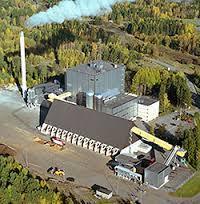
The new power plant unit, Brista 2, produces district heat for local residents and electricity for the Nordic power market from sorted municipal and industrial waste.

Duane Tilden‘s insight:

>”Brista 2 is already the fourth CHP plant we have commissioned this year in the Nordic and Baltic countries. Combined heat and power production is at the core of our strategy, and whenever possible we utilise renewable and local fuels,” says Per Langer, Executive Vice President of Fortum’s Heat Division.

Production capacity of the new Brista plant unit is 60 megawatts (MW) heat and 20 MW electricity. The annual heat production, about 500 gigawatt-hours (GWh), corresponds to the annual heating needs of about 50,000 mid-sized homes. The estimated annual electricity production of Brista 2 is 140 GWh. Fortum co-owns the plant (85%) together with the municipal energy company Sollentuna Energi (15%). <

See on online.wsj.com

Fracking chairman: shale gas not going to cut prices

Rennie Campbell's avatarenergy & water insights

Lord Browne, former head of BP and current chairman of the UK’s largest shale gas company Cuadrilla, said this week that fracking is unlikely to reduce gas prices. In a speech at the London School of Economics he also said that…

  • the recent strike price agreed between the government and EDF for nuclear power was “very, very expensive”
  • oil and gas currently receive more subsidies than renewable energy, which he described as “like running the heating and air conditioning at the same time”

The economic, geological, regulatory and social differences between the UK and US mean it is highly unlikely that the shale gas revolution being experienced in North America can be translated across the Atlantic, with even modest production unlikely before the mid-2020s according to most in the industry.

Despite repeated assurances from David Cameron and George Osborne that shale gas will reduce prices, Browne has recognised…

View original post 210 more words

Obama approves border-crossing pipeline carrying corrosive fracked gas diluent to Alberta Tar-Sands

See on Scoop.itGreen Energy Technologies & Development

But the pipeline has problems with stress corrosion cracking. Is it safe to expand?

Duane Tilden‘s insight:

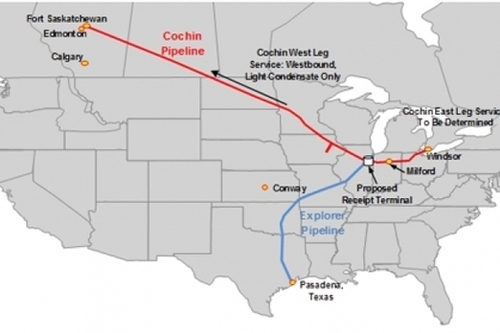
>Kinder Morgan Cochin LLC is now allowed to reverse and expand to build a 1,900-mile proposed pipeline to transport gas produced by hydraulic fracturing of the Eagle Ford Shale basin in Texas north into Alberta. It would carry gas condensate that is used to dilute the bitumen in the tar sands. The extra-thick oil produced in the tar sands needs to be cut with 30 per cent condensate so it can be carried, according to the Financial Post.

The Cochin pipeline has had some safety issues in the past, however. Last year, the National Energy Board sent Kinder Morgan a letter regarding Stress Corrosion Cracking (SCC) failure in the U.S. back in 2003. At the time, the U.S. Pipeline and Hazardous Materials Safety Administration (PHMSA) issued an order imposing a 20 per cent pressure restriction on the pipeline. Kinder Morgan later voluntarily imposed a further restriction on the operating pressure and received approval to increase  the operating pressure of the pipeline in US to 6895 kPa (1000 psi) in March 2012.<

See on www.vancouverobserver.com