New Zero-Down, No-Risk Energy Efficiency Investment Fund Aims To Unlock $150 Billion In Savings

See on Scoop.itGreen Energy Technologies & Development

Double your money, create more than 1 million jobs and make a big dent in US carbon and greenhouse gas emissions – that’s what could be realized if the US were to double energy productivity by 2030, according to the Alliance Commission on National…

Duane Tilden‘s insight:

Looking to spur energy-efficiency gains across the US, CalCEF and Metrus Energy on March 13 launched a new financial intermediary service that could unlock the doors to a projected $150 billion in energy-efficiency savings by providing “otherwise hard-to-get financing for small and medium-sized businesses (SMBs).”

Added CalCEF managing director Paul Frankel:  “The Efficiency Resource Fund is a trail-blazing investment vehicle that taps a massive, underserved market opportunity.  We’re enabling a whole class of projects that would otherwise not be completed, while at the same time delivering not just savings for customers but also attractive returns for impact investors and generating capacity for utilities.”

See on cleantechnica.com
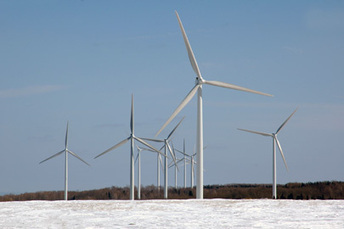
Stanford researchers map out an alternative energy future for New York

See on Scoop.itGreen & Sustainable News

A study, co-authored by Stanford researcher Mark Z. Jacobson, outlines a path to statewide renewable energy conversion, and away from natural gas and imported fuel.

Duane Tilden‘s insight:

The study is the first to develop a plan to fulfill all of a state’s transportation, electric power, industry, and heating and cooling energy needs with renewable energy, and to calculate the number of new devices and jobs created, amount of land and ocean areas required, and policies needed for such an infrastructure change. It also provides new calculations of air pollution mortality and morbidity impacts and costs based on multiple years of air quality data.

To ensure grid reliability, the plan outlines several methods to match renewable energy supply with demand and to smooth out the variability of WWS resources. These include a grid management system to shift times of demand to better match with timing of power supply, and “over-sizing” peak generation capacity to minimize times when available power is less than demand.

The study’s authors are developing similar plans for other states, including California and Washington. They took no funding from any interest group, company or government agency for this study.

See on news.stanford.edu

Why HVAC Performance Gets Worse Over Time

See on Scoop.itGreen Energy Technologies & Development

HVAC systems in mid- to large-sized commercial buildings have increased in complexity steadily over the last 15 years. With the introduction of DDC controls and other building automation functions, even the most straightforward VAV systems are a compilation of components from multiple manufacturers, built by multiple contractors, that must be programmed and sequenced to work together seamlessly as intended.

Duane Tilden‘s insight:

[…] Considering the ultimate objective for HVAC systems — keeping building occupants safe, healthy and comfortable, while using the least amount of energy — it is no wonder HVAC has become so complex.

Beginning in 2013, […] the complexity of HVAC systems will increase yet again. […] new buildings and major renovations will be required to be designed and built with new technologies including demand-controlled ventilation, energy-recovery ventilation, daylight-harvesting controls, and economizer cycles for even small comfort cooling applications. […]

See on www.facilitiesnet.com

[…] Advanced Energy Management Patent Portfolio Developed by Pacific Northwest National Laboratory

See on Scoop.itGreen Energy Technologies & Development

SEATTLE, WA–(Marketwire – Jan 29, 2013) – Calico Energy Services (www.calicoenergy.com) and the Department of Energy’s Pacific Northwest National Laboratory (PNNL, www.pnnl.gov) today announced that Calico has licensed a portfolio of advanced energy management Intellectual Property (IP) developed by PNNL.

Duane Tilden‘s insight:

PNNL’s development of the technology was funded by DOE’s Office of Electricity Delivery and Energy Reliability and the American Recovery and Reinvestment Act. The innovative Patent Portfolio is based on a single, integrated smart grid model that utilizes an economic signal to automatically balance supply and demand at the lowest possible cost.

“PNNL’s Patent Portfolio is a breakthrough that allows an electric power system to virtually balance itself,” said Jesse Berst […]

See on www.marketwire.com

DOE Report Shows Smart Grid Program Funds Mismanaged — Occupational Health & Safety

See on Scoop.itGreen & Sustainable News

The DOE inspector general said in a report that funds from $700 million smart-grid technology program have been mismanaged.

Duane Tilden‘s insight:

There are 32 projects made possible from the 2009 grant, 11 of which were reported on by Friedman.

“Our review of 11 projects, awarded $279 million in Recovery Act funding and $10 million in non-Recovery Act funding, identified weaknesses in reimbursement requests, cost-share contributions, and coordination efforts with another Department program,” Friedman said in the report to Secretary of Energy Steven Chu.

Some additional issues found by Friedman included overpayments and failures in the procedures for vetting recipient cost-share contributions

See on ohsonline.com

Chicago Suburb Oak Park Joins International Solar-Powered Smart Grid Test

See on Scoop.itGreen & Sustainable News

The village of Oak Park, a suburb west of Chicago, was recently selected from a list of competing volunteer neighborhoods to be the test site for smart grid technology.

Duane Tilden‘s insight:

The project is a joint venture between the Korean Smart Grid Institute and the Institute for Sustainable Energy Development, and will involve placing a set of twelve or thirteen 3-kilowatt solar panels, along with a battery system, on the roofs of 100 residential and 100 multifamily buildings. They’ll also all be linked up to an electrical grid boasting smart meters, and once the test run of the system is over the building owners will get to keep the installations, worth $20,000 to $30,000 [each].

The [scenario for Oak Park homeowners] we talk about the most is this idea of collecting the solar energy during the day and storing it in the battery and then having the house run on the battery at night so you’re completely offline at night and the battery provides a phantom load — your clocks, TV.

The [average number of outages] for Oak Park is 45 minutes per year. What the number doesn’t tell you about is the stories I hear when [residents] call up on day three of still not having power. Then I get calls from restaurants. You’re talking about an entire week’s or month’s inventory gone.

See on thinkprogress.org

PowerTools App Helps SDG&E Customers Manage & Save Energy

See on Scoop.itGreen Building Operations – Systems & Controls, Maintenance & Commissioning

San Diego Gas & Electric (SDG&E) and Candi Controls announced that the PowerTools app is available for customers to download on their mobile phone or tablet…

Duane Tilden‘s insight:

“As a number of innovations for the home rely on the collection and use of consumer energy data, a self-regulatory program powered by independent third-party enforcement will ensure that participating companies commit to responsible practices,” said Chris Babel, chief executive officer of TRUSTe�. “With the Privacy Smart Powered by TRUSTe Seal, SDG&E sends a clear signal to its customers that it respects their personal information.”

SDG&E is a regulated public utility that provides safe and reliable energy service to 3.4 million consumers through 1.4 million electric meters and more than 840,000 natural gas meters in San Diego and southern Orange counties. The utility’s area spans 4,100 square miles. SDG&E is committed to creating ways to help our customers save energy and money every day. SDG&E is a subsidiary of Sempra Energy SRE +0.53% , a Fortune 500 energy services holding company based in San Diego.

See on www.marketwatch.com

10 Key Data Center Energy Management Trends for 2013

See on Scoop.itGreen Building Operations – Systems & Controls, Maintenance & Commissioning

The ways data centers consume power will continue to undergo both subtle and substantive transformations in 2013. The first three trends identified here started in 2012, when organizations began struggling with increased power demands in the face of constrained capacity caused by both inefficient equipment and stranded power…

Duane Tilden‘s insight:

[…] For example, because rates for electricity are at their lowest at night when demand is low and baseload generating capacity is under-utilized, shifting the current workload to “follow the moon” can result in considerable savings.

[…] To eliminate the stranded power that exists in virtually every data center, capacity planning efforts will also begin to include power distribution and actual consumption as critical design factors.

[…] To eliminate the considerable overlap between the DCIM and other management systems used by the IT department and the Building Management System (BMS) used by the Facility department, organizations will begin migrating to DCIM as the primary platform for managing data centers, and will integrate other systems with it. …

See on www.energymanagertoday.com

Commercial, institutional and federal buildings | Office of Energy Efficiency

See on Scoop.itGreen Building Operations – Systems & Controls, Maintenance & Commissioning

ENERGY STAR Portfolio Manager, developed by the U.S. Environmental Protection Agency, is being adapted for the Canadian buildings sector.

Duane Tilden‘s insight:

Portfolio Manager is a free, interactive energy management tool that allows you to track and assess energy and water consumption across your entire portfolio of buildings in a secure online environment.

See on oee.nrcan.gc.ca

Guest Post: The Future of Energy Management in Commercial Buildings : Greentech Media

See on Scoop.itGreen Building Operations – Systems & Controls, Maintenance & Commissioning

Industry experts make predictions for 2013.

Duane Tilden‘s insight:

…the developments of 2012 are indicative of longer trends affecting how we will occupy and operate commercial buildings in 2013.

Policy and Disclosure

2012 saw a number of industry “firsts.” Perhaps none is more significant than the adoption of energy disclosure laws, which require residential and commercial buildings to reveal — sometimes publicly — the energy performance of the buildings. To date, six cities have passed such laws, which require the use of EPA’s Energy Star Portfolio Manager for buildings…

Utilities and the Green Button

Another major trend of 2012 has been the adoption by 35 electric and gas utilities of the “Green Button,” a voluntary, standardized data format for energy data. Green Button, a data standard developed by industry along with the National Institute of Standards and Technology (NIST), and ratified by the North American Energy Standards Board (NAESB), is meant to provide customer data in a computer-readable format so that software applications can uniformly tackle energy problems and identify opportunities for savings.

Civic Government

2012 was also a major year for civic and federal governments, as energy efficiency was a focus for large portfolios of public buildings. While some cities have already made strides in improving their own building performance, there has been a faster adoption of new technologies and operations strategies, and more vocal public acknowledgement of their goals to reduce energy and save taxpayer money.

See on www.greentechmedia.com