Integration: Net-zero energy design | Consulting-Specifying Engineer

See on Scoop.itGreen Building Design – Architecture & Engineering

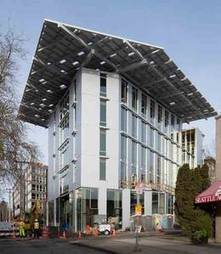
-ASHRAE has a goal: net-zero energy for all new buildings by 2030. What do engineers need to know to achieve this goal on their projects?

Duane Tilden‘s insight:

>As net-zero energy and low-energy design projects become more prevalent, engineers must be prepared to collaborate with all members of a project team including architects, energy specialists, lighting designers, builders, and owners in order to accomplish net-zero energy goals with little to no cost premium. Is this possible today or will it take another 10 or more years to get there?

There are many examples of completed projects demonstrating that not only is this possible, but it has been done in all regions of the country using readily available building products and common construction methods. So what’s the secret? It’s all about the design.<

See on www.csemag.com

Renewable Energy or Efficiency for the Data Center: Which first? #GreenComputing

See on Scoop.itGreen & Sustainable News

New advancements in green technology and design are making the idea of a green data center into a reality.

Duane Tilden‘s insight:

>Without doubt, the facility is a triumph of advanced environmental design and will serve as a template for future construction. Indeed, activity surrounding renewable-based data infrastructure is picking up, with much of it being led by the burgeoning renewable energy industry itself. VIESTE Energy, LCC, for example, has hired design firm Environmental Systems Design (ESD) to plan out a series of data centers across the U.S. that run on 100 percent renewable energy. A key component of the plan is a new biogas-fed generator capable of 8 to 15MW performance. The intent is to prove that renewables are fully capable of delivering reliable, cost-effective service to always-on data infrastructure.

The question of reliability has always weighed heavily on the renewables market, but initiatives like the VIESTE program could help counter those impressions in a very important way, by establishing a grid of distributed, green-energy data supply. In fact, this is the stated goal of the New York State Energy Research and Development Authority (NYSERDA), which has gathered together a number of industry leaders, including AMD, HP and GE, to establish a network of distributed, green data centers that can be used to shift loads, scale infrastructure up and down and in general make it easier for data users to maintain their reliance on renewable energy even if supply at one location is diminished. In other words, distributed architectures improve green reliability through redundancy just as they do for data infrastructure in general.

But not everyone on the environmental side is convinced that renewables are the best means of fostering data center efficiency. In a recent article in the journal Nature Climate Change, Stanford researcher Dr. Jonathan Koomey argues that without populating existing infrastructure with low-power hardware and data-power management technology first, data operators are simply wasting precious renewable resources that could be put to better use elsewhere. For projects like the NWSC and VIESTE, then, renewables may make sense because they power state-of-the-art green technology. But not as an industry-wide solution–renewables won’t make sense until hardware life cycles run their course.<

See on www.itbusinessedge.com

Grasscrete Chosen as One of the Best Sustainable Building Products of GreenBuild

Grasscrete Chosen as One of the Best Sustainable Building Products of GreenBuild.

Wireless Transmission of Energy in Buildings – Building Automation

See on Scoop.itGreen Building Operations – Systems & Controls, Maintenance & Commissioning

Energy harvesting wireless technology becomes more attractive for OEMs as a basis technology for products and solutions that contribute to a building’s efficient energy management. The wireless modules gain their power from the surrounding environment…

Duane Tilden‘s insight:

>Energy harvesting technology enables batteryless automation devices and systems to make buildings more energy-efficient based on sustainable, resource-saving technologies that eliminate the need for batteries. […]

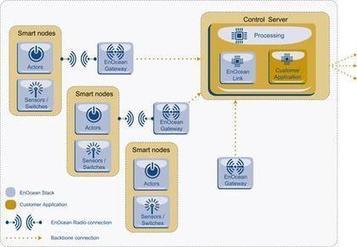
In a complex commercial building scenario, EnOcean Link can be implemented on a central device, like a control server, which controls the whole building, holds the automation intelligence, and can be physically located outside the building (in the cloud). Several gateways in the building record radio telegrams from thousands of distributed batteryless wireless sensors and relay receivers, and send back information or command data when needed. These gateways are connected to the control server by a backbone, which does not have to be based on EnOcean radio, or even be wireless. The middleware, located in the central unit, interprets all telegrams received by the gateways and provides them to the automation system.

High energy efficiency goals demand flexible automation systems for all kind of buildings that cover several areas. This particularly affects retrofit projects, where the intelligent control of energy consumption is the key factor for a building’s improved energy and carbon footprint. Energy harvesting wireless technology fulfills the demands for today’s and tomorrow’s automation and energy management systems. […]<

See on www.manufacturing.net

The Negawatt Revolution — Solving the CO-2 [& Energy] Problem —

See on Scoop.itGreen Energy Technologies & Development

Introduction

“My 1976 article entitled “Energy Strategy: The Road Not Taken?” which appeared in Foreign Affairs, suggested two ways in which the energy system could probably evolve over the next fifty years or so, using the United States as an example. If you divided by something like a factor of nine or ten, you would get Canada.”…

“If the U.S. spent only enough on efficiency to keep up with growth and demand for electric services, plus the net retirement of generating capacity, we would have almost enough capital left in surplus to double our rate of investment in durable manufacturing industries.”

The Importance of Electrical Efficiency

“Why do I concentrate on electricity? First, because it is by far the costliest form of energy. Each cent per kilowatt-hour is equivalent in heat content to oil at $17 dollars a barrel, roughly the world oil price. So the electricity we buy, even in Canada where it is quite cheap, is equivalent to heat at many times the world oil price. Therefore saving electricity is more financially rewarding than saving direct fuels. In addition, electricity has enormous capital leverage because central electric systems — the whole systems — are about 100 times as capital intensive as the traditional direct fuel systems (you know, Texas and Louisiana and Alberta oil and gas — the sorts of things on which our economies were built). In fact a quarter of all the development capital in the world goes to electrification.

“Also electricity has huge environmental leverage. Power plants burn a third of the fuel in the world. They account for a third of the CO2, therefore, released from the burning of fossil fuel. In my own country they release two thirds of the sulphur oxides and a third of the nitrogen oxides. What’s more, every unit of electricity you save at the point of use saves typically three or four units of fuel, namely coal at the power plant. And in socialist or developing countries that ratio is more like five or six to one.

So you get the most environmental benefit from saving electricity, as well as the most financial benefit.”

See on www.ccnr.org