LED Savings Estimator for Common Commercial Lighting Fixtures

Sarah Moniz's avatarGCE TV

energy savings calculator

With the recent increase in electricity rates, it has never been more important for electrical contractors to show your customers some LED options.  Everyone knows that LED lighting fixtures are more energy efficient, last longer, and require less maintenance and replacement.  However, there will still be commercial customers and business owners who are nervous about the upfront costs associated with a full retrofit or new installation.

While some money will be spent upfront purchasing new LED fixtures, the savings associated with the reduced wattage fixtures can rapidly offset the initial costs.  And with rebates available for commercial customers of NGRID, NSTAR, WMECO, Unitil and Cape Light Compact, your customers will see a return on investment in a short period time with energy savings for years to come.

The Energy group at Granite City Electric is available to work with you on any new construction or retrofit project to ensure all…

View original post 234 more words

Focus on financing energy efficiency

“EEFIG’s report states that energy efficiency investment is the most cost effective manner to reduce the EU’s reliance, and expenditure, on energy imports costing over €400 billion a year. Today, this makes energy efficiency investments strategically important due to high levels of energy imports, energy price instability and the need for Europe to transition to a competitive low carbon and resilient economy. EEFIG’s members see energy efficiency investing as having a fundamental and beneficial role to play in the transition towards a more competitive, secure and sustainable energy system with an internal energy market at its core.

EEFIG participants believe that the European Fund for Strategic Investments (EFSI) should put energy efficiency first and that it is essential in the context of the Energy Union to reframe the role that energy efficiency plays in how Europe plans for, finances, and constructs its energy system.”

Wide Bandgap Semiconductors – LED’s and the Future of Power Electronics

Hidden inside nearly every modern electronic is a technology — called power electronics — that is quietly making our wor…

Source: www.youtube.com

See on Scoop.itGreen Energy Technologies & Development


“Hidden inside nearly every modern electronic is a technology — called power electronics — that is quietly making our world run. Yet, as things like our phones, appliances and cars advance, current power electronics will no longer be able to meet our needs, making it essential that we invest in the future of this technology.

Today [January 15, 2014], President Obama will announce that North Carolina State University will lead the Energy Department’s new manufacturing innovation institute for the next generation of power electronics. The institute will work to drive down the costs of and build America’s manufacturing leadership in wide bandgap (WBG) semiconductor-based power electronics — leading to more affordable products for businesses and consumers, billions of dollars in energy savings and high-quality U.S. manufacturing jobs.

Integral to consumer electronics and many clean energy technologies, power electronics can be found in everything from electric vehicles and industrial motors, to laptop power adaptors and inverters that connect solar panels and wind turbines to the electric grid. For nearly 50 years, silicon chips have been the basis of power electronics. However, as clean energy technologies and the electronics industry has advanced, silicon chips are reaching their limits in power conversion — resulting in wasted heat and higher energy consumption.

Power electronics that use WBG semiconductors have the potential to change all this. WBG semiconductors operate at high temperatures, frequencies and voltages — all helping to eliminate up to 90 percent of the power losses in electricity conversion compared to current technology. This in turn means that power electronics can be smaller because they need fewer semiconductor chips, and the technologies that rely on power electronics — like electric vehicle chargers, consumer appliances and LEDs — will perform better, be more efficient and cost less.

One of three new institutes in the President’s National Network of Manufacturing Innovation, the Energy Department’s institute will develop the infrastructure needed to make WBG semiconductor-based power electronics cost competitive with silicon chips in the next five years. Working with more than 25 partners across industry, academia, and state and federal organizations, the institute will provide shared research and development, manufacturing equipment, and product testing to create new semiconductor technology that is up to 10 times more powerful that current chips on the market. Through higher education programs and internships, the institute will ensure that the U.S. has the workforce necessary to be the leader in the next generation of power electronics manufacturing.

Watch our latest video on how wide bandgap semiconductors could impact clean energy technology and our daily lives.”

source:  http://energy.gov/articles/wide-bandgap-semiconductors-essential-our-technology-future


Clothes Dryers Latest Home Appliance to Obtain Energy Star Certification

For the first time in six years, Energy Star certification, a standard seal of approval for energy efficiency, has been expanded to include another major household appliance. Clothes dryers, perhaps the last of …

Source: www.pddnet.com

>” […] Clothes dryers, perhaps the last of the major household appliances to be included in the U.S. Environmental Protection Agency’s program, became available in 45 Energy Star models starting Presidents’ Day weekend, according to the EPA.

“Dryers are one of the most common household appliances and the biggest energy users,” said EPA Administrator Gina McCarthy.

While washing machines have become 70 percent more energy-efficient since 1990, dryers — used by an estimated 80 percent of American households — have continued to use a high amount of energy, the agency says. […]

“Refrigerators were the dominant energy consumer in 1981. Now dryers are the last frontier in the home for radical energy conservation,” said Charles Hall, senior manager of product development for Whirlpool.

Energy Star-certified dryers include gas, electric and compact models. Manufacturers offering them include LG, Whirlpool, Kenmore, Maytag and Safemate.

All of the energy-efficient models include moisture sensors to ensure that the dryer does not continue running after the clothes are dry, which reduces energy consumption by around 20 percent, the EPA says.

In addition, two of the Energy Star-approved models — LG’s EcoHybrid Heat Pump Dryer (model DLHX4072) and Whirlpool’s HybridCare Heat Pump Dryer (model WED99HED) — also include innovative “heat pump” technology, which reduces energy consumption by around 40 percent more than that, the EPA and manufacturers say.

Heat-pump dryers combine conventional vented drying with heat-pump technology, which recycles heat. The technology, long common in much of Europe, is similar to that used in air conditioners and dehumidifiers.

Although Energy Star models can cost roughly $600 more than comparable standard models, Hall said the higher cost is more than balanced out by energy savings and up to $600 rebates offered by government and utility incentive programs.

But the real impact will be felt once the transition to Energy Star models is complete. According to the EPA, if all the clothes dryers sold in the U.S. this year were Energy Star-certified, it would save an estimated $1.5 billion in annual utility costs and prevent yearly greenhouse-gas emissions equal to more than 2 million vehicles.

To earn the Energy Star label, products must be certified by an EPA-recognized third party based on rigorous testing in an EPA-recognized laboratory.”<

See on Scoop.itGreen Energy Technologies & Development

Life-Cycle Cost Analysis (LCCA) | Whole Building Design Guide

Life-cycle cost analysis (LCCA) is a method for assessing the total cost of facility ownership. It takes into account all costs of acquiring, owning, and disposing of a building or building system. LCCA is especially useful when project alternatives that fulfill the same performance requirements, but differ with respect to initial costs and operating costs, have to be compared in order to select the one that maximizes net savings.

Source: www.wbdg.org

DESCRIPTION

A. Life-Cycle Cost Analysis (LCCA) Method

The purpose of an LCCA is to estimate the overall costs of project alternatives and to select the design that ensures the facility will provide the lowest overall cost of ownership consistent with its quality and function. The LCCA should be performed early in the design process while there is still a chance to refine the design to ensure a reduction in life-cycle costs (LCC).

The first and most challenging task of an LCCA, or any economic evaluation method, is to determine the economic effects of alternative designs of buildings and building systems and to quantify these effects and express them in dollar amounts.

lcca_2

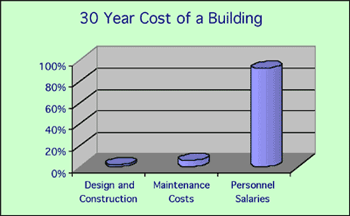
Viewed over a 30 year period, initial building costs account for approximately just 2% of the total, while operations and maintenance costs equal 6%, and personnel costs equal 92%.
Graphic: Sieglinde Fuller
Source: Sustainable Building Technical Manual / Joseph J. Romm,Lean and Clean Management, 1994.

B. Costs

There are numerous costs associated with acquiring, operating, maintaining, and disposing of a building or building system. Building-related costs usually fall into the following categories:lcca_5
Initial Costs—Purchase, Acquisition, Construction Costs

Fuel Costs,

Operation, Maintenance, and Repair Costs

Replacement Costs; Residual Values—Resale or Salvage Values or Disposal Costs, Finance Charges—Loan Interest Payments

Non-Monetary Benefits or Costs

Only those costs within each category that are relevant to the decision and significant in amount are needed to make a valid investment decision. Costs are relevant when they are different for one alternative compared with another; costs are significant when they are large enough to make a credible difference in the LCC of a project alternative. All costs are entered as base-year amounts in today’s dollars; the LCCA method escalates all amounts to their future year of occurrence and discounts them back to the base date to convert them to present values. […]

Energy and Water Costs

Operational expenses for energy, water, and other utilities are based on consumption, current rates, and price projections. Because energy, and to some extent water consumption, and building configuration and building envelope are interdependent, energy and water costs are usually assessed for the building as a whole rather than for individual building systems or components.

Energy usage: Energy costs are often difficult to predict accurately in the design phase of a project. Assumptions must be made about use profiles, occupancy rates, and schedules, all of which impact energy consumption. At the initial design stage, data on the amount of energy consumption for a building can come from engineering analysis or from a computer program such as eQuest.ENERGY PLUS (DOE), DOE-2.1E and BLAST require more detailed input not usually available until later in the design process. Other software packages, such as the proprietary programs TRACE (Trane), ESPRE (EPRI), and HAP (Carrier) have been developed to assist in mechanical equipment selection and sizing and are often distributed by manufacturers.

When selecting a program, it is important to consider whether you need annual, monthly, or hourly energy consumption figures and whether the program adequately tracks savings in energy consumption when design changes or different efficiency levels are simulated.  […]

Operation, Maintenance, and Repair Costs

(Courtesy of Washington State Department of General Administration)

Non-fuel operating costs, and maintenance and repair (OM&R) costs are often more difficult to estimate than other building expenditures. Operating schedules and standards of maintenance vary from building to building; there is great variation in these costs even for buildings of the same type and age. It is therefore especially important to use engineering judgment when estimating these costs.

Supplier quotes and published estimating guides sometimes provide information on maintenance and repair costs. Some of the data estimation guides derive cost data from statistical relationships of historical data (Means, BOMA) and report, for example, average owning and operating costs per square foot, by age of building, geographic location, number of stories, and number of square feet in the building. The Whitestone Research Facility Maintenance and Repair Cost Reference gives annualized costs for building systems and elements as well as service life estimates for specific building components. The U.S. Army Corps of Engineers, Huntsville Division, provides access to a customized OM&R database for military construction (contact: Terry.L.Patton@HND01.usace.army.mil).

Replacement Costs

The number and timing of capital replacements of building systems depend on the estimated life of the system and the length of the study period. Use the same sources that provide cost estimates for initial investments to obtain estimates of replacement costs and expected useful lives. A good starting point for estimating future replacement costs is to use their cost as of the base date. The LCCA method will escalate base-year amounts to their future time of occurrence.

Residual Values

The residual value of a system (or component) is its remaining value at the end of the study period, or at the time it is replaced during the study period. Residual values can be based on value in place, resale value, salvage value, or scrap value, net of any selling, conversion, or disposal costs. As a rule of thumb, the residual value of a system with remaining useful life in place can be calculated by linearly prorating its initial costs. For example, for a system with an expected useful life of 15 years, which was installed 5 years before the end of the study period, the residual value would be approximately 2/3 (=(15-10)/15) of its initial cost.

Other Costs

Finance charges and taxes: For federal projects, finance charges are usually not relevant. Finance charges and other payments apply, however, if a project is financed through an Energy Savings Performance Contract (ESPC) or Utility Energy Services Contract (UESC). The finance charges are usually included in the contract payments negotiated with the Energy Service Company (ESCO) or the utility.

Non-monetary benefits or costs: Non-monetary benefits or costs are project-related effects for which there is no objective way of assigning a dollar value. Examples of non-monetary effects may be the benefit derived from a particularly quiet HVAC system or from an expected, but hard-to-quantify productivity gain due to improved lighting. By their nature, these effects are external to the LCCA, but if they are significant they should be considered in the final investment decision and included in the project documentation. See Cost-Effective—Consider Non-Monetary Benefits.

To formalize the inclusion of non-monetary costs or benefits in your decision making, you can use the analytical hierarchy process (AHP), which is one of a set of multi-attribute decision analysis (MADA) methods that consider non-monetary attributes (qualitative and quantitative) in addition to common economic evaluation measures when evaluating project alternatives. ASTM E 1765 Standard Practice for Applying Analytical Hierarchy Process (AHP) to Multi-attribute Decision Analysis of Investments Related to Buildings and Building Systems published by ASTM International presents a procedure for calculating and interpreting AHP scores of a project’s total overall desirability when making building-related capital investment decisions. A source of information for estimating productivity costs, for example, is the WBDG Productive Branch.  [….]

D. Life-Cycle Cost Calculation

After identifying all costs by year and amount and discounting them to present value, they are added to arrive at total life-cycle costs for each alternative:

LCC =  I + Repl — Res + E + W + OM&R + O

LCC = Total LCC in present-value (PV) dollars of a given alternative
I = PV investment costs (if incurred at base date, they need not be discounted)
Repl = PV capital replacement costs
Res = PV residual value (resale value, salvage value) less disposal costs
E = PV of energy costs
W = PV of water costs
OM&R = PV of non-fuel operating, maintenance and repair costs
O = PV of other costs (e.g., contract costs for ESPCs or UESCs)

E. Supplementary Measures

Supplementary measures of economic evaluation are Net Savings (NS), Savings-to-Investment Ratio (SIR), Adjusted Internal Rate of Return (AIRR), and Simple Payback (SPB) or Discounted Payback (DPB). They are sometimes needed to meet specific regulatory requirements. For example, the FEMP LCC rules (10 CFR 436A) require the use of either the SIR or AIRR for ranking independent projects competing for limited funding. Some federal programs require a Payback Period to be computed as a screening measure in project evaluation. NS, SIR, and AIRR are consistent with the lowest LCC of an alternative if computed and applied correctly, with the same time-adjusted input values and assumptions. Payback measures, either SPB or DPB, are only consistent with LCCA if they are calculated over the entire study period, not only for the years of the payback period.

All supplementary measures are relative measures, i.e., they are computed for an alternative relative to a base case.  […]”<

See on Scoop.itGreen Building Design – Architecture & Engineering

Hospital Retrofits Heating and Domestic-Hot-Water Systems For Substantial Energy Savings

At Holton Community Hospital in rural Holton, Kan., two cast-iron atmospheric boilers and three gas-fired water heaters that had been in place for nearly 20 years were operating inefficiently.

Source: hpac.com

>” […] Based on the boiler-plate outputs and firing rates of the existing boilers and domestic water heaters at design conditions and outputs, three Knight XL heating boilers with inputs of 500,000 Btuh, two 119-gal. Squire indirect water heaters, and a 119-gal. buffer tank were selected. […]

On one of the Knight XL heating boilers, a Grundfos MAGNA3 variable-speed circulator pump was installed. The boiler controls the speed of the pump using the built-in Smart System. When the boiler modulates down, the pump slows to maintain a constant temperature rise across the heat exchanger at all times. Reducing pump revolutions reduces power consumption tremendously.

Monitoring equipment was placed on both the lead boiler and the member boiler not dedicated to domestic water. The lead boiler had the MAGNA3 40-80 F variable-speed circulator pump, while the member boiler used the UPS 43-100 F constant-speed circulator pump.

For analysis, the team compared two similar days, March 20 and 21, at a time when only the two monitored boilers would be running. At that time, domestic water use would be unlikely, reducing the chance the third boiler would fire and affect the measured values.Figure 1 shows the power consumed by the constant-speed circulator and the variable-speed circulator when each was the lead.

Lochinvar Chart2_AMD

FIGURE 1. Pump power consumption.


Pump-speed modulation resulted in significant energy savings. The MAGNA3 reached a maximum power usage of 270 W, but slowed to a minimum of just over 50 W, while the UPS ran at a continuous 365 W. Over the course of the hour, the MAGNA3 averaged 156 W.

With Smart System, the boiler adjusts the flow through its heat exchanger to control delta-T as well as system median temperature. Delta-T across the boiler is constant, resulting in enhanced building comfort, increased heat transfer, and electricity savings.

In January 2014, Holton Community Hospital spent a total of $1,207.31 on gas and electricity. In comparison, the hospital’s gas and electricity bills for January 2013 were $2,805.41—more than twice as much. […]”<

See on Scoop.itGreen Building Operations – Systems & Controls, Maintenance & Commissioning

Impact of energy efficiency standards in the US

Minimum Efficiency Standards for Electric Motors to Increase – DOE

DOE’s analyses estimate lifetime savings for electric motors purchased over the 30-year period that begins in the year of compliance with new and amended standards (2016-45) to be 7.0 quadrillion British thermal units (Btu). The annualized energy savings—0.23 quadrillion Btu—is equivalent to 1% of total U.S. industrial primary electricity consumption in 2013.

Source: www.eia.gov

>” Nearly half of the electricity consumed in the manufacturing sector is used for powering motors, such as for fans, pumps, conveyors, and compressors. About two thirds of this machine-drive consumption occurs in the bulk chemicals, food, petroleum and coal products, primary metals, and paper industries. For more than three decades the efficiency of new motors has been regulated by federal law. Beginning in mid-2016, an updated standard established this year by the U.S. Department of Energy (DOE) for electric motors will once again increase the minimum efficiency of new motors.

The updated electric motor standards apply the standards currently in place to a wider scope of electric motors, generating significant estimated energy savings. […]

Legislation has increased the federal minimum motor efficiencies requirements over the past two decades, covering motors both manufactured and imported for sale in the United States. The Energy Policy Act of 1992 (EPAct) set minimum efficiency levels for all motors up to 200 horsepower (hp) purchased after October 1997. The U.S. Energy Independence and Security Act (EISA) of 2007 updated the EPAct standards starting December 2010, including 201-500 hp motors. EISA assigns minimum, nominal, full-load efficiency ratings according to motor subtype and size. The Energy Policy and Conservation Act of 1975 also requires DOE to establish the most stringent standards that are both technologically feasible and economically justifiable, and to periodically update these standards as technology and economics evolve.

Motors typically fail every 5 to 15 years, depending on the size of the motor. When they fail they can either be replaced or repaired (rewound). When motors are rewound, their efficiencies typically diminish by a small amount. Large motors tend to be more efficient than small motors, and they tend to be used for more hours during the year. MotorMaster+ and MotorMaster+ International, distributed by the U.S. Department of Energy and developed by the Washington State University Cooperative Extension Energy Program in conjunction with the Bonneville Power Administration, are sources for cost and performance data on replacing and rewinding motors.

Improving the efficiency of motor systems, rather than just improving the efficiency of individual motors, may hold greater potential for savings in machine-drive electricity consumption. Analysis from the U.S. Department of Energy shows that more than 70% of the total potential motor system energy savings is estimated to be available through system improvements by reducing system load requirements, reducing or controlling motor speed, matching component sizes to the load, upgrading component efficiency, implementing better maintenance practices, and downsizing the motor when possible.”<


See on Scoop.itGreen Energy Technologies & Development

Energy Efficiency in Buildings – How VFD’s Save Energy

Have you wondered why Pumps and Fans are such a great opportunity to save energy using variable speed drives? ABB can help you estimate your energy savings a…

Source: www.youtube.com

>”  Efficiencies of Motors and Drives

The full load efficiency of AC electric motors range from around 80% for the smallest motors to over 95% for motors over 100 HP. The efficiency of an electric motor drops significantly as the load is reduced below 40%. Good practice dictates that motors should be sized so that full load operation corresponds to 75% of the rated power of the motor. […]

The efficiency of an electric motor and drive system is the ratio of mechanical output power to electrical input power and is most often expressed as a percentage.

Motor System Efficiency =Output MechanicalInput Electrical x 100%

A VFD is very efficient. Typical efficiencies of 97% or more are available at full load. At reduced loads the efficiency drops. Typically, VFDs over 10 HP have over 90% efficiency for loads greater than 25% of full load. This is the operating range of interest for practical applications. […]

The system efficiency is lower than the product of motor efficiency and VFD efficiency because the motor efficiency varies with load and because of the effects of harmonics on the motor.

Unfortunately, it is nearly impossible to know what the motor/ drive system efficiency will be, but because the power input to a variable torque system drops so remarkably with speed, an estimate of the system efficiencies is really all that is needed.

When calculating the energy consumption of a motor drive system, estimated system efficiency in the range of 80-90 % can be used with motors ranging from 10 HP and larger and loads of 25% and greater.

In general, lower efficiency ranges correspond to small motor sizes and loads and higher efficiency ranges corresponds to larger motors and loads.

b. Comparison with Conventional Control Methods

Estimating Energy Savings

Fans and pumps are designed to be capable of meeting the maximum demand of the system in which they are installed.

However, quite often the actual demand could vary and be much less than the designed capacity. These conditions are accommodated by adding outlet dampers to fans or throttling valves to pumps.

These are effective and simple controls, but severely affect the efficiency of the system.

Using a VFD to control the fan or pump is a more efficient means of flow control than simple valves or inlet or outlet dampers. The power input to fans and pumps varies with the cube of the speed, so even seemingly small changes in speed can greatly impact the power required by the load. […]

In addition to major energy savings potential, a drive also offers built-in power factor correction, better process control and motor protection. […]”<*

* Extracted from:  http://www.nrcan.gc.ca/energy/products/reference/15385

See on Scoop.itGreen Building Design – Architecture & Engineering

Reduce Costs and Energy Use Through Elevator Efficiency Upgrades

Buying or installing elevator equipment that promotes low-energy consumption can help save money and reduce a building’s environmental footprint.

Source: highrisefacilities.com

>”As part of a building’s overall energy usage, elevators consume up to 10 percent of the total energy in a building. From an environmental standpoint, the most significant impact elevators have is the electricity use while the elevator is in service. Therefore, buying or installing elevator equipment that promotes low-energy consumption can help save money and reduce a building’s environmental footprint.

Buildings and Energy

One way to measure overall energy usage is by calculating the power factor (PF) of the building and/or its energy-consuming devices. These are generally motors, transformers, high intensity discharge (HID) lighting, fluorescent devices or other pieces of equipment that require magnetism to operate. […]

Power factor is a measurement of electrical system efficiency in the distribution and consumption of electrical energy. It is the percentage of the amount of electric power being provided that is converted into real work and expressed as a number between zero and one. For example, if a device had a .70 PF, then 70 percent of the power that the utilities generate to run the device is actually being converted into real work. The lower the PF number, the poorer the PF efficiency. The higher the PF number, the greater the PF efficiency.

In some areas, utilities use PF in the computation of the demand charge. A low PF for a customer’s facility could result in a demand charge penalty that increases the monthly demand cost. This is where newer, more innovative elevator control systems can contribute to lower energy consumption and improve a buildings’ overall PF.

Because of electrical losses caused during generation, distribution and consumption of electricity, the amount of power needed to be provided by a utility company will be greater than the amount for which they get paid by consumers.

Comparative Analysis

During a recent modernization of two identical traction elevators, before and after energy data was collected. The original, first generation silicon controlled rectifier (SCR), direct current (DC) motor control was measured using a series of fixed run patterns and known loads. After modernization, the new insulated-gate bipolar transistor (IGBT)-based alternating current (AC) motor control for a permanent magnet synchronous motor system was measured using the same run patterns and known loads.

The SCR-DC system used far more energy (watts/hour) to move the exact same load through the exact same distance compared to the IGBT-based permanent magnet AC control (Chart 1). In fact, in these six load tests, the IGBT-based system used less than half the energy. An incredible 383 percent increase in power factor of the IGBT-based system compared to the SCR-DC system (Chart 2). That means more of the energy consumed was being converted into real work with less waste in terms of heat and magnetism.

These kinds of energy usage reductions and PF increases are becoming even greater as newer elevator technology gets incorporated into buildings (Chart 3).

It’s easy to see how reducing energy consumption and increasing power rating can benefit the building’s owners and operators. However, these same improvements benefit the community as well. The electricity not being used in one building can be used by other customers — allowing utilities to meet the community’s electricity demand without increasing electricity generation. That translates into no rolling blackouts or brownouts, no new power plants being built and an overall smaller environmental footprint.

Hydraulic Elevators

Up to this point, traction elevator technology was discussed where wire ropes pull the elevator from above the car. In contrast, the hydraulic elevator pushes the elevator cab through the hoistway. The way a hydraulic system works is a piston and cylinder are sunk in the ground below the elevator. To go up, a pump forces oil from an oil tank reservoir into the cylinder — causing the piston to rise, making the elevator cab go up. To go down, gravity and the weight of the cab pushes the piston down into the cylinder and forces the hydraulic oil back into the tank reservoir. Historically, hydraulic elevators (or hydros) have been installed where either the building had fewer floors (typically six to eight) or lower material and installation costs were a consideration (when compared to a traction elevator). […]

Considerations Beyond the Hoistway

Energy reduction of a building’s elevators can also impact heating, ventilation and air conditioning (HVAC) systems. Quite often, elevator machine rooms are air conditioned to support removal of the heat generated by elevator control systems. Motor-generator-based elevator controls create a tremendous amount of heat; the effect is multiplied when several systems are contained in the same machine room.

Additionally, a check should be made of the shut-down timer typically employed with motor-generators (M-G) sets. Is it working? Does the M-G set turn off after a set period of time? Or has the timer failed and no longer shuts down the motor-generator, wasting energy as the M-G set turns but no work is being done by the elevator?

The elevator cab’s lighting can impact both the energy consumption and HVAC systems. A recent survey conducted of a 34-story high rise office building with 18 elevators showed the cab lights were on 24-hours a day. There are 28 incandescent light bulbs per elevator. That worked out to 100-amps of power being consumed continuously. By replacing the incandescent bulbs with compact fluorescents, energy consumption could be cut to 30 percent. And if a 24-hour clock timer is added to shut the lights off at midnight, even more energy could be saved.

Reducing Energy Consumption

Finally, if you’re considering an elevator modernization, call your electric provider or visit their Website to explore the possibility of energy rebates from the local utility provider. It is quite common for utilities to offer dollar incentives for specific building improvements that reduce energy consumption and improve PF.

There are various benefits to building owners and facility managers who lower their power consumption and understand how power factor helps reduce the overall cost of energy, particularly the energy used to run the elevators in their buildings. These benefits go beyond the elevators themselves to include benefits derived from HVAC systems, cab lighting and energy consumed when the elevators are not moving that affect the monthly utility bill.”


See on Scoop.itGreen Energy Technologies & Development