Unknown's avatar

About duanetilden

Engineer, Entrepreneur, Blogger, Farmer, Traveler and Nature Lover. I love music, quotes and blog about Green Building & Energy.

Japan Set to Restart First Nuclear Reactor Since Industry Shut-Down After Fukushima Disaster

Japan is due to switch on a nuclear reactor for the first time in nearly two years on Tuesday, as Prime Minister Shinzo Abe seeks to reassure a nervous public that tougher standards mean the sector is

Sourced through Scoop.it from: www.reuters.com

>” […] Abe and much of Japanese industry want reactors to be restarted to cut fuel imports, but opinion polls show a majority of the public oppose the move after the nuclear crisis triggered by the earthquake and tsunami in March 2011.

In the worst nuclear disaster since Chernobyl 25 years earlier, the meltdowns at the Fukushima Daiichi plant caused a release of radioactive material and forced 160,000 from their homes, with many never to return.

The crisis transfixed the world as the government and the Fukushima operator, Tokyo Electric Power (Tepco), fumbled their response and took two months to confirm that the reactors had undergone meltdowns.

Kyushu Electric Power said it aimed to restart its No. 1 reactor at its Sendai plant at 0130 GMT on Tuesday (2130 ET on Monday).

The plant on the west coast of Kyushu island is the furthest away of Japan’s reactors from Tokyo, where protesters regularly gather outside Abe’s official residence to oppose atomic energy.

At nearly 1,000 km (600 miles) from the capital, Sendai is closer to Shanghai or Seoul.

A successful restart would mark the culmination of a process whereby reactors had to be relicensed, refitted and vetted under tougher standards that were introduced following the disaster.

While two reactors were allowed to restart for one fuelling cycle in 2012, the whole sector has been shut down since September 2013, forcing Japan to import record amounts of expensive liquefied natural gas.

As well as cutting energy costs, showing it can reboot the industry safely is crucial for Abe’s plans to export nuclear technology, said Malcolm Grimston, a senior research fellow at Imperial College in London.

“Japan also has to rehabilitate itself with the rest of the world’s nuclear industry,” said Grimston.

At the Sendai plant, Kyushu Electric expects to have power supply flowing within a few days if all goes to plan. It aims to start the station’s No. 2 unit in October.

The head of Japan’s atomic watchdog said that the new safety regime meant a repeat of the Fukushima disaster would not happen, but protesters outside the Sendai plant are not convinced.

“You will need to change where you evacuate to depending on the direction of the wind. The current evacuation plan is nonsense,” said Shouhei Nomura, a 79-year-old former worker at a nuclear plant equipment maker, who now opposes atomic energy and is living in a protest camp near the plant.

Of Japan’s 25 reactors at 15 plants for which operators have applied for permission to restart, only five at three plants have been cleared for restart. […]”<

See on Scoop.itGreen & Sustainable News

Virtual Power Plants Aggregate Renewable Energy Battery Storage Systems

Aggregating connected energy storage systems to create ‘virtual power plants’ is likely to become a big part of the next phase of storage, according to the executive director of the US-based Energy Storage Association.

Sourced through Scoop.it from: storage.pv-tech.org

>” […] Part of the beauty is that this kind of storage-based ‘multi-tasking’ could be secondary to the main aims of the storage being installed, such as integrating solar.

“You don’t have to do it every day, but on an infrequent basis you can jump into the marketplace to help make money and subsidise all your projects. And, you can do big things for the grid. You will look like a power plant as far as the grid can tell. You can replace the need for a new peaking plant or something like that. [There are] a lot of great things you can do with distributed storage; the sum of [its] parts is greater than the individual pieces.”

Companies are already trialling the concept in various configurations around the world, analyst Omar Saadeh, senior grid analyst at GTM Research, told PV Tech Storage recently. Saadeh said VPPs are one way utilities could use storage to meet “a higher demand for rapidly deployable grid flexibility”.

One example Saadeh cited was a project called PowerShift Atalantic in Canada, which was “designed to manage and mitigate intermittent power from large-scale wind generation, currently totalling 822MW”.

“Through the multiple flexible curtailment service providers, aggregated loads have the ability to balance wind intermittency by responding to virtual power plant dispatch signals in near-real time, providing the equivalent of a 10-minute spinning reserve ancillary service typically executed by pollution-heavy peaker plants,” Saadeh said.

“Since March 2014, the project included 1,270 customer-connected devices with 18 MW of load flexibility, approximately 90% residential.”

Saadeh said Europe has been especially active on the concept, calling France one of the “leading supporters” of such developments.

“They’ve looked at many promising applications including partial islanding, or microgrids, DER-oriented marketplace development, and renewable balancing services.”

German utility Lichtblick, which claims to generate its power 100% from renewables, is another entity which has already got started on VPPs, which it calls a “swarm” of devices. Its battery system providers in VPP programmes include Tesla Energy and Germany’s Sonnenbatterie. Meanwhile another big Tesla partner, SolarCity, also intends to aggregate storage using the EV maker turned energy industry disruptor’s Powerwall for homes. […]”<

See on Scoop.itGreen Energy Technologies & Development

Transparent Solar Cells Could Turn Office Tower Windows and Mobile Devices Into Power Sources

“It’s a whole new way of thinking about solar energy,” says startup CEO about using transparent solar cells on buildings and electronics.

Sourced through Scoop.it from: news.nationalgeographic.com

>” […] With the help of organic chemistry, transparent solar pioneers have set out to tackle one of solar energy’s greatest frustrations. Although the sun has by far the largest potential of any energy resource available to civilization, our ability to harness that power is limited. Photovoltaic panels mounted on rooftops are at best 20 percent efficient at turning sunlight to electricity.

Research has boosted solar panel efficiency over time. But some scientists argue that to truly take advantage of the sun’s power, we also need to expand the amount of real estate that can be outfitted with solar, by making cells that are nearly or entirely see-through.

“It’s a whole new way of thinking about solar energy, because now you have a lot of potential surface area,” says Miles Barr, chief executive and co-founder of Silicon Valley startup Ubiquitous Energy, a company spun off by researchers at Massachusetts Institute of Technology and  Michigan State University. “You can let your imagination run wild. We see this eventually going virtually everywhere.”

Invisible Spectrum Power

Transparent solar is based on a fact about light that is taught in elementary school: The sun transmits energy in the form of invisible ultraviolet and infrared light, as well as visible light. A solar cell that is engineered only to capture light from the invisible ends of the spectrum will allow all other light to pass through; in other words, it will appear transparent.

Organic chemistry is the secret to creating such material. Using just the simple building blocks of carbon, hydrogen, oxygen, and a few other elements found in all life on Earth, scientists since at least the early 1990s have been working on designing arrays of molecules that are able to transport electrons—in other words, to transmit electric current.  […]

Harvesting only the sun’s invisible rays, however, means sacrificing efficiency. That’s why Kopidakis says his team mainly focuses on creating opaque organic solar cells that also capture visible light, though they have worked on transparent solar with a small private company in Maryland called Solar Window Technologies that hopes to market the idea for buildings.

Ubiquitous Energy’s team believes it has hit on an optimal formulation that builds on U.S. government-supported research published by the MIT scientists in 2011.

“There is generally a direct tradeoff  between transparency and efficiency levels,” says Barr. “With the approach we’re taking, you can still get a significant amount of energy at high transparency levels.”

Barr says that Ubiquitous is on track to achieve efficiency of more than 10 percent—less than silicon, but able to be installed more widely. “There are millions and millions of square meters of glass surfaces around us,” says Barr. […]”<

See on Scoop.itGreen Building Design – Architecture & Engineering

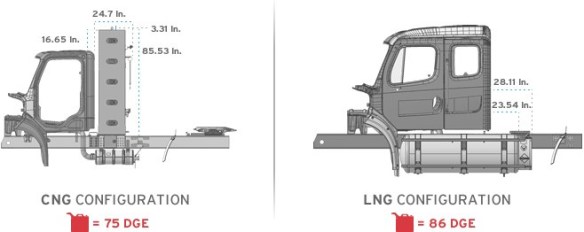
Natural Gas Sector Gets Congressional Action on LNG Tax Rate Drop

Liquefied natural gas (LNG) as a transportation fuel option is back on the competitive race track, thanks to a part of the temporary (three-month) highway funding bill passed by the U.S. Senate Thursday, according to natural gas vehicle (NGV) advocates. The House-passed version had a similar provision.

Image Source:  www.freightlinertrucks.com

Sourced through Scoop.it from: www.naturalgasintel.com

>” […] At a Congressional hearing last December, the global energy and procurement director for Atlanta-based UPS called for “removing barriers” to NGVs, adding that if Congress really wanted to accelerate the adoption of LNG use in heavy-duty trucks and more use of U.S.-produced natural gas supplies, it needed to eliminate “disproportionate taxing of LNG compared with diesel fuel.”

Noting that President Obama was expected to sign the latest measure, Newport Beach, CA-based Clean Energy Fuels Corp. said the new leveling provision will effectively lower the tax on LNG by 14.1 cents/gal. Twenty-six state legislatures have already taken similar action, a Clean Energy spokesperson told NGI.

Clean Energy CEO Andrew Littlefair said the use of LNG in heavy-duty trucks, locomotives and large marine vessels has been growing steadily in North America, and “anyone who cares about a cleaner environment and energy independence should be very grateful for what the U.S. Congress has done, making LNG much more competitive.”

Executives with America’s Natural Gas Alliance (ANGA), and the NGVAmerica and American Gas Association (AGA) trade associations echoed Littlefair’s sentiments.

“We applaud Congress for including language to equalize the federal highway excise tax on LNG,” said ANGA CEO Marty Durbin. “This provision has garnered strong bipartisan support over the years, and we are thrilled to see it become law.”

Calling the action a “common-sense change” that will mean greater fuel cost savings, NGVAmerica President Matt Godlewski said the passage of the LNG provision is great news for trucking fleets that are looking for clean-burning fuels. His calculation places the excise tax on LNG at 24.3 cents/DGE, compared to its current 41.3 cents/DGE level, Godlewski said.

“Currently, fleets operating LNG-powered trucks are effectively taxed for their fuel at a rate 70% higher than that of diesel fuel,” he said.

An AGA spokesperson clarified the number to point out that the current federal excise tax on both diesel and LNG is 24.3 cents/gallon, but because LNG does not have the same energy content/gallon of fuel, it takes 1.7 gallons of LNG to equal a gallon of diesel. “Since the excise tax is based on volume (gallons) — not energy content — LNG is taxed at 170% of the rate of diesel on an energy equivalent basis,” he said.

“This provision provides the level playing field that natural gas has needed to reach its full potential as a transportation fuel,” said Kathryn Clay, AGA vice president for policy strategy.

Each of the trade groups has been lobbying Congress for some time to take this corrective action on LNG. Under the new provision, the energy equivalent of a diesel gallon of LNG is defined as having a Btu content of 128,700, which AGA said is equal to 6.06 pounds of LNG.

Separately, the new measure defines the energy equivalent of a gallon of compressed natural gas (CNG) as having a Btu content of 115,400, or 5.66 pounds of CNG. […]”<

See on Scoop.itGreen & Sustainable News

Energy Efficiency is Key to Educational Institutions’ Core Mission

CHICAGO, Aug. 4, 2015 /PRNewswire/ — According to a new study … energy efficiency is recognized among U.S. higher education institutions as key to fulfilling their schools’ core mission, with almost 9 out of 10 respondents expecting to increase or maintain energy efficiency investments next year.

Photo:  Lillis Complex, University of Oregon

Sourced through Scoop.it from: www.prnewswire.com

>” […] Eighty-eight percent of respondents also agree that energy efficiency is the most cost effective way to meet their energy needs while at the same time reducing greenhouse gas emissions and cutting costs.

The biggest factor driving schools’ energy efficiency efforts is cost savings, according to the survey conducted with higher education facility leaders, with environmental benefits and industry standards rounding out the top three reasons for becoming more energy efficient. However, obstacles exist to achieving these objectives. While 92 percent of respondents stated that their school had a culture that encourages energy efficiency practices, organizational barriers are challenging their ability to achieve efficiency goals. Fifty-nine percent view this as the biggest obstacle, with insufficient funding and lack of a clear definition of success also ranking highly.

Another factor impacting institutions is aging infrastructure, with 59 percent indicating that the average age of their buildings exceeds 15 years, and only one in five reporting that the average age of their building is below 10 years. As facility leaders look to upgrade existing buildings, compatibility with new technology ranks as most important when considering making an investment. Compatibility with legacy systems outranked quality of the product and technology advancements of the solution.

“A majority of the higher education buildings that stand today are expected to be in operation for the next few decades,” said Tara Canfield, Segment Director, Education and Commercial Office Buildings at Schneider Electric. “Tremendous opportunities exist to improve energy efficiency and reduce waste in these existing buildings. In particular, by integrating building systems, facility managers can view energy use from a single interface, identify long-term opportunities for savings and continuously optimize their facility to yield the highest levels of efficiency over time. This integration also enables organizations to better use data from the Internet of Things, turning building insights into meaningful action that will improve operations.” […]

This survey was conducted by Redshift Research in June 2015 among 150 U.S. facilities leaders in higher educational establishments. Respondents have responsibility related to purchasing energy solutions, and their biggest responsibilities included facility management and operations management. Results of any sample are subject to sampling variation. […]”<

See on Scoop.itGreen & Sustainable News

Armored Trucks get Natural Gas & Electric Plug-in Hybrid Conversion to Reduce Emissions by 99.9% & Big Fuel Economy

Efficient Drivetrains and American Repower are partnering to convert a fleet of six armored vans to run on compressed natural gas with a plug-in hybrid.

Sourced through Scoop.it from: www.autoblog.com

>”When hauling around massive amounts of money and valuables around Southern California, security is generally a much bigger concern than fuel economy. However, the need for vehicles to become more efficient is hitting every segment, even armored vans. That’s why Efficient Drivetrains Inc. and North American Repower are teaming up to convert six of these 26,000-pound behemoths run on natural gaswith a plug-in hybrid offering additional help. The first one should be hauling riches for Sectran Security around Los Angeles in 2016.

All three companies are already positioning the upcoming conversion as a win-win solution to current issues. The armored vehicles can still do their job of hauling money around the LA area but with a claimed 99.9 percent reduction in emissions from the current diesel engines. Generally, the vans make frequent stops while at work but must stay running for security reasons. This can potentially run afoul of California’s rule not to let diesels idle more than five minutes. With this upcoming version, drivers will be able to go electrically between stops and then will use the natural gas when cruising.

This work combines the strengths of both firms working on these vehicles. North American Repower already specializes in natural gas engine management and conversions, and Efficient Drivetrains is very familiar with the world of plug-ins. The funding for the project includes a $3-million grant from the California Energy Commission, plus the same amount in private funds.”<

[…]

>”Press Release:

North American Repower and Efficient Drivetrains, Inc. to Deliver First PHEV-RNG Armored Truck
Collaboration reduces emissions by 99.9 percent

OCEANSIDE, Calif. & MILPITAS, Calif.–(BUSINESS WIRE)–Two global leaders in developing and manufacturing advanced transportation vehicles have teamed up to manufacture a first-of-its-kind fleet of Class-5 armored vehicles that combine the benefits of Renewable Natural Gas (RNG) and zero emission Plug-In Hybrid Electric Vehicle (PHEV) technology.

“We’re excited to be partnering with EDI on this breakthrough innovation”

North American Repower—California’s leading natural gas engine management and conversion technology company— and Efficient Drivetrains, Inc.—a global leader in developing high-efficiency Plug-in Hybrid Electric Vehicle solution—will convert a fleet of six 26,000 pound, Class-5 medium-duty armored vehicles operated by Sectran Security into PHEV vehicles that run on electricity and renewable natural gas—known as “Zero Emission with Range Extension” vehicles. The collaboration supports the dramatic acceleration in California toward a zero emissions environment. Today, the Sectran Security trucks make frequent stops as part of their highly congested urban routes. At each stop, the engines are kept idling for security purposes, but now risk violating California’s strict diesel idling regulations, which prohibit idling the engine for more than five minutes. With the modernized trucks, Sectran can completely eliminate engine idling by operating in all-electric mode during stop-and-go operations on urban routes and in hybrid-mode during highway operations. When complete, the vehicles possess impressive performance statistics—the demonstration trucks will enable Sectran to reduce annual diesel consumption by 31,000+ gallons, significantly reduce annual fuel costs, and reduce emissions by 99.9 percent. […]”<

See on Scoop.itGreen Energy Technologies & Development

Oil Well Waste Water Used to Generate Geothermal Power

The team took off-the-shelf geothermal generators and hooked them to pipes carrying boiling waste water. They’re set to flip the switch any day. When they do, large pumps will drive the steaming water through the generators housed in 40-foot (12-meter) containers, producing electricity that could either be used on site or hooked up to power lines and sold to the electricity grid.

Sourced through Scoop.it from: www.bloomberg.com

>”Oil fracking companies seeking to improve their image and pull in a little extra cash are turning their waste water into clean geothermal power.

For every barrel of oil produced from a well, there’s another seven of water, much of it boiling hot. Instead of letting it go to waste, some companies are planning to harness that heat to make electricity they can sell to the grid.

Companies such as Continental Resources Inc. and Hungary’s MOL Group are getting ready to test systems that pump scalding-hot water through equipment that uses the heat to turn electricity-generating turbines before forcing it back underground to coax out more crude.

Though the technology has yet to be applied broadly, early results are promising. And if widely adopted, the environmental and financial benefits could be significant. Drillers in the U.S. process 25 billion gallons (95 billion liters) of water annually, enough to generate as much electricity as three coal-fired plants running around the clock — without carbon emissions.

“We can have distributed power throughout the oil patch,” said Will Gosnold, a researcher at the University of North Dakota who’s leading Continental Resources’ project well.

Geothermal power also holds out the promise of boosting frackers’ green credentials after years of criticism for being the industry’s worst polluters, says Lorne Stockman, research director at Oil Change International, an environmental organization that promotes non-fossil fuel energy.

“This is one way to make it look like the industry cares about the carbon issue,” he said. Even if steam generates less carbon than other oil field power sources, “if you’re in the business of oil and gas, you’re not part of the solution.”

Cheap Oil

Then there’s the money. With crude at less than $50 a barrel, every little bit can help lower costs. At projects like the one being tested by Continental Resources in North Dakota, a 250 kilowatt geothermal generator has the potential to contribute an extra $100,000 annually per well, according to estimates from the U.S. Energy Department.

That’s not big money and the $3.4 million cost to test the technology is still too much to apply to each of Continental’s hundreds of wells. Yet if the company can lower the costs of the technology, it will not only generate electricity it will also extend the economic life of wells, making them more profitable, said Greg Rowe, a production manager with Continental Resources. […]”<

See on Scoop.itGreen Energy Technologies & Development

Rationale Behind Construction of Site C Dam on Peace River in BC Deeply Flawed

Thirty five years ago concerned ratepayers challenged BC Hydro, the BC Utilities Commission and the Provincial government to admit that electricity conservation and small power projects were preferable to flooding the farm lands of the Peace Valley. Building another dam was not the answer then, and it is not the answer today.

Image Credit:  http://www.straight.com

Sourced through Scoop.it from: vancouver.24hrs.ca

>” Roger Bryenton & Associates, 2015 […] Conservation, plus a variety of smaller, low impact green projects can save and produce more electricity at a lower cost, with less risk, than Site C.

British Columbia has demonstrated its responsibility to live in harmony with nature when building, living and developing resources; doing “more with less”. BC Hydro is to be commended on using conservation and Independent Power producers to supply a reliable and robust power system. Ratepayers recognize these efforts and will help by saving electricity, conservation, and using small scale, “flexible” projects which can readily be adjusted to changes in demand.

Presently, we are excluding the Columbia River Treaty benefits, Alcan and Teck-Cominco power resources, and time-of- use rates which could optimize the “provincial system”. Power from the Columbia River Treaty is being sold at market rates of 3 to 4 cents/kWh rather than be included in the supply equation, where it would be worth 8 to 10 (or more) cents/kWh. Alcan and Cominco have massive dams and plants that could contribute capacity when needed, while regulations presently prevent time-of-use rates to reduce peak demand, a technique used by leading utilities worldwide.

Site C is not needed for a number of reasons:

1. Columbia River Entitlement – Both the Capacity and the Annual Energy of Site C are close to what the Columbia River entitlement offers: Site C is 1,100MW and 5,100 GWh/yr while Columbia is 1,250 MW and 4,400 GWh/yr.

2. Cost – In the original submission, the cost estimate of Site C was $5.7 Billion, or $83/MWh (8.3 cents/kWh). During hearings this increased, first to $7.9 Billion , or $114/MWh (11.4 cents/kWh).  It has increased again, to the present $8.8 billion or $126 /MWh ( 12.6 cents /kWh). By BC Hydro’s own calculations, there are literally hundreds of clean, renewable small projects that can provide capacity and energy under $114, and many more under $126/MWh.

3. Timing – Even a small amount of new power will not be needed until 2027! A massive dam takes 8 to 10 years to complete. Conservation and small power plants require a few months to 3 years to complete. Building an 1,100 MW dam if we only need 100MW is “like using a sledge hammer to crack a nut” (A. Lovins). We will not need 1100MW even by 2033 when conservation and small plants can better follow growth .

4. Capacity – Firm Capacity is only needed for a few hours every year! We do not need a huge dam to do this.

– Time of use rates. By 2020 almost 400MW of savings at $31/kW-yr would be available by significantly shifting peak loads. BC Hydro does this operationally but has refused to include it in their submitted plan.
– Pumped storage at Mica and elsewhere is economical at these prices – we do not need to flood more farmland.
– Geothermal also offers firm capacity.
– An Agreement with Alcan for some peaking, a few hours each year is feasible, but not proposed in the Site C plan.

5. Energy – Conservation, doing “more with less”, has been effective during the past 35 years, when Site C hearings originally delayed this project!

“Deep DSM” – Demand-Side Management, Option 5 of BC Hydro’s Integrated Resource Plan, can save almost 1,600MW by 2020 with energy savings of 9,600 GWh/yr. This is almost 400MW and 2000 GWh/ yr more than DSM 2. The cost is only $49/MWh; roughly half of what Site C would cost!  […]”<

See on Scoop.itGreen Energy Technologies & Development

A New Era for Geothermal Energy in Alberta?

Standard thinking for decades has been that geothermal technology is too costly and inefficient to be a significant source of energy. But a growing number of experts say the time may be right for geothermal to assume a higher profile, especially in ‘perfectly situated’ Alberta.

Sourced through Scoop.it from: www.cbc.ca

>” […] The economics of renewable energy projects are improving as governments begin to introduce carbon taxes and other fees on large carbon-emitting facilities, such as coal power plants.

Geothermal power plants turn hot water into electricity. Companies drill underground for water or steam similar to the process of drilling for oil. The heat is brought to the surface and used to spin turbines. The water is then returned underground.

“I think Alberta is perfectly situated to make the technology work,” said Todd Hirsch, chief economist with ATB Financial. “All the geothermal energy experts say it is all wrong for Alberta. You have to go down so deep to get any heat. Well actually, we have experience drilling through four miles [6.4 km] worth of rock to get at other things that are valuable.”

Hirsch describes geothermal as “a perfectly green, perfectly renewable source of electricity.” He also suggests geothermal could be a boon for the province, where companies have had a knack for developing “marginal resources” such as the oilsands.

“I think geothermal energy might be one that Alberta wants to champion specifically because it doesn’t work here,” said Hirsch. “If we can make it work here in Alberta, then it is a cinch to sell the technology to the Chinese and the Germans and everyone elsewhere geothermal doesn’t work.” […]

What are the costs?

Geothermal power plants cost more money than natural gas facilities. For some perspective, consider the Neal Hot Springs plant in Oregon that was constructed in 2012 for $139 million for 22 megawatts of production.

The Shepard natural gas power plant in Calgary began operating this year with a total cost of $1.4 billion for 800 megawatts of electricity. In this comparison, the geothermal facility costs three times as much per megawatt of power.

Enbridge, a part-owner of the Neal Hot Springs plant, has said the plant saves about 159,000 tonnes per year of carbon dioxide emissions compared to a similar-sized natural gas facility, and about more than 340,000 tonnes per year compared to a coal power plant.

Coal facilities supply nearly 40 per cent of electricity in Alberta.

While the NDP government has yet to announce a specific policy, the party ran on a campaign platform in the recent election pledging to phase out coal.

Premier Rachel Notley has announced an increase to the province’s carbon pricing rules and is expected to announce significant climate change policies this year. Such changes improve the economics of renewable energy projects, such as geothermal.

“It requires a long-term vision to develop,” said Dunn. “How much do we want to invest in the future?” “<

See on Scoop.itGreen Energy Technologies & Development

Geothermal Energy Projects in BC Show Economic Promise

Two potential geothermal energy projects near Pemberton could generate electricity for about seven cents a kilowatt hour — only slightly higher than the 5.8 cents to 6.1 cents a kilowatt hour cost estimate of the Site C dam project.

Sourced through Scoop.it from: www.edmontonjournal.com

>” […]  There are no geothermal energy projects operating in B.C. but the study estimated the cost per kilowatt hour for the nine sites would range from 6.9 to 7.1 cents for Pebble Creek and Meager Creek near Pemberton to 17.6 cents for Clarke Lake near Fort Nelson.

BC Hydro senior strategic technology specialist Alex Tu said some of the projects appear promising but stressed the cost estimates are still “very uncertain” and carry a lot of risk.

“Even though it says seven cents a kilowatt hour, it’s still a risky proposition,” he said. “All the geothermal in the province is still looked at as very uncertain and very high risk but if you can make the project happen, seven cents is a good price.”

Tu noted BC Hydro invested tens of millions of dollars drilling at the two Pemberton area sites in the 1970s and 1980s but could only produce enough steam for a 20-kilowatt demonstration facility that operated for 18 months.

Geothermal power facilities work by drilling into the earth and redirecting steam or hot water into turbines that convert the energy from the fluid into electricity.

Tu said Hydro has always been open to geothermal power as an alternative energy source but no geothermal projects have ever been submitted to Hydro in any of its calls for power from independent power producers.

Hydro’s standing offer program offers to pay producers $100 a megawatt hour for smaller energy projects of up to 15 megawatts. The two Pemberton area geothermal sites each have estimated capacities of 50 to 100 megawatts.

Borealis GeoPower chief geologist Craig Dunn, whose Calgary-based firm hopes to build two geothermal power plants in B.C. by 2018, said he was excited by the Kerr Wood study, which was commissioned by BC Hydro and Geoscience BC.

“I think it’s a giant step forward in recognizing that geothermal is a viable energy opportunity for the province of British Columbia,” he said.

Dunn said the drilling and turbine technology associated with geothermal power continues to improve, making that form of energy more economically viable than ever.

“As a private developer, I know that my costs are significantly less than the estimates,” he said.

Tu estimated the cost of the two proposed Borealis geothermal sites near Valemount and Terrace at about $120 to $140 a megawatt hour but Dunn said current drilling economics — with many drilling rigs now inactive due to the oil industry slowdown — could cut that estimate by 25 to 50 per cent.  […]”<

See on Scoop.itGreen Energy Technologies & Development