CanSIA 2012-Smart Grid Breakout Session

CanSIA 2012-Smart Grid Breakout Session.

“At CanSIA Solar Canada in Toronto I [Joshua LaForge] attended a breakout session that focused on developing grid technologies for the integration of solar PV and other renewables. The speakers covered a broad range of topics, including weather forecasting for solar load balancing (Rhonda Wright-Hilbig, IESO), economic modelling of renewable penetration (Justin Malecki, Clearsky Advisors), and PV-pilot projects in isolated communities (PJ Fernandex, ABB and Scott Henneberry, Schneider Electric).”

Smart Grid May be Shortest Route to Obama’s Green Energy Goals – Forbes

See on Scoop.itGreen Energy Technologies & Development

President Obama’s inaugural address listed climate change and renewable energy as among his top priorities in his second term. But one of the most critical means by which to achieve those goals was never mentioned: the smart grid.

Duane Tilden‘s insight:

[…] Collaboration is instrumental, although Yeager warns that some interests can deflect progress because they are unable to set aside their agendas.

“We have to change policies to enable innovation,” he previously told this writer. “Utilities will not do this by themselves. They will want more power sources and to make more money. They have no incentive to empower consumers. Until the incentives for utilities change, they will block the door and the public utility commissions will keep the status quo.”

Yeager likened it to the days before telecommunications reform: Innovation will remain pent up in a regulatory model that has no motivation to change. And nothing will happen unless regulators force utilities to adopt those smart grid technologies. …

[…] Whereas energy conservation has typically been a back-burner subject, today it is up front. That awareness in combination with a difficult economy means that people will continue to search out ways to cut energy consumption, and costs.

“It will get there, but the smart grid really is still being defined,” says Nosbaum, […]

The smart grid supports the Obama’s administration’s green initiatives. As such, the president allocated $4.5 billion in the 2009 stimulus plan to various projects. […]

Over time, DNV KEMA says that a total of $16 billion in incentives will be targeted to the smart grid. That, in turn, will multiply and create a total of $64 billion in projects tied to the efficient production, transport and use of energy. The consultancy adds that such investments will produce 280,000 new jobs.

See on www.forbes.com

Wing Power Energy focuses on micro-wind systems for cell towers, buildings – Boston Business Journal

See on Scoop.itGreen Energy Technologies & Development

While large wind farms like the Cape Wind Project routinely take years to get approval and support, Wing Power Energy is focused on micro-wind systems – small generators that produce less than 10 kilowatts…

Duane Tilden‘s insight:

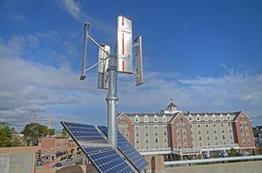
[…]Wing Power Energy’s technology is a vertical, four-blade wind propeller combined with a solar panel, which together can generate as much as 3.5 kilowatt hours of electricity.

Recently, the company put up a live demonstration in the City of Salem, consisting of three hybrid wind/solar turbines on the rooftop of a municipal parking garage powering 4G LTE enabled Verizon wireless equipment, including two video surveillance cameras, one digital signboard and a complete wireless network, completely off grid and running only on the power generated by the turbines. The company now has about 15 systems up and running or in the works around the country.

See on www.bizjournals.com

Renewables Move up the Rankin’s

Renewables Move up the Rankin’s.

IRENA: Fossil fuel subsidies cause everlasting expenses and pollution

See on Scoop.itGreen & Sustainable News

Abu Dhabi: Decreasing costs of renewable energy sources may convince the world governments to minimise subsidies on polluting fossil fuels, a senior official of International Renewable Energy Agency (Irena) said here on Sunday.

Duane Tilden‘s insight:

World governments were ignoring the fact that although renewable energy sources require big initial investments, their long-term operational and maintenance costs are minimal, he [Frank Wouters, Deputy Director General of Irena] pointed out.

Effective policies are more important than subsidies for countries to scale up renewable energy on a large scale, experts participating in the assembly also pointed out.

Anywhere in the world, investment in renewable power generation depends on stable regulatory frameworks, transparent planning processes and clear procedures for connection to the grid, said the participants at a workshop as part of the assembly.

See on gulfnews.com

Pioneering Global Atlas for Renewable Energy Goes Online

See on Scoop.itGreen Energy Technologies & Development

The world’s first open-access Global Atlas of renewable energy resources goes live today, announced at the annual general assembly of the International Renewable Energy Agency (IRENA).

Duane Tilden‘s insight:

–  “In the next 10 years we expect a huge rise in the investments in renewable energy. The Global Solar and Wind Atlas will help us make the right decisions,” says Martin Lidegaard, Danish Minister of Climate, Energy and Building, and President of the 3rd session of the IRENA Assembly.

–  Note to Editors

IRENA is mandated by 159 countries and the European Union to promote the sustainable use of all forms of renewable energy, and to serve as the global hub for renewable energy cooperation and information exchange. Formally established in 2011, IRENA is the first major international organization to be headquartered in the Middle East.

See on www.financialpost.com

The Negawatt Revolution — Solving the CO-2 [& Energy] Problem —

See on Scoop.itGreen Energy Technologies & Development

Introduction

“My 1976 article entitled “Energy Strategy: The Road Not Taken?” which appeared in Foreign Affairs, suggested two ways in which the energy system could probably evolve over the next fifty years or so, using the United States as an example. If you divided by something like a factor of nine or ten, you would get Canada.”…

“If the U.S. spent only enough on efficiency to keep up with growth and demand for electric services, plus the net retirement of generating capacity, we would have almost enough capital left in surplus to double our rate of investment in durable manufacturing industries.”

The Importance of Electrical Efficiency

“Why do I concentrate on electricity? First, because it is by far the costliest form of energy. Each cent per kilowatt-hour is equivalent in heat content to oil at $17 dollars a barrel, roughly the world oil price. So the electricity we buy, even in Canada where it is quite cheap, is equivalent to heat at many times the world oil price. Therefore saving electricity is more financially rewarding than saving direct fuels. In addition, electricity has enormous capital leverage because central electric systems — the whole systems — are about 100 times as capital intensive as the traditional direct fuel systems (you know, Texas and Louisiana and Alberta oil and gas — the sorts of things on which our economies were built). In fact a quarter of all the development capital in the world goes to electrification.

“Also electricity has huge environmental leverage. Power plants burn a third of the fuel in the world. They account for a third of the CO2, therefore, released from the burning of fossil fuel. In my own country they release two thirds of the sulphur oxides and a third of the nitrogen oxides. What’s more, every unit of electricity you save at the point of use saves typically three or four units of fuel, namely coal at the power plant. And in socialist or developing countries that ratio is more like five or six to one.

So you get the most environmental benefit from saving electricity, as well as the most financial benefit.”

See on www.ccnr.org