Energy Efficiency in Data Centres to Lower Costs and Benefit the Environment

See on Scoop.itGreen Energy Technologies & Development

LONDON, Jan. 16, 2013 /PRNewswire/ — The data centre market is growing at an extremely high rate and its boom…

Duane Tilden‘s insight:

“Data centre managers are under constant pressure to lower the TCO [Total Cost of Ownership] and energy is one of the main components of the overall data centre operation cost.  […]

Data centres are classified as mission critical facilities and any down time will result in a significant financial loss. In order to ensure highest availability, data centre managers employ high powered UPS systems. These UPS systems consume about 7% of the total energy.   […]

See on www.prnewswire.com

Lower nitrogen losses with perennial biofuel crops

See on Scoop.itGreen & Sustainable News

Perennial biofuel crops such as miscanthus, whose high yields have led them to be considered an eventual alternative to corn in producing ethanol, are now shown to have another beneficial characteristic — the ability to reduce the escape of…

Duane Tilden‘s insight:

In the study, funded by the Energy Biosciences Institute, miscanthus, switchgrass, and mixed prairie species were compared against a typical corn-corn-soybean rotation. Harvested biomass and nitrogen, nitrous oxide emissions, and nitrate leaching in the mid-soil profile and through tile drainage lines were all measured.

The researchers found that the perennial crops quickly reduced nitrate leaching in the mid-soil profile as well as from tile lines. “By year four each of the perennial crops had small losses,” Smith said. “Nitrous oxide emissions also were much smaller in the perennial crops–including switchgrass, which was fertilized with nitrogen, while prairie and miscanthus were not. Overall, nitrogen levels were higher for the corn and soybean treatment as well as switchgrass, but were lower for prairie and miscanthus. Prairie and miscanthus levels were lower due to harvest of the plant biomass (and nitrogen) each winter, with no fertilizer nitrogen additions to replace it, as occurred in corn and switchgrass,” she said.

See on www.sciencedaily.com
Why Frack When You Can Grow Biofuel? USDA Has $25 Million In Answers

See on Scoop.itGreen & Sustainable News

The U.S. Department of Agriculture has just embarked on a new round of $25 million in funding for four new biofuel research and development projects, offering farmers and other rural property owners the potential for new alternatives to selling or…

Duane Tilden‘s insight:

One of USDA’s new projects addresses this approach through a new cropping system, in which the weedy biofuel plant camelina will be rotated with wheat-based plants. The $5 million project, through Kansas State University, will study the commercial feasibility of converting camelina to biobased adhesives and coatings as well as biofuel.

Another $6.5 million will go to Ohio State University to demonstrate an innovative anaerobic digestion system (anaerobic refers to bacteria that thrive without oxygen) that can handle multiple feedstocks. The new system will use natural decomposition to break down manure, agricultural waste, woody biomass and biofuel crops.

There is no such thing as impact-free energy production, but all of these biofuel projects are designed to fit sustainably into the core business of the farmer, which all boils down to long term land stewardship.

See on cleantechnica.com

Gas Drilling, North Dakota : Image of the Day

See on Scoop.itGreen & Sustainable News

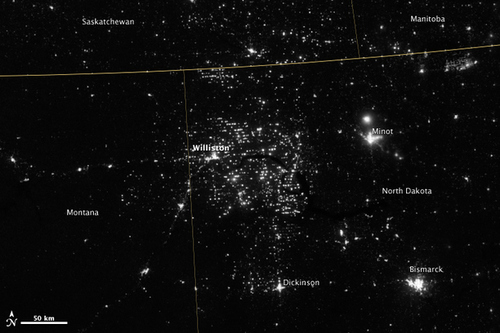
Cities and people are scarce in northwestern North Dakota, but nighttime satellite imagery shows the Bakken Formation aglow with brightly-lit drilling equipment.

Duane Tilden‘s insight:

Northwestern North Dakota is one of the least-densely populated parts of the United States. Cities and people are scarce, but satellite imagery shows the area has been aglow at night in recent years. The reason: the area is home to the Bakken shale formation, a site where gas and oil production are booming.

On November 12, 2012, the Visible Infrared Imaging Radiometer Suite (VIIRS) on the Suomi NPP satellite captured this nighttime view of widespread drilling throughout the area. Most of the bright specks are lights associated with drilling equipment and temporary housing near drilling sites, though a few are evidence of gas flaring. Some of the brighter areas correspond to towns and cities including Williston, Minot, and Dickinson. …

See on earthobservatory.nasa.gov