How Cold Weather Affects Fuel Consumption

See on Scoop.itGreen & Sustainable News

If there’s one thing Canadians know how to do, it’s drive in the winter. But did you know it’s a sci…

Duane Tilden‘s insight:

>"Expect to use more fuel in the winter. The U.S. Environmental Protection Agency found that a drop in temperature from 24°C to 7°C increased fuel consumption in urban commutes by 12 to 28 percent for eight different vehicles tested. For a vehicle that typically achieves a 500 km range on a full tank of fuel, this represents a loss of 60 to 140 km per fill-up during the winter months.

• Aerodynamic resistance is greater in the winter. Cold, dry, winter air is about 12 percent denser than warm, humid, summer air, increasing highway fuel consumption by about 1.3 percent in the winter. The average wind speed is also higher in the winter, which contributes to increased aerodynamic resistance and fuel consumption.

• Winter roads create difficult driving conditions. With increased asphalt deterioration and a mix of snow, ice, slush, water, salt, gravel and sand, Canadian roads can be pretty awful in winter and harder to manage. Your vehicle’s engine works harder to offset the increased rolling resistance, as your tires have to work to push aside heavy snow and road cover. The snow and ice also increase wheel slippage, which results in higher fuel consumption.

• Winter gas normally has lower energy density. Gasoline composition is seasonally and geographically adjusted based on historical temperature data. A litre of winter gas has less energy content than a litre of summer gas, typically in the range of 1.5 to three percent.

• Winter driving taxes a vehicle’s electrical system. Except for air conditioning, your vehicle’s electrical loads are normally higher in cold weather due to greater demand from heating, defrosting, head lights and interior lights, heated seats, heated mirrors and increased use of the windshield washer pump. The energy for these electrical loads is provided by the vehicle’s electrical system, which obtains power from the engine."<

See on www.onthego.to

U.S. Army and USGS Confirm Historic Link Between Earthquakes and Hydraulic Fracturing

See on Scoop.itGreen & Sustainable News

The U.S. natural gas industry claims that hydraulic fracturing, otherwise known as fracking is safe. Yet government agencies have determined otherwise.

Duane Tilden‘s insight:

>"Until two years ago Oklahoma typically had about 50 earthquakes a year, but in 2010, 1,047 quakes shook the state.

 Why?

In Lincoln County, where most of this past weekend’s seismic incidents were centered, there are 181 injection wells, according to Matt Skinner, an official from the Oklahoma Corporation Commission, the agency which oversees oil and gas production in the state.

Cause and effect?

The practice of injecting water into deep rock formations causes earthquakes, both the U.S. Army and the U.S. Geological Survey have concluded.

The U.S. natural gas industry pumps a mixture of water and assorted chemicals deep underground to shatter sediment layers containing natural gas, a process called hydraulic fracturing, known more informally as “fracking.” While environmental groups have primarily focused on fracking’s capacity to pollute underground water, a more ominous byproduct emerges from U.S. government studies – that forcing fluids under high pressure deep underground produces increased regional seismic activity.

As the U.S. natural gas industry mounts an unprecedented and expensive advertising campaign to convince the public that such practices are environmentally benign, U.S. government agencies have determined otherwise."<

See on oilprice.com

Exxon’s CEO Rex Tillerson NIMBY fracking lawsuit in Texas – WSJ

See on Scoop.itGreen & Sustainable News

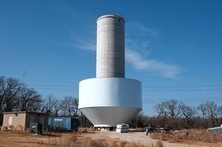
In a wealthy Dallas suburb, some residents are complaining about the noise and traffic that would result from a water tower used for fracking. One of the tower’s critics is Exxon CEO Rex Tillerson.

Duane Tilden‘s insight:

>"He and his neighbors had filed suit to block the tower, saying it is illegal and would create "a noise nuisance and traffic hazards," in part because it would provide water for use in hydraulic fracturing. Fracking, which requires heavy trucks to haul and pump massive amounts of water, unlocks oil and gas from dense rock and has helped touch off a surge in U.S. energy output.

It also is a core part of Exxon’s business.

Rex Tillerson

While the lawsuit Mr. Tillerson joined cites the side effects of fracking, a lawyer representing the Exxon CEO said he hadn’t complained about such disturbances. "I have other clients who were concerned about the potential for noise and traffic problems, but he’s never expressed that to me or anyone else," said Michael Whitten, who runs a small law practice in Denton, Texas. Mr. Whitten said Mr. Tillerson’s primary concern is that his property value would be harmed.

An Exxon spokesman said Mr. Tillerson declined to comment. The company "has no involvement in the legal matter" and its directors weren’t told of Mr. Tillerson’s participation, the spokesman said.

The dispute over the 160-foot water tower goes beyond possible nuisances related to fracking. Among the issues raised: whether a water utility has to obey local zoning ordinances and what are the rights of residents who relied on such laws in making multi-million-dollar property investments. The latter point was the focus of Mr. Tillerson’s comments at the November council meeting."<

See on online.wsj.com

California’s drought and Agriculture – Running out of Water

See on Scoop.itGreen & Sustainable News

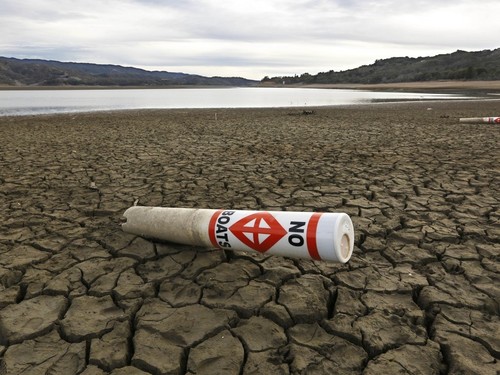
Droughts aren’t new to the golden state, but this one is for the ages and it comes with a distinct set of troubles

Duane Tilden‘s insight:

>"The situation has even sparked a trip from President Obama, who visited the epicenter of California’s massive agriculture industry, the Central Valley, on Friday and announced $100 million in livestock disaster assistance, $5 million in targeted assistance for hard-hit areas, $5 million for watershed protection programs, $60 million for food banks and 600 new sites for a summer meals program, $3 million in emergency water assistance for rural communities, and a commitment from the federal government to reduce water use and focus nation-wide on climate resilience. […]

The elephant in the room when it comes to water in California is agriculture, which uses around 80 percent of the state’s developed water supply. Ag in California is king — the state has more than 80,000 farms and an annual revenue of $45 billion a year. The California department of Food and Agriculture reports that 400 commodities are grown in the state and almost half of all the fruits, vegetables and nuts produced in the US come from California. The biggest money maker is milk at $6.9 billion a year, followed by grapes, almonds, nursery plants, cattle, strawberries, lettuce, walnuts, hay and tomatoes.

However large swathes of the state’s agricultural areas, like the Central Valley, are only farmable because of subsidized water coming through a network of canals and pumps that send water from the wetter north to more arid lands further south via the State Water Project and the federal Central Valley Project (parts of Southern California also get an allotment of the Colorado River).

Of course we need food, but are we growing the right food in the right places and with the best technology possible to reduce water use? In some places yes, but across the board, definitely not."<

See on www.salon.com

Evidence Suggests Nuclear Powered Core Provides 50% of Earth’s Heat Energy

See on Scoop.itGreen & Sustainable News

Geoneutrino detector probes deep into the Earth

Duane Tilden‘s insight:

“About 50% of the heat given off by the Earth is generated by the radioactive decay of elements such as uranium and thorium, and their decay products. That is the conclusion of an international team of physicists that has used the KamLAND detector in Japan to measure the flux of antineutrinos emanating from deep within the Earth. The result, which agrees with previous calculations of the radioactive heating, should help physicists to improve models of how heat is generated in the Earth.

Geophysicists believe that heat flows from Earth’s interior into space at a rate of about 44 × 1012 W (TW). What is not clear, however, is how much of this heat is primordial – left over from the formation of the Earth – and how much is generated by radioactive decay.  […]

One possibility that has been mooted in the past is that a natural nuclear reactor exists deep within the Earth and produces heat via a fission chain reaction. Data from KamLAND and Borexino do not rule out the possibility of such an underground reactor but place upper limits on how much heat could be produced by the reactor deep, if it exists. KamLAND sets this limit at about 5 TW, while Borexino puts it at about 3 TW.”

See on physicsworld.com

Life Giving NUCLEAR EARTH Reactor

Is planet Earth powered by a Nuclear Reactor at the core?
“How? Nuclear fission generates neutrinos, and we have neutrino detectors. The proven flux of neutrino from the core corresponds to fission generating more than half the Earth’s heat flux.

Most of it comes from Uranium 238 and Thorium 232 fission. Ten percent of the heat flux also comes from radioactive Potassium 40 decay.”

Patrice Ayme's avatarPatrice Ayme's Thoughts

It’s fashionable among pseudo-progressives to be rabidly anti-nuclear. Much better to burn coal, and frack rocks, they say, and they smoke. Who are those ingrates? Assuredly ignorant of the fact that all this coal they love so much was generated thanks to… nuclear power! Let me explain. It’s called science.

It is very likely that there will be much more habitable worlds in the galaxy than worlds with even the simplest animals having evolved there. Life is fragile, ours had many close calls. Moreover Earth is characterized by many very special traits: a large, stabilizing moon, a vast liquid ocean, a strong magnetic field shielding Earth surface with its magnetic armor, plate tectonics, volcanoes, etc… I argued this at length in:

http://patriceayme.wordpress.com/2013/11/06/40-billion-earths-yes-no/

All these phenomena come from just one cause: the CENTRAL EARTH FISSION NUCLEAR REACTOR.

Where Do You Think All This Magma Comes From? Nuclear Fission! Where Do You Think All This Magma Comes From? Nuclear Fission!

The Core Nuclear Reactor turns…

View original post 831 more words

SolarCoin a new cryptocurrency based on Solar Energy

See on Scoop.itGreen & Sustainable News

A new cryptocurrency with a solar-powered twist could be just the incentive we need to make the shift to clean energy.

Duane Tilden‘s insight:

>SolarCoin chose solar rather than another renewable technology because investment in solar panels is easier than in wind turbines, for example. "Solar is interesting because it can be very grassroots," says Gogerty. He and a colleague first conceived of an energy-backed asset in 2011 but couldn’t make the idea work without a central bank. Bitcoin makes the bank unnecessary. "We’re very thankful for Bitcoin leading the change."

Bitcoin has been accused of wasting energy in the past because of the computing power it takes to mine coins, but Gogerty says that SolarCoin is 50 times more energy-efficient because its algorithm allows the total number of coins to be mined faster – and that’s before factoring in the energy boost from new solar panels.

If SolarCoin succeeds, the model could even be applied to other environmental projects, such as conserving the rainforest or endangered species. "If someone can come up with the mechanism and the approach, it would be a great thing," says Gogerty.<

See on www.newscientist.com

Scientists pooh-pooh Victoria’s $780M plan to stop piping sewage into the ocean

“Almost all of Victoria’s sewage — about 1,500 liters per second — is discharged through two pipes running more than a kilometre off the city’s southern coast. Aside from a 6mm mesh that sieves out condoms, feminine products and other large particulates, the sewage is untreated.”

Bitcoin is not just digital currency. It’s Napster for finance.

Radical beverage refrigeration technology cools on demand

See on Scoop.itGreen Energy Technologies & Development

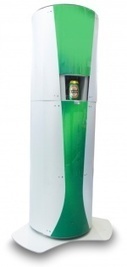
UK-based Pera Technology has developed a new refrigeration technology known as V-Tex, which has the ability to cool drinks while consuming less energy.

Duane Tilden‘s insight:

>The V-Tex has the ability to cool a standard 35cl can of drink in just 45 seconds, the company claims.

Paul Tattersall, project manager at Pera Technology, said: "The energy consumed by commercial refrigerators and freezers is quite staggering. Across Europe, an estimated 85TWh of electricity is used, comparable to around 25 million households. […]


The Rapidcool consortium set out to develop a novel, fast-cooling apparatus that cools drinks on demand. This is a much smarter alternative to the current norm, where large volumes of drinks are stored in chillers for prolonged periods, just waiting to be consumed. This not only wastes a lot of energy, but chilled stock can easily run out. V-Tex technology is flexible and ensures consumers can always obtain a cooled beverage quickly.

The main challenge faced by the team was to optimise cooling efficiency to meet consumer demand for extremely fast cooling without ‘slushing’. This occurs when the outer layers of liquid freeze before the inner liquid is cooled. The V-Tex technology rotates the drink under optimised conditions to create a ‘Rankine vortex’ and obtain cooling speeds better than other approaches while avoiding the effects of slushing and fizzing when the drink is opened. The cooling chamber can be easily integrated into existing vending machines or open-cabinets, in addition to working as a standalone cooling unit.<

See on www.foodbev.com