Kinder Morgan President Shocked by Level of Protest Against Burnaby Trans Mountain Pipeline

Following months of protests, and most recently a court injunction to remove protesters on Burnaby Mountain that resulted in numerous arrests, Kinder Morgan is holding a telephone town hall tonight.

Source: globalnews.ca

>” […] Asked if he was surprised by the protest and the numbers who showed up and Anderson said, no. Instead what was shocking was what he called people’s “willingness to disobey the injunction and put themselves up for arrest.“

[…] Also the diversity of the crowd, which included according to Anderson, “hardcore protesters, local interest groups and residents in the community,” that made it difficult for Kinder Morgan to have a conversation and plan appropriate action.

“We tried to remain calm and not be heavy-handed,” Anderson said.

But five protestors, who were arrested and are being sued for $5 million, may see it differently.

Anderson called the lawsuit an “unfortunate part of the process” but says it was necessary to get the work done safely. […]

The survey work may be done but for the City of Burnaby’s Mayor Derek Corrigan, there’s still a matter of the bill for the Burnaby Mountain policing costs.

“I want [Kinder Morgan] to pay,” Corrigan said in an earlier interview.

“We told them not to go on to the mountain, we told them to obey our bylaws, we were overruled by the National Energy Board, so they can’t possibly say in any way this was our fault or responsibility.”

But for Anderson, the police officers were necessary to enforce the legal injunction for “legally authorized work.”

“The police were there to protect us against unlawful protestors. Policing is a municipal responsibility and I think it remains a municipal responsibility,” Anderson said. […]

“I think Kinder Morgan’s playing the poor me with regards to their activities,” he said.

“I find it quite surprising; I don’t know many people that are going to feel sorry for a multinational corporation that’s exerting its influence on a local government.” […]”

See on Scoop.itGreen & Sustainable News

Studies Are Misleading; Keystone XL Project May Kill More Jobs Than It Creates

The report concludes that the job estimates put forward by TransCanada are unsubstantiated and the project will not only create fewer jobs than industry states, but that the project could actually kill more jobs than it creates.

Source: www.ilr.cornell.edu

>” […] Main findings include:

The project budget that has a direct impact on U.S. employment is between $3 and $4 billion or about half of what industry claims.50% or more of the steel pipe, the main material input used for Keystone XL, will be manufactured outside of the U.S.Jobs will be temporary and between 85-90% of the people hired to do the work will be non-local or from out of state.The Perryman study, which estimates around 119,000 (direct, indirect and induced) jobs is a poorly documented study commissioned by TransCanada.Job losses would be caused by additional fuel costs in the Midwest, pipeline spills, pollution and the rising costs of climate change.  Even one year of fuel price increases as a result of Keystone XL could cancel out some or all of the jobs created by the project.”<


See on Scoop.itGreen & Sustainable News

Proposed ‘Energy East’ Pipeline Benefits Overblown Argues Report

The proposed Energy East pipeline won’t be the boon to Eastern Canadian refineries that supporters claim because the vast majority of the oil in it would be bound for export markets, environmental groups argue in a report being released Tuesday.

Source: www.cbc.ca

>” […]

Refinery capacity already in use

The report Tuesday said the three refineries along the Energy East route — Suncor Energy’s in Montreal, Valero’s near Quebec City and Irving’s in Saint John, N.B. — have a combined capacity of 672,000 barrels per day.

Of that, the groups figure 550,000 barrels per day can come from elsewhere — offshore crude in Atlantic Canada, booming U.S. shale resources and, eventually, via Enbridge Inc.’s recently approved reversed Line 9 pipeline between southwestern Ontario and Montreal. That leaves just 122,000 barrels per day of refining capacity that can be served by Energy East, the report said.

“It’s very frustrating to watch a company trying to convince Canadians that they should accept these massive risks based on some perceived benefit that they may receive. When you dig into it, you find that it’s an empty promise,” said Adam Scott, with Environmental Defence.

“It’s just not true that Eastern Canada’s going to benefit in the way that TransCanada’s saying they are. And when you look and see that this is a project about putting vast quantities of oil onto tankers and shipping them out of the country, people who are convinced that ‘this is going to mean more local jobs for me’ are going to be very disappointed.” […]”<

See on Scoop.itGreen & Sustainable News

Oil’s Price Drop Forces Lower Prices for Brazilian Biofuel (Ethanol) Makers

The plunge in oil prices to multi-year lows could have a sour aftertaste for Brazilian sugar processors.

Source: blogs.wsj.com

“> […] The drop in crude prices may spell even more trouble for one of the mills’ two chief products: ethanol. Processors have ramped up production of the biofuel as a way to generate revenue as sugar prices plunged. But now that alternative may lose its luster if cheap gasoline gets in the way. Ultimately, it may push more sugar on the market.

Raw sugar futures on ICE Futures U.S. recently fell 1.6% to a more than six-week low of 15.68 cents a pound. […]

Brazil is the world’s top producer of cane-based ethanol and cane processors have been dedicating more of their cane to produce the biofuel as an alternative to producing sugar, which has slumped in price.

Since Brazil’s cane harvest began in April, mills in the center-south – Brazil’s main cane-growing region – have dedicated 56.1% of their cane to make ethanol, and the rest to make sugar, compared with a 54.7%-45.2% split at the same point last year, according to sugar-industry group Unica.

“If gasoline gets cheaper, it affects ethanol’s competiveness in the blend,” said Jack Scoville, a vice president at Chicago brokerage Price Futures Group. […]”<

See on Scoop.itGreen & Sustainable News

Oil price loss seen as gain for consumers: ‘What is saved at the pumps will be spent at malls’

The petrodollar effect: Just how much is the loonie tied to oil prices?

Fracking linked to BC’s liquefied natural gas gambit

See on Scoop.itGreen & Sustainable News

A surplus of natural gas in North America explains why the B.C. government is so desperate to launch a new industry

Duane Tilden‘s insight:

>“The prices that the [B.C.] government is looking at in paving the roads with gold is basically based on these short-term factors that are not likely to persist,” Lee said.

Natural Gas Development Minister Rich Coleman did not make himself available for an interview to respond to Lee’s comments.

B.C. misread U.S. energy revolution

The B.C. government missed the mark with its earlier forecasts on royalties because it failed to predict an explosion in U.S. energy production.

This largely came about through hydraulic fracturing, otherwise known as “fracking”, and horizontal drilling. Technological innovations in fracking generated huge new supplies, causing North American natural-gas prices to plummet.

The falling prices resulted in fewer royalties flowing into the B.C. government treasury.

Fracking involves pumping huge amounts of water along with sand and chemicals into shale-rock formations to free trapped gas.

Horizontal drilling enables companies to retrieve locked supplies by moving the drill bit across a deposit rather than going straight down.

A single platform can send horizontal drills in a multitude of directions, enhancing efficiency and saving money.

In his 2013 book, The Frackers: The Outrageous Inside Story of the New Billionaire Wildcatters (Penguin), Gregory Zuckerman chronicled how a handful of U.S. energy-industry outcasts refined these techniques and caused an American energy revolution.

“To me, it’s fascinating that this resurgence started in 2007 and 2008, which is right when America was sort of on its back,” he told the Straight by phone.

Zuckerman, a Wall Street Journal reporter, said that the United States is now producing about eight million barrels of oil per day, up from five million barrels per day in 2008.

In addition, U.S. natural-gas production rose more than 21 percent between 2008 and 2013.

ExxonMobil CEO Rex Tillerson has predicted that the U.S. will be energy self-sufficient by 2020.

The Frackers reveals that the people who spearheaded this sharp increase in energy production were not working for major oil companies like ExxonMobil, Shell, BP, or Chevron.

Rather, they were an assortment of little-known wildcatters from Texas and Oklahoma—George Mitchell, Aubrey McClendon, Tom Ward, and Harold Hamm—who became billionaires as a result.

They crisscrossed areas with shale reserves, buying drilling rights from property owners. Although there has been a lot of howling from environmentalists about the contamination of water supplies with fracking chemicals, the industry continues to grow.

“Everyone focuses on fracking—and fracking is key, as is horizontal drilling—but the most important thing is that innovators like Mitchell got it to work in shale, which everyone kind of ignored, especially the big guys and the experts,” Zuckerman said.

By targeting shale, Zuckerman maintained, Mitchell changed the country and the world.

That’s because manufacturers with high natural-gas input costs—such as makers of chemicals, tires, cement, and aluminum—are basing operations in the United States because of the low natural-gas prices. And Zuckerman said that this will give the U.S. a competitive advantage against other countries for years to come.

“Some economists say as many as two million jobs are going to be created,” he stated.<

See on www.straight.com

Kinder Morgan files for Trans Mountain pipeline expansion to triple capacity

See on Scoop.itGreen & Sustainable News

A second pipeline proposal to transport oil to Asia was officially launched on Monday when Kinder Morgan filed a project application for its $5.4-billion Trans Mountain expansion.

Duane Tilden‘s insight:

>The project would nearly triple oil capacity to 890,000 barrels annually and bring about 400 more tankers a year into Burrard Inlet (up from about 80) if it is approved by the National Energy Board and subsequently by the federal government.

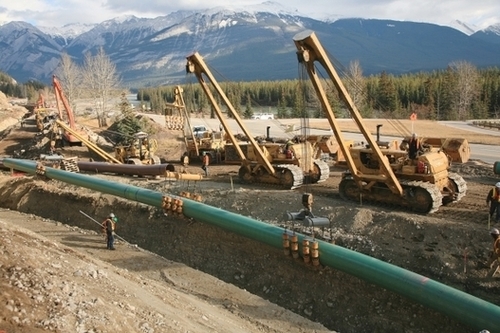
The 1,150-kilometre pipeline will carry diluted bitumen from the Alberta oilsands, starting in Edmonton, through Jasper and across B.C. to the company’s Westbridge Terminal in Burnaby.

Kinder Morgan says nearly three-quarters of the proposed expanded pipeline’s length across most of the province will follow the existing right-of-way where the pipeline was first built in the 1950s. About 17 per cent of the route, and virtually all the way through the Lower Mainland west of Fort Langley, will deviate from the current line, but would follow other existing utility corridors or infrastructure.

Kinder Morgan is promising enhanced tanker safety in its more-than-15,000-page submission, and says it is continuing discussions with First Nations, whose support is critical to large infrastructure development projects in B.C.

The twinning of Kinder Morgan’s existing pipeline has already seen years of pushback from First Nations, environmentalists and community groups concerned about the potential for spills along the pipeline and from tankers. Both Vancouver and Burnaby’s city councils have voiced opposition to the project.

The project would create about 90 permanent jobs, and employ 4,500 people at the peak of construction.<

See on www.vancouversun.com