Aluminum Superatoms – High Temperature Superconducting Materials

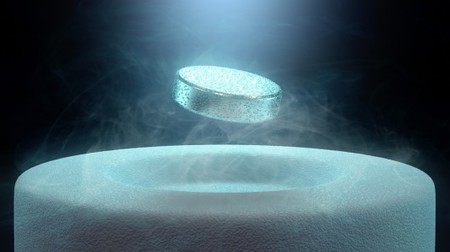
Superconductors can carry electricity with no resistance and are used for specialized applications like MRIs, maglev trains and particle accelerators. Superconductor-based electronics would be extremely efficient because they would generate no waste heat, but he fact that they would only work at temperatures close to absolute zero makes them impractical.

Source: www.gizmag.com

>” […]

Scientists at the University of Southern California (USC) have made steps toward discovering a new family of superconductor materials that work at relatively high temperatures, with possible applications in physics research, medical imaging and high-performance electronics.

As electrons travel through an integrated circuit, they regularly bump into microscopic imperfections within the conductive wire and veer off course, creating electrical resistance and releasing waste energy as heat. Waste heat is a big inconvenience to both designers and end-users of electronics, but it simply can’t be avoided using the materials currently at our disposal.

[…] Thirty years ago, a new class of so-called “high-temperature superconductors” was discovered, although the name can be deceiving because these still require temperatures below 135 K (-135 °C or -210 °F) to operate, which still makes them impractical for use in electronics.

Now the USC team led by professor Vitaly Kresin has discovered hints of yet another family of superconductors which work at relatively high temperatures. Specifically, they found out that while single atoms of aluminum only turn superconductive at very low temperatures (around 1 K), so-called “superatoms” (clusters of evenly spaced atoms that behave as a single atom) of aluminum turn superconductive at much higher temperatures, around 100 K.

Superconductivity takes place when so-called Cooper pairs form within a material. These are pairs of electrons that are very faintly attracted to each other and activate a mechanism whereby the electrons don’t veer off course, and therefore lose heat, whenever they bump into an imperfection within the material. Because the attractive force between the electrons, which happens only under certain conditions, is so weak (two electrons would normally repel each other), even a small amount of external energy (which could be given off in the form of heat) can upset this equilibrium. This is why superconductors only work at very low temperatures.

Kresin and team built a series of aluminum superatoms between 32 and 95 atoms large. For superatoms containing 37, 44, 66 and 68 aluminum atoms, the scientists found evidence that Cooper pairings were taking place, turning the material into a superconductor.

The researchers suggest that creating superatoms of different metals could lead to the discovery of similar superconductors that work at relatively high temperatures. While the threshold temperature was 100 K (-280 °F, -173 °C) for an aluminum superatom, different materials are likely to turn superconductive at different (hopefully much higher) temperatures.

“One-hundred Kelvin might not be the upper-temperature barrier,” says Kresin. “It might just be the beginning.”

Should one of these materials operate as a superconductor at room temperature, it would likely have huge impact on the worlds of electronics, medical imaging, microscopy and electric motors, just to name a few. ”

A paper describing the advance appears on the journal Nano Letters.

Source: University of Southern California

See on Scoop.itGreen Energy Technologies & Development

Net Zero Case Study: Bullitt Center – Green Materials

The Bullitt Center in Seattle, Washington, is one of the most self-sufficient buildings on the planet.  It is net zero energy and, after the water reuse system is approved by city authorities, net zero water.  Net zero means that the building uses the same amount as it creates or generates – it is self-sufficient.

Source: greenbuildingelements.com

>”[…]

Healthy Green Materials

The Living Building Challenge requires projects to avoid as many of the chemicals and substances that are found on the Red List as possible.  These substances have been recognized by government agencies, such as the US Environmental Protection Agency, the European Union Commission, and the State of California, as potentially harmful to human or animal life on Earth.  Not all of the substances can be avoided, though, due to the lack of availability of materials that do not contain them.

The Bullitt Center team avoided over 360 known chemicals on this list.  Some were easy to avoid, as alternatives were readily available.  The team also worked with suppliers to create products that met their requirements, changing the way the products were made and making them available to others.

Most plumbing valves, even those made of brass and bronze, contain up to 7% lead.  Lead free valves, with an allowable lead content of only 0.25%, were used in both the potable and non-potable water systems, including fire sprinklers.Phthalates are commonly used in PVC and other plastic products.  A high-performance water barrier company performed 6 months of research to develop a product that did not contain phthalates, just for the Bullitt Center project.  The new product has now replaced the original version going forward.  Dioxins are a by-product of the manufacture, combustion, and disposal of products containing chlorine, most notably PVC products.  Couplings for no-hub ductile iron pipe are commonly made with neoprene, which contains chlorine.  The team worked with the manufacturer to special order couplings made of EPDM (ethylene propylene diene monomer) rubber.  The electrician was able to find electrical wire not coated in PVC that met code standards.  The fiberglass insulation in the project is held together by a plant-based polymer, not the usual one that contains formaldehyde.

Certified Wood

The Bullitt Center is a wood-framed structure.  Because of its location and the importance of the timber industry in the Pacific Northwest, the project team decided this was the best choice for the project.  100% of the lumber in the building has been harvested from anForest Stewardship Council (FSC) certified source.  The project was also recognized as the only commercial project to receive the Forest Stewardship Council Project Certification, in recognition of responsible forest products use throughout the building.

Local Sourcing

Perhaps the greatest story about green materials and the Bullitt Center involves the curtain wall (window) system.  Due to the high performance needs of the project, only one product could be used, and it was only manufactured in Europe.  A Washington company partnered with the European manufacturer to gain the knowledge to manufacture and install the system in the US.   The Washington company flew their employees over to find out how to make and install the system, and a licensing agreement was reached.  Now this high performance system is available in the US for future projects to use.

[…]”<

See on Scoop.itGreen Building Design – Architecture & Engineering

Net Zero Building Nears Completion in Edmonton

the mosaic centre for conscious community and commerce is nearly ready for occupancy, which could make it the most northerly net-zero structure on the planet.

Source: www.journalofcommerce.com

>” […] The Edmonton centre’s designers and builders are hoping that others can learn from the project that sustainable design doesn’t have to be costly or time consuming – so much so that they have made the contract, calculations and drawings available to anyone.

The City of Edmonton said the Mosaic Centre will be the world’s most northerly commercial building to achieve net zero status, the city’s first designated LEED platinum building, the first in Alberta to be petal certified by the Living Building Challenge and Canada’s first triple bottom line commercial building.

Once completed, the new 30,000 square foot building will include  photovoltaic panels that will cover much of the roof.

It will also have LED lighting designed with a time-clock/daylight controller to meet minimum light levels and a geo-exchange system which will draw heat in winter and coolant in summer.

The 32 bore hole geothermal system reduced the size of the system by 40 kW, saving about $150,000.

It was built 25 per cent ahead of schedule and five per cent under budget.

HKA architect Vedran Skopac, who worked on the project, said it was done to prove to the industry that complex, sustainable buildings can be delivered on time, on budget and without animosity between the parties.

He said the key to this all started with using Integrated Project Delivery (IPD).

The model emphasizes collaboration at an early stage and encourages all the participants to use their talents and insights throughout the different stages for best results.

“It goes all the way down to the end of the line of the tradesmen,” Skopac said.

“We invested so much in designing the process, and training and making everyone a leader.”

Skopac said a major influence on designing the actual structure was creating collision spaces, or places where building residents would be forced to meet and interact.

Skopac also wanted to influence sustainable behavior, like making windows easy to operate and open rather than using air conditioning, and making natural light penetrate deep into the building rather than encourage residents to turn on lights. […]”<

See on Scoop.itGreen Building Design – Architecture & Engineering