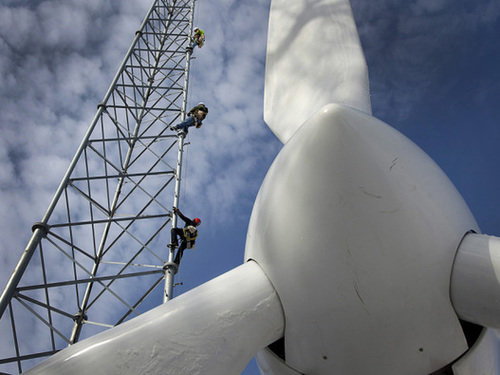
Wind power capacity grew 20% globally in 2012, figures show

See on Scoop.itGreen Energy Technologies & Development
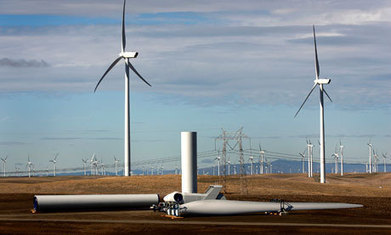
A relative slowdown in new wind turbine construction in China was offset by increases in the US, Germany, India and the UK

Duane Tilden‘s insight:

“While China paused for breath, both the US and European markets had exceptionally strong years,” said Steve Sawyer, secretary general of the Global Wind Energy Council (GWEC), which produced the statistics. “Asia still led global markets, but with North America a close second, and Europe not far behind.”

The UK now ranks sixth in the world for installed wind power, with 8.5GW. In Europe, only Germany (31GW) and Spain (23GW) have more. China leads the world with 77GW installed and the US is second with 60GW. […]

The record year for installation in the US was driven by a rush to beat an anticipated end to tax credits: 8GW of the total 13GW were installed in the last quarter of 2012. However, the tax credit has since been extended, meaning a dramatic slowdown in the US in 2013 is less likely. […]

See on www.guardian.co.uk

Biofuels hold unlimited opportunity to grow the rural economy

See on Scoop.itGreen & Sustainable News

Biofuels hold unlimited opportunity to grow the rural economy – WASHINGTON D.C. — At USDA we’ve made record efforts in the past four years to support homegrown energy. This year we’re looking ahead to a promising future for …

Duane Tilden‘s insight:

We’ve supported more than 200 biorefineries in their efforts to produce advanced biofuels, […]We have also taken steps to identify and expand new markets for these advanced biofuels. […] USDA is working with the Department of Energy and the Department of the Navy to expand advanced biofuels for military aviation and maritime use.


See on www.bladenjournal.com

“From Coal to Renewable Energy: Lessons Learned and Best Practices from Ontario” — an ISEEE Special Presentation

See on Scoop.itGreen & Sustainable News

Ontario has announced that by the end of this year, the province will become the first jurisdiction in North America to shut down its fleet of coal-fired power plants. This will mark the conclusion of a transition in just over a decade – ahead of schedule – from relying on coal for 25 per cent of Ontario’s electricity supply to ending entirely the province’s use of coal, while…

Duane Tilden‘s insight:

Date: February 11, 2013 | 2:00PM

Location: Energy, Environment and Experiential Learning Building, Room 210 Campus map: http://www.ucalgary.ca/map/

Speaker(s): Lois Corbett and Tim Weiss

See on www.iseee.ca

Historic Energy Decisions in U.S. and Canada | The Energy Collective

See on Scoop.itGreen & Sustainable News

Renewable energy in the U.S. and Canada will rise while the consumption of fossil fuels lessens.Wishful thinking by some people to the contrary, fossil fuels are here to stay for at least the next 30-40 years. In North America this timeframe will be an era of transition as the proportion of renewable energy in the U.S. and Canada will rise while the consumption of fossil fuels lessens.

Duane Tilden‘s insight:

The increase in U.S. oil production is the result of advances in non-traditional drilling technologies, including oil hydrofracking […].  For its natural gas production, the U.S. is in the throes of a hydrofracking frenzy, producing natural gas in unprecedented amounts. […]

The U.S. trend toward energy self sufficiency represents a precarious situation for Canada’s economic wellbeing since 95 percent of Canada’s energy exports (including hydroelectric power) today go to the U.S.  […]

See on theenergycollective.com

Renewable energy debt issuers abound | FP Street | News | Financial Post

See on Scoop.itGreen Energy Technologies & Development

If the fixed income analysts at BMO Capital Markets have got it right, investors can expect another crop of issues by companies whose business is renewable energy, a move, they suggest will generate ‘a gust of income for your portfolio’…

Duane Tilden‘s insight:

In his view, the level of issuance in 2012 “will easily be surpassed this year,” he wrote in a 24-page report.

Laing makes that argument on the basis that across the land, there are more than 8,500 megawatts in projects at various stages of development “stemming from previous calls for green power.”

Most of those projects are based in B.C., Ontario and Quebec. According to his report, Canada’s wind energy capacity stood at 6,000MW at the end of 2012, up from 140MW in 2000.

See on business.financialpost.com

Renewable energy now cheaper than new fossil fuels in Australia | Bloomberg New Energy Finance

See on Scoop.itGreen & Sustainable News

Sydney, 7 February 2013 – Unsubsidised renewable energy is now cheaper than electricity from new-build coal- and gas-fired power stations in Australia, according to new analysis from research firm Bloomberg New Energy Finance.

Duane Tilden‘s insight:

[…] research on Australia shows that since 2011, the cost of wind generation has fallen by 10% and the cost of solar photovoltaics by 29%. In contrast, the cost of energy from new fossil-fuelled plants is high and rising. New coal is made expensive by high financing costs. […] New gas-fired generation is expensive as the massive expansion of Australia’s liquefied natural gas (LNG) export market forces local prices upwards. […]

[…] Australia’s fleet of coal-fired power stations built by state governments in the 1970s and 1980s can still produce power at lower cost than renewables, because their original construction cost has now been depreciated.

“New wind is cheaper than building new coal and gas, but cannot compete with old assets that have already been paid off,” Bhavnagri said. “For that reason policy support is still needed to put megawatts in the ground today and build up the skills and experience to de-carbonise the energy system in the long-term.”

See on about.bnef.com

Why HVAC Performance Gets Worse Over Time

See on Scoop.itGreen Energy Technologies & Development

HVAC systems in mid- to large-sized commercial buildings have increased in complexity steadily over the last 15 years. With the introduction of DDC controls and other building automation functions, even the most straightforward VAV systems are a compilation of components from multiple manufacturers, built by multiple contractors, that must be programmed and sequenced to work together seamlessly as intended.

Duane Tilden‘s insight:

[…] Considering the ultimate objective for HVAC systems — keeping building occupants safe, healthy and comfortable, while using the least amount of energy — it is no wonder HVAC has become so complex.

Beginning in 2013, […] the complexity of HVAC systems will increase yet again. […] new buildings and major renovations will be required to be designed and built with new technologies including demand-controlled ventilation, energy-recovery ventilation, daylight-harvesting controls, and economizer cycles for even small comfort cooling applications. […]

See on www.facilitiesnet.com

Emissions: First-time reports from industry reveal massive methane emissions — 02/06/2013 — www.eenews.net

See on Scoop.itGreen Energy Technologies & Development

U.S. EPA’s addition of oil, gas and coal methane emissions to its online greenhouse gas tracking tool revealed an 82.6-million-metric-ton increase in carbon dioxide equivalents over numbers from the previous year, when those figures were not…

Duane Tilden‘s insight:

Coal power still dominates emissions

Last year, EPA completed standards requiring hydraulically fractured gas wells to use technology that will cut toxic emissions and smog-forming pollution by 2015.

As a co-benefit, the upgrades will also reduce methane by up to 1.7 million tons, said EPA. However, environmental groups have said that the methane issue must be addressed separately from other pollutants (ClimateWire, April 19, 2012).

Coal-fired power plants are the largest source of carbon emissions, outpacing the second-largest source — petroleum and natural gas systems — by a factor of almost 10-to-1. Power plants accounted for two-thirds of total greenhouse gas emissions.

See on www.eenews.net

Fracking Seen by EPA as No. 2 Emitter of Greenhouse Gases

See on Scoop.itGreen Energy Technologies & Development

Natural gas and oil production is the second-biggest source of U.S. greenhouse gases, the government said, emboldening environmentalists who say tighter measures are needed to curb the emissions from hydraulic fracturing.

Duane Tilden‘s insight:

[…] the U.S. Environmental Protection Agency for the first time included oil and natural- gas production. Emissions from drilling, including fracking, and leaks from transmission pipes totaled 225 million metric tons of carbon-dioxide equivalents during 2011, second only to power plants, which emitted about 10 times that amount.

The EPA report on oil and gas looked at emissions from basins, or large production areas, not individual wells. Among the top emitters were ConocoPhillips’ operations in the San Juan basin in New Mexico, and Apache Corp.’s operations in the Permian basin in Texas. Both companies are based in Houston.

See on www.bloomberg.com

North American Windpower: The Biggest Wind Energy Deals Of 2012

See on Scoop.itGreen Energy Technologies & Development

Bringing wind power news and analysis to industry professionals, North American Windpower covers utility-scale projects, renewable energy policy, turbine technology, and the market for new products and services.

Duane Tilden‘s insight:

In addition, there were 16 debt deals amounting to nearly $12.5 billion in 2012, compared to $11 billion in 15 deals in 2011, Mercom notes, adding that most of the larger debt deals were in China. The top debt deal was the $5.5 billion in credit received by Chinese turbine maker Xinjiang Goldwind Science Technology.

Mercom also tracked approximately $14 billion in 71 announced large-scale project funding deals in 2012. Of that amount, $4.2 billion in 22 deals came in the fourth quarter. In comparison, large-scale project funding announcements in 2011 came to approximately $11 billion in 52 deals.

Top project funding investors in 2012 included Union Bank, with seven deals; EBRD and KfW IPEX-Bank, with six deals; and JP Morgan and Rabobank, with five deals apiece.

See on www.nawindpower.com