Biofuels groups downplay ruling’s impact on investment – The Hill’s E2-Wire

See on Scoop.itGreen Energy Technologies & Development

Biofuels groups are downplaying a Friday federal court decision that some believe could cut off investments in advanced green fuels.

Duane Tilden‘s insight:

The rule requires refiners to blend 36 billion gallons of biofuel into traditional transportation fuel by 2022. Of that total, 21 billion gallons must come from cellulosic and “advanced” biofuels, which are made from non-edible feedstock.

But the court said EPA acted in “excess of the agency’s statutory authority” in projecting refiners could blend 10.45 million gallons of cellulosic biofuel in 2012, as only 22,000 gallons were produced.

[…]

In its lawsuit against the EPA, the American Petroleum Institute (API) argued refiners were forced to buy credits to fill the gap in the agency’s projections and actual production levels.

The court sided with API on that point, giving the oil-and-gas lobby its first victory in its full-court press to repeal the biofuel mandate.

API is pushing Congress to tear down the rule and is fighting the rule through the courts. It also has a lawsuit on file challenging EPA’s projections for 2011.

“We are glad the court has put a stop to EPA’s pattern of setting impossible mandates for a biofuel that does not even exist. This absurd mandate acts as a stealth tax on gasoline with no environmental benefit that could have ultimately burdened consumers,” API Group Downstream Director Bob Greco said in a Friday statement.

See on thehill.com

Explore a new topic on the inter-operations of personal electronic devices in groups.

Ken's avatarThe Past and Present Future


Watch the GroupTogether video on YouTube


See also my post with some further perspective on the GroupTogether project.


GroupTogetherMarquardt, N., Hinckley, K., and Greenberg, S., Cross-Device Interaction via Micro-mobility and F-formations.  In ACM UIST 2012 Symposium on User Interface Software and Technology (UIST ’12). ACM, New York, NY, USA,  Cambridge, MA, Oct. 7-10, 2012, pp. 13-22. Also known as the GroupTogether system.
https://doi.org/10.1145/2380116.2380121
[PDF] [Talk PPTX] [Talk PPTX] [Watch on YouTube]


View original post

Smart Grid: Put away your tinfoil hats. Texas study proves smart meters can’t exert thought control

See on Scoop.itGreen Energy Technologies & Development

Smart Grid – The results of a study released by the PUC of Texas is sure to get a thumbs down from smart meter opponents there. Read the story to find out why.

Duane Tilden‘s insight:

[…] the study was conducted in response to smart meter opponents who complained about EMF causing a range of health problems, invasion of privacy issues and more.


[…] a continuing smart meter backlash has been going on for the past few years in several states. And you may recall, a Texas woman pulled a handgun on a utility worker in July of last year to prevent him from installing a smart meter at her home.


[…] as the report’s executive summary concludes, "Smart meters are not intended for, are not designed to, and do not have the capability to harm an individual or direct a person’s thoughts or actions."

See on www.smartgridnews.com

Many Consumers Remain Unfamiliar With Smart Grid Concepts, According to New Pike Research Survey – DailyFinance

See on Scoop.itGreen Energy Technologies & Development

Many Consumers Remain Unfamiliar With Smart Grid Concepts, According to New Pike Research Survey BOULDER,

Duane Tilden‘s insight:

[…] According to a new consumer survey from Pike Research, […] nearly one-third of respondents (30 percent) were unfamiliar with smart grids, and one-quarter (24 percent) were unfamiliar with smart meters.

See on www.dailyfinance.com

CanSIA 2012-Smart Grid Breakout Session

CanSIA 2012-Smart Grid Breakout Session.

“At CanSIA Solar Canada in Toronto I [Joshua LaForge] attended a breakout session that focused on developing grid technologies for the integration of solar PV and other renewables. The speakers covered a broad range of topics, including weather forecasting for solar load balancing (Rhonda Wright-Hilbig, IESO), economic modelling of renewable penetration (Justin Malecki, Clearsky Advisors), and PV-pilot projects in isolated communities (PJ Fernandex, ABB and Scott Henneberry, Schneider Electric).”

Smart Grid May be Shortest Route to Obama’s Green Energy Goals – Forbes

See on Scoop.itGreen Energy Technologies & Development

President Obama’s inaugural address listed climate change and renewable energy as among his top priorities in his second term. But one of the most critical means by which to achieve those goals was never mentioned: the smart grid.

Duane Tilden‘s insight:

[…] Collaboration is instrumental, although Yeager warns that some interests can deflect progress because they are unable to set aside their agendas.

“We have to change policies to enable innovation,” he previously told this writer. “Utilities will not do this by themselves. They will want more power sources and to make more money. They have no incentive to empower consumers. Until the incentives for utilities change, they will block the door and the public utility commissions will keep the status quo.”

Yeager likened it to the days before telecommunications reform: Innovation will remain pent up in a regulatory model that has no motivation to change. And nothing will happen unless regulators force utilities to adopt those smart grid technologies. …

[…] Whereas energy conservation has typically been a back-burner subject, today it is up front. That awareness in combination with a difficult economy means that people will continue to search out ways to cut energy consumption, and costs.

“It will get there, but the smart grid really is still being defined,” says Nosbaum, […]

The smart grid supports the Obama’s administration’s green initiatives. As such, the president allocated $4.5 billion in the 2009 stimulus plan to various projects. […]

Over time, DNV KEMA says that a total of $16 billion in incentives will be targeted to the smart grid. That, in turn, will multiply and create a total of $64 billion in projects tied to the efficient production, transport and use of energy. The consultancy adds that such investments will produce 280,000 new jobs.

See on www.forbes.com

NREL: News – NREL Teams Up on Three ARPA-E Projects to Optimize Electric Vehicle Battery Management and Controls

See on Scoop.itGreen Energy Technologies & Development

Over the next three years, NREL engineers will work with teams led by Utah State University, Washington University, and Eaton Corporation to optimize utilization, life, and cost of lithium-ion (Li-ion) batteries for electric-drive vehicles (EDVs) through improved battery management and controls. The three projects are funded under the AMPED program with more than $7.4 million from DOE’s Advanced Research Projects Agency-Energy (ARPA-E).

Duane Tilden‘s insight:

The ultimate goal of these projects is to make EDVs viable options for a larger and wider population of drivers. The projects for each team are:

Power Management of Large Battery Packs – Utah State University ($3 million)

Objectives:    Reduction in battery size, 20% longer battery pack lifetime or 20% reduction in battery pack energy content and 50% increase in cold temperature charge rate […]
Battery Management System Design – Washington University ($2 million)

Objective:     20% increase in utilization of untapped Li-ion battery capacity at the cell level […]
Predictive Battery Management for Hybrid Vehicles -Eaton Corporation ($2.4 million)

Objective:    50% improvement in fuel economy of heavy-duty HEVs without sacrificing battery life […]

See on www.nrel.gov

Wing Power Energy focuses on micro-wind systems for cell towers, buildings – Boston Business Journal

See on Scoop.itGreen Energy Technologies & Development

While large wind farms like the Cape Wind Project routinely take years to get approval and support, Wing Power Energy is focused on micro-wind systems – small generators that produce less than 10 kilowatts…

Duane Tilden‘s insight:

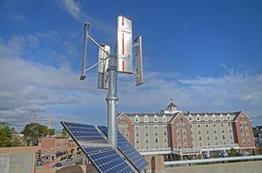
[…]Wing Power Energy’s technology is a vertical, four-blade wind propeller combined with a solar panel, which together can generate as much as 3.5 kilowatt hours of electricity.

Recently, the company put up a live demonstration in the City of Salem, consisting of three hybrid wind/solar turbines on the rooftop of a municipal parking garage powering 4G LTE enabled Verizon wireless equipment, including two video surveillance cameras, one digital signboard and a complete wireless network, completely off grid and running only on the power generated by the turbines. The company now has about 15 systems up and running or in the works around the country.

See on www.bizjournals.com

Commercial, institutional and federal buildings | Office of Energy Efficiency

See on Scoop.itGreen Building Operations – Systems & Controls, Maintenance & Commissioning

ENERGY STAR Portfolio Manager, developed by the U.S. Environmental Protection Agency, is being adapted for the Canadian buildings sector.

Duane Tilden‘s insight:

Portfolio Manager is a free, interactive energy management tool that allows you to track and assess energy and water consumption across your entire portfolio of buildings in a secure online environment.

See on oee.nrcan.gc.ca

Photovoltaics vs. Biofuel

See on Scoop.itGreen Energy Technologies & Development

As facility managers and building owners prepare for another year of green pushes and renewable energy options, has research determined a winner in the photovoltaic vs. biofuel energy battle?

Duane Tilden‘s insight:

[…] in a paper titled “Spatially Explicit Life Cycle Assessment of Sun-to-Wheels Transportation Pathways in the U.S.” and published in the Dec. 26 issue of the journal Environmental Science & Technology, showed photovoltaics (PV) to be much more efficient than biomass at turning sunlight into energyto fuel a car.

“PV is orders of magnitude more efficient than biofuels pathways in terms of land use – 30, 50, even 200 times more efficient – depending on the specific crop and local conditions,” says Geyer. “You get the same amount of energy using much less land, and PV doesn’t require farm land.”

The researchers examined three ways of using sunlight to power cars: a) the traditional method of converting corn or other plants to ethanol; b) converting energy crops into electricity for BEVs rather than producing ethanol; and C) using PVs to convert sunlight directly into electricity for BEVs.

… “The cost of solar power is dropping, and our quick calculations suggests that with the federal tax credit, electric vehicles are already competitive.”

What does this mean for the future?

“What it says to me is that by continuing to throw money into biofuels, we’re barking up the wrong tree,” Geyer explains. …

See on www.buildings.com