New Boston Start-up Tracks Multifamily Residential Energy Efficiency “Score”

wego_screen_shotWegoWise Inc., which provides energy analytics to private property owners and public housing entities, last week launched WegoScore, a rating system that assesses buildings in three areas, energy, water and carbon and then spits out a score between one and 100.

Source: www.bizjournals.com

>” […] “We are focusing on a universal approach with meaningful reductions,” WegoWise founder and CTO Barun Singh said of the platform.

With the water crisis in California and with 39 percent of carbon dioxide coming from buildings, property owners and public housing agencies are making energy-saving retrofits and want to market what they’ve done.

Those buildings that reach a high rating are issued certificates and decals to let the world know they are more efficient. Maloney Properties Inc., a Wellesley-based real estate management, sales and construction firm with 350 buildings, is featuring its decal proudly. Other area companies include Peabody Properties in Braintree and Homeowners Rehab, based in Cambridge.

The score not only brings awareness to a building’s efficiency, it also provides a way for property owners to market the value of the work completed in their buildings to perspective tenants who are concerned about the environment, Singh said. And the stickers are a fun way to market their accomplishments.

After using WegoWise, Maloney Properties was able to find $2.5 million in 2014 retrofits and expects to save 10 to 20 percent on utility costs related to the retrofits annually. John Magee, an assistant facilities director at Maloney, said the real estate company has been looking for a way to market the value of its properties. And now, the WegoScore will enable it to do that.

With the $4.9 million in funding it has raised from Boston Community Capital, WegoWise was able to build a portfolio of 23,000 multifamily buildings covering more than 600 million square feet. With all of the data that WegoWise has collected since its launch in 2010, coming up with a rating system would be a simple solution, right? Not exactly, according Singh.

Launching WegoScore was an expensive and lengthy process for the 25-person company, he said. Before launching the rating system, Singh said he wanted to be sure that had enough data to come up with a score that was meaningful.

“The end result is a straight-forward algorithm,” he said.

The WegoScore is currently only available for multifamily buildings, according to the company. Scores will be refreshed on a weekly basis and stickers are awarded twice a year.

In addition to gaining interest from its existing customers, venture-backed WegoWise is also garnering the attention of other potential partners including banks, who could use the score as a way to get a sense of the building and decide whether or not to lend to them, and insurance providers that would make decisions based on the building’s efficiency score and other factors. […]”<

See on Scoop.itGreen Building Operations – Systems & Controls, Maintenance & Commissioning
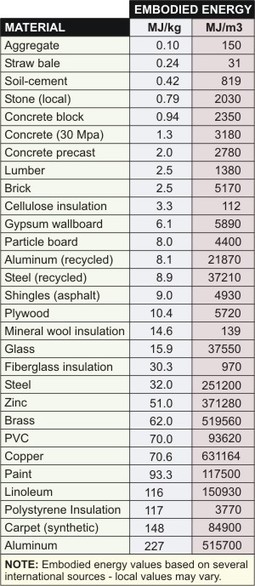
Embodied Energy – A Measure of Sustainability in Buildings & Construction

Embodied energy in building materials has been studied for the past several decades by researchers interested in the relationship between building materials, construction processes, and their environmental impacts.

Source: www.canadianarchitect.com

>” […]

What is embodied energy?
There are two forms of embodied energy in buildings:

· Initial embodied energy; and
· Recurring embodied energy

1.  The initial embodied energy in buildings represents the non-renewable energy consumed in the acquisition of raw materials, their processing, manufacturing, transportation to site, and construction. This initial embodied energy has two components:

  • Direct energy the energy used to transport building products to the site, and then to construct the building; and
  • Indirect energy the energy used to acquire, process, and manufacture the building materials, including any transportation related to these activities.

2.  The recurring embodied energy in buildings represents the non-renewable energy consumed to maintain, repair, restore, refurbish or replace materials, components or systems during the life of the building.

As buildings become more energy-efficient, the ratio of embodied energy to lifetime consumption increases. Clearly, for buildings claiming to be “zero-energy” or “autonomous”, the energy used in construction and final disposal takes on a new significance. […]”<

See on Scoop.itGreen & Sustainable News

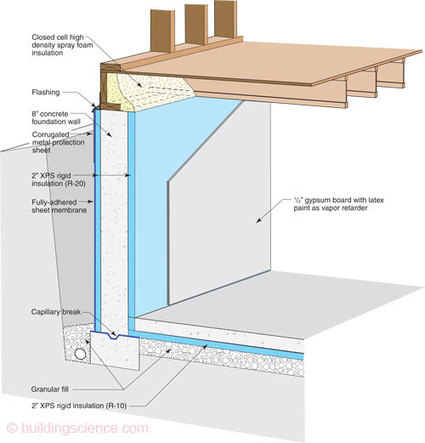
High-R20 Concrete Foundation Construction Diagram – Building Science

This construction strategy has an installed insulation R-value of R-20.

Source: www.buildingscience.com        >” […]


  • Dampproofing
  • 2″ XPS rigid insulation
  • Concrete foundation wall
  • 2″ XPS rigid insulation
  • 2″ XPS rigid sub-slab insulation
  • Gypsum board with vapor retarder paint
  • 2″ XPS rigid insulation under slab

Thermal Control:  This construction strategy has an installed insulation R-value of R-20 and has a predicted annual heating energy loss of 16.7 MBtus.

Moisture Control:  Two inches of XPS on the interior, connected to the thermal break at the slab edge, controls the interior vapor drive and capillary wicking to the interior so there are no moisture related issues from inward vapor diffusion or capillary wicking.

Constructability and Cost:  The interior of the insulated concrete form will require drywall or other thermal barrier to achieve the fire rating required by code. The gypsum board is very easy to attach to the plastic clips designed into the ICF. The drywall should not be painted, if it is not necessary, to allow maximum drying of the concrete. It may be easier and more practical to install a thin framed wall (e.g. 2×3 wood or steel framing) on the interior of the ICF to allow any necessary services to be run in the wall, and potentially more insulation.

Other Considerations:  Because the concrete is installed between two vapor retarding layers, it will take several years for the concrete to dry to equilibrium. Since additional interior vapor control should be avoided, no more than latex paint should be used on the interior surface of the drywall. […]”<


See on Scoop.itGreen Building Design – Architecture & Engineering

Berkeley City Property Owners to Pay For Energy Audits

Later this month, the Berkeley City Council is slated to approve a new law — designed to increase building sustainability and reduce greenhouse gas emissions — that will mandate new fees and recurring energy assessments for local property owners.

Source: www.berkeleyside.com

>” […] The law would require payment of a $79-$240 filing fee, depending on building size, by property owners every 5-10 years. On top of that, property owners will be required to undergo building energy assessments on the same cycle, conducted by registered contractors, to the tune of an estimated $200 for a single-family home and up to $10,000 for large commercial buildings.

The goal of the new law, according to the city, is to make “building energy use information more transparent to owners and prospective renters or buyers,” and ultimately inspire more investment in energy upgrades. The law would replace existing minimum energy and water efficiency measures in Berkeley. The proposed ordinance would not require that upgrades are actually done, but will compile energy scores and summaries for city properties, and make them readily available online.

Explained city sustainability coordinator Billi Romain, “Rather than require a list of specific measures, it requires an evaluation of a building’s efficiency opportunities and identifies all available incentives and financing programs.”

Romain said the hope is that, by giving people a “road map” for potential improvements, they will be more likely to schedule them to fit in with other home projects, such as seismic work. In addition to cutting down on local greenhouse gas emissions, the new ordinance has several other goals, from reducing utility costs that cause local dollars to “leak out” of Berkeley, to creating a more comfortable, durable building stock, as well as fortifying the local “green” workforce. […]

According to a city Energy Commission report on the ordinance, the assessments would take place on a five-year cycle for large buildings and every 8-10 years, or upon sale, for medium-sized and small buildings. Some of the costs may be offset by rebates and other incentives, and the program is set to include temporary “hardship deferrals” for those with financial constraints, and exemptions for high-efficiency buildings (see page 14). […]”<


See on Scoop.itGreen Building Operations – Systems & Controls, Maintenance & Commissioning