Shaw partners with City of Calgary to offer free public WiFi

See on Scoop.itTwitter & Social Media

The City of Calgary has reached an agreement with Shaw Communications to provide free Wi-Fi at city-owned locations.

Duane Tilden‘s insight:

>After reviewing applications, the city decided Shaw had the best proposal and technical expertise, and awarded Shaw the contract.

Shaw will partner with the city to install free WiFi zones in a variety of public locations including recreation facilties, parks and LRT stations.

“The City manages a variety of public spaces and we were looking to partner with an organization that would be able to provide reliable WiFi services, at no cost to citizens, as well as meet industry regulations and provide technical support,” says Heather Reed-Fenske, the city’s manager of  Information Technology.

During the initial launch of the program, public WiFi will be available in a select number of public spaces. […]

Mayor Naheed Nenshi says free public WiFi will give Calgarians better access to city services.

Once the initial zones are up and running, the city will collect feedback from Calgarians to evaluate the success of the program.

An announcement is expected soon on when the service will be available.<

See on globalnews.ca
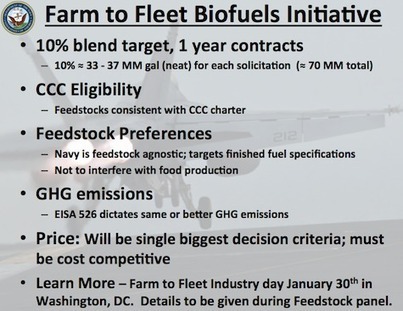
USDA, US Navy Unveil Farm to Fleet Program Shift to Biofuels Blends

See on Scoop.itGreen Energy Technologies & Development

In Washington, U.S.Secretary of Agriculture Tom Vilsack and Navy Secretary Ray Mabus unveiled the “Farm to Fleet” program, through which the Navy will begin to add biofuels into its regular domestic purchases of approximately 77 million gallons of…

Duane Tilden‘s insight:

>The Navy’s Transition to Biofuels: Testing and Certification

The Navy began testing aviation biofuels and marine biofuels on a ship-by-ship and jet-by-jet basis several years ago. Last summer, the Navy demonstrated a Green Strike Group operating on biofuels during the 2012 RIMPAC exercises.[RIMPAC is the world’s largest international maritime warfare exercise, held every two years out of Pearl Harbor, Hawaii, hosted by the US Pacific Fleet and featuring 22 nations and 42 ships in 2012, enhancing interoperability between Pacific Rim armed forces].

“It was at RIMPAC,” McGinn observed, “that we really got an end-to-end view on all the supply chain issues. Now, we are ready to deploy quickly. Now, it’s down to business. The intention now is to alert industry that we are open for business and that we are starting this program in a very realistic way.”

The Navy’s Transition to Biofuels: Capacity Building and Assurance of Supply

Alongside the testing and certification efforts, the Navy, USDA and DOE had announced a program in 2012 to directly invest up to $510 million, through the DPA Title III office and Commodity Credit Corporation (CCC), in order to assure that capital would be available to build production capacity and offset feedstock costs for drop-in biofuels that would meet the Navy’s needs, timelines and cost goals.

[Note for newer readers: DOE and DOD’s portion goes to DPA Title III to build biorefineries, USDA’s portion is in CCC funds to address feedstock development.]<

See on www.renewableenergyworld.com

Kinder Morgan files for Trans Mountain pipeline expansion to triple capacity

See on Scoop.itGreen & Sustainable News

A second pipeline proposal to transport oil to Asia was officially launched on Monday when Kinder Morgan filed a project application for its $5.4-billion Trans Mountain expansion.

Duane Tilden‘s insight:

>The project would nearly triple oil capacity to 890,000 barrels annually and bring about 400 more tankers a year into Burrard Inlet (up from about 80) if it is approved by the National Energy Board and subsequently by the federal government.

The 1,150-kilometre pipeline will carry diluted bitumen from the Alberta oilsands, starting in Edmonton, through Jasper and across B.C. to the company’s Westbridge Terminal in Burnaby.

Kinder Morgan says nearly three-quarters of the proposed expanded pipeline’s length across most of the province will follow the existing right-of-way where the pipeline was first built in the 1950s. About 17 per cent of the route, and virtually all the way through the Lower Mainland west of Fort Langley, will deviate from the current line, but would follow other existing utility corridors or infrastructure.

Kinder Morgan is promising enhanced tanker safety in its more-than-15,000-page submission, and says it is continuing discussions with First Nations, whose support is critical to large infrastructure development projects in B.C.

The twinning of Kinder Morgan’s existing pipeline has already seen years of pushback from First Nations, environmentalists and community groups concerned about the potential for spills along the pipeline and from tankers. Both Vancouver and Burnaby’s city councils have voiced opposition to the project.

The project would create about 90 permanent jobs, and employ 4,500 people at the peak of construction.<

See on www.vancouversun.com

Siemens awarded largest onshore wind power construction contract in Iowa

See on Scoop.itGreen Energy Technologies & Development

Siemens has received an order from the U.S. energy company MidAmerican Energy for the supply of 448 wind turbines.

Duane Tilden‘s insight:

>Hamburg, 2013-Dec-16

Siemens to supply 448 wind turbines with a total capacity of 1,050 megawatts and provide service for several yearsThe customer, MidAmerican Energy, will equip five wind power projects in the U.S. state of Iowa with Siemens wind turbinesClean energy for nearly 320,000 American households

Siemens has received an order from the U.S. energy company MidAmerican Energy for the supply of 448 wind turbines. With a total capacity of 1,050 megawatts (MW), this represents not only the largest order for onshore wind turbines for Siemens, but also the largest single order for onshore wind power awarded globally to date. The wind turbines, each with a nominal rating of 2.3 MW and a rotor diameter of 108 meters, are to be installed in five different projects in Iowa. Siemens will also be responsible for service and maintenance of the wind turbines.<

See on www.siemens.com

Should Community Managers or Board Members Oversee, Manage or Direct Construction, Remodeling or Renovation Projects?

Interesting article. Definitely a third party consultant with expertise in construction management/project management should be retained. In many instances where buildings are involved liability issues abound, and without knowledge of these issues, there can be extra costs incurred during construction.

Property managers or board members generally do not have this expertise, nor do they have liability insurance in case of problems down the road. An Architect or Engineer is usually the professional choice for larger projects or where the building is being altered in any significant way.

The Maintenance Manager's avatarThe Maintenance Manager

managementYou would think that no one in their right mind would want to step into a construction management role willingly, at least not without getting paid handsomely to take on that magnitude of responsibility and liability.  Consider that most larger jobs are plagued with change orders because it’s very difficult to predict with any certainly how much of the old existing timber, much of which is often hidden within the structure, is going to be compromised by either wood rot or termites.  In addition, many owners and board members decide they want to make changes as the project progresses, as their imaginations take flight.  Finally, jobs often change due to building department or financial constraints.  Essentially, larger construction and/or renovation projects are fluid and ever-changing. 

View original post 319 more words

Beyond Timers and Photocells: Wireless Lighting Control is Here

The Maintenance Manager's avatarThe Maintenance Manager

wirelessMost managers, HOA’s and buildings use either time clocks or photocells to turn their parking lot lights, landscape lights, signage and other outdoor lights on and off.  While time clocks and photocells are better than a plain switch, they are 1970’s technology. A new company called “Wireless Telematics”

View original post 194 more words

LEED v4: CHANGES ARE COMING TO CONSTRUCTION & DEMOLITION RECYCLING

greenhalo's avatarmy green halo

After extensive review and discussion, USGBC members have approved major changes in LEED v4, which includes a focus on performance in the Materials & Resources category.  Are you ready?

leed v4


Key Changes in LEED v4….

Alternative Daily Cover:

Projects will still receive 1 and 2 points for 50% and 75% diversion from landfill; however, Alternative Daily Cover has been specifically excluded from diversion from landfill calculations.

Pilot 3rd Point:

An additional point from the LEED Pilot Credit Library may be awarded to projects using a C&D recycling facility whose recycling rates have been verified by an authorized third-party.  This pilot point is currently in-progress with USGBC and is anticipated to be available in about a month.

Why is Third-Party Certification Important?

With LEED v4’s emphasis on performance it is important that recycling rates claimed by C&D recycling facilities are accurate and verified.  In addition to the Pilot 3rd Point under…

View original post 71 more words

Dallas — yes, Dallas — bans fracking in most of the city

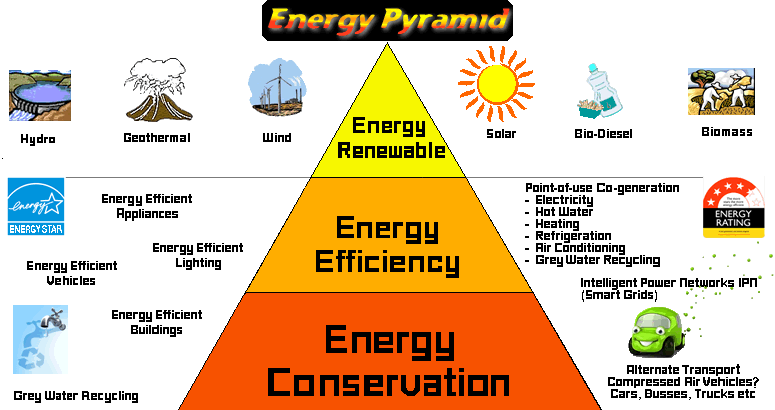
Utilities and Energy Efficiency – How to Bridge the Gap

energy-efficiency-pyramid

Image found at: http://bit.ly/1bAHOiM

See on Scoop.itGreen Building Operations – Systems & Controls, Maintenance & Commissioning

As much as such improvements can provide positive financial returns to utility customers, the utilities themselves face some very real financial barriers to offering customer energy efficiency programs.

Duane Tilden‘s insight:

>The inherent conflict between a utility’s business objectives and the objectives of customer energy efficiency programs has long been recognized. Alternative regulatory mechanisms can be implemented that not only make utilities indifferent to the amount of energy they sell, but that also can provide positive earnings from their customer energy efficiency programs. Alternative regulatory mechanisms such as “decoupling,” (separating an utility’s revenues from the amount of energy it sells to customers) are in place in a growing number of states.

Since the premise of these alternative regulatory mechanisms is that they can protect utilities from suffering financial harm from energy efficiency programs, ACEEE examined the experiences of a selected group of utilities to find out how well such regulations have worked. The utilities we selected all have relatively large-scale energy efficiency programs that serve all types of customers. We interviewed utility program managers and executives as well as clean-energy advocates and regulators. We also examined the financial performance of these utilities as represented by their stock performance.

What we found is that these utilities all have performed well financially. We found no evidence to suggest that energy efficiency programs have had negative effects on shareholder returns. While addressing utility business concerns with energy efficiency programs is clearly important, doing so is really just one part of comprehensive policies and regulations that support customer energy efficiency programs. Other keys to successful energy efficiency programs include:

Strong commitments to energy efficiency by regulators and utilities,Ongoing collaboration among utilities and stakeholders,Shared sense of purpose and common goals, and Willingness to experiment and learn from experiences.

See on aceee.org

Ten Clean Energy Stocks for 2013: Lessons Learned

See on Scoop.itGreen & Sustainable News

As we come into the final stretch of 2013, my annual model portfolio of Ten Clean Energy Stocks for 2013 looks certain to break its five year winning streak of beating its industry benchmark.

Duane Tilden‘s insight:

>Story Stocks

The big stories of 2013 were Elon Musk’s Tesla Motors (NASD:TSLA) and Solar City (NASD:SCTY), up 306 percent and 350 percent respectively.  As a value-focused contrarian investor, I’ve long known that there will be many years when story stocks outperform, but they also have a tendency to fall rapidly from their peaks.  Tesla has already fallen 30 percent from its peak over the last two months.  A contrarian eschews such spectacular gains in order to avoid the rapid declines that come to such story stocks on the slightest bit of bad news.  

Even if 2014 were to be another year led by other story stocks, I would not consider that reason to abandon my contrarian strategy.  Missing the rapid rise of stock you don’t own is not a loss, although it may feel like it to people who focus overmuch on the headlines.  If holding a contrarian investing stance were emotionally easy, everyone would be doing it.<

See on www.renewableenergyworld.com