Liquid Air for Utility-Scale Energy Storage? : Greentech Media

See on Scoop.itGreen Energy Technologies & Development

U.K.-based startup Highview Power Storage uses super-cooled air to store energy at potentially massive scale.

Duane Tilden‘s insight:

"In fact, it’s cost-competitive with the two most cost-effective energy storage technologies today: compressed air and pumped hydro. But where compressed air requires underground caverns, and pumped hydro requires dams and reservoirs, Highview’s system can scale up at 1 megawatt-hour of energy for every 10 tons of liquid air, Brett said."

See on www.greentechmedia.com

Tax credit extension for wind industry brings uncertainty

See on Scoop.itGreen Energy Technologies & Development

It’s unclear whether renewing the credit will undo recent layoffs.

Duane Tilden‘s insight:

“…The legislation is expected to help projects already or soon to be in the pipeline, but it’s unclear if a one-year extension will attract development of new projects or what the impact will be on restoring cut jobs….

The industry considers the 2.2-cents per kilowatt tax credit critical to wind being competitive with natural gas and solar energy.

The wind industry employs about 75,000 workers in the United States, and the credit extension could save 37,000 jobs, according to a statement from the American Wind Energy Association. But the group says uncertain federal policies have caused a “boom-bust” cycle for the industry. …”

See on www.omaha.com

Disadvantages of Solar Energy – InterNACHI

See on Scoop.itGreen Energy Technologies & Development

Solar energy has promise, but it still poses challenges

Duane Tilden‘s insight:

Some of the Disadvantages listed include:

–  lack of consistency and reliability.

–  size. To power an entire building, a large solar array is required.

–  panel deterioration. Like anything else left out in the sun, solar panels gradually become damaged by ultraviolet radiation. Rain, snow, dirt, temperature fluctuations, hail and wind also pose serious hazards.

–  cost.  The number of solar array panels needed to capture energy for an entire home typically costs tens of thousands of dollars….


See on www.nachi.org

Princeton’s nanomesh nearly triples solar cell efficiency | ExtremeTech

See on Scoop.itGreen Energy Technologies & Development

A research team at Princeton has used nanotechnology to create a mesh that increases efficiency over traditional organic solar cells nearly three fold.

Duane Tilden‘s insight:

"Led by Stephen Chou, the team has made two dramatic improvements: reducing reflectivity, and more effectively capturing the light that isn’t reflected. …Princeton’s new solar cell is much thinner and less reflective. By utilizing sandwiched plastic and metal with the nanomesh, this so-called “Plasmonic Cavity with Subwavelength Hole array” or “PlaCSH” substantially reduces the potential for losing the light itself. In fact, it only reflects about 4% of direct sunlight, leading to a 52% higher efficiency than conventional, organic solar cells.

PlaCSH is also capable of capturing a large amount of sunlight even when the sunlight is dispersed on cloudy days, which results in an amazing 81% increase in efficiency under indirect lighting conditions when compared to conventional organic solar cell technology. All told, PlaCSH is up to 175% more efficient than conventional solar cells. As you can see in the image to the right, the difference in reflectivity between conventional and PlaCSH solar cells is really quite dramatic."


see also:  http://www.opticsinfobase.org/oe/abstract.cfm?uri=oe-21-S1-A60

Stephen Y. Chou and Wei Ding

"Three of central challenges in solar cells are high light coupling into solar cell, high light trapping and absorption in a sub-absorption-length-thick active layer, and replacement of the indium-tin-oxide (ITO) transparent electrode used in thin-film devices. Here, we report a proposal and the first experimental study and demonstration of a new ultra-thin high-efficiency organic solar cell (SC), termed “plasmonic cavity with subwavelength hole-array (PlaCSH) solar cell”, that offers a solution to all three issues with unprecedented performances…."

See on www.extremetech.com

[US Dept. of Energy] Federal Energy Management Program: Energy Management Guidance

See on Scoop.itGreen Building Design – Architecture & Engineering

EERE » Federal Energy Management Program » Laws & Regulation

Energy Management Guidance

FEMP provides guidance on Federal laws and regulations to assist energy managers in complying with energy management requirements and goals. This section organizes FEMP guidance by the following subjects:

  • General Guidance for Facilities
  • Covered Facilities (EISA Section 432)
  • Sustainable Building Design and Operation
  • Greenhouse Gas Management
  • Advanced Metering
  • Water Efficiency
  • Energy-Efficient Products
  • Renewable Energy Technologies
  • Fleet Management
Duane Tilden‘s insight:

This webpage provides a comprehensive set of up to date links providing a wide range of Energy Management guidelines.  It is set up as a resource for Federal Agencies, thus is National in scope and covers a range of topics.  A useful nexus site for anyone in the industry of Energy Efficiency or Renewable Energy, and professions/users/decision makers who rely on a reliable source of Government Agency information.  ~ DT

See on www1.eere.energy.gov

Student leaders want universal energy standards on Montana campuses

See on Scoop.itGreen Energy Technologies & Development

The Montana University System could shave tens of thousands of dollars off its utility costs by making energy upgrades to its buildings and investing the savings back into projects aimed at further efficiency, a recent study suggests.

Duane Tilden‘s insight:
  • “While researching the SBI, they came across a Montana code passed by the Legislature in 2009. It directs state agencies, including the university system, to adopt high-performance building standards when new state buildings are constructed, or when major renovations take place.”
  • “The standards call on agencies to optimize energy performance and enhance indoor environmental quality. They also direct agencies to conserve natural resources and cut energy costs.”
  • “But four years after the code was adopted, the state has not agreed upon a universal high-performance building standard. The lack of such guidance — good for all state buildings, including those at public universities — has student leaders and other proponents frustrated.”
  • ”To the layman, the array of standards appear similar in their goal to make efficiency a way of life in taxpayer-funded buildings across Montana. Yet the rating systems differ, however slightly, and state officials haven’t agreed on which standard agencies should follow.
  • “There’s a number of high-performance building standards being proposed and used,” Javins said. “There’s been a series of (state) meetings to develop the administrative rules so they can enact that 2009 legislation.” “

See on missoulian.com

Technology Surge Leads to Reinstatement of ASTM Solar Energy Standard, ASTM Interna

See on Scoop.itGreen Energy Technologies & Development

Technology Surge leads to reinstatement solar energy standard. – ASTM International

Duane Tilden‘s insight:

"“Since 2003, there has been tremendous growth in solar energy systems technology, along with new developments in materials science related to solar energy, windows technology and thermal energy management films,” says Daryl Myers, an ASTM member who is retired after 37 years…"


"The standard establishes uniform criteria for measurement procedures, equipment and reporting of results with respect to modern measurement equipment. ASTM E903 will be used by manufacturers of glass, coatings, films and optical components of solar energy systems elements to assess the reliability, durability and performance of these components in order to optimize the entire materials system performance."

See on news.thomasnet.com

Smart Grid: The why, when and how of full-circle customer engagement

See on Scoop.itGreen Energy Technologies & Development

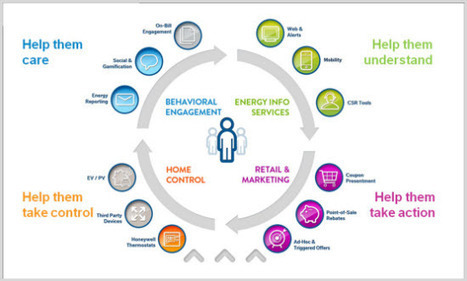
Smart Grid – The electric power industry has entered a new phase of customer engagement. No longer is it sufficient to put a Band-Aid on existing approaches. Instead, utilities need to step back

Duane Tilden‘s insight:

….In recent years, vendors including Google and Microsoft have experimented with going around utilities in an attempt to establish a direct relationship with power customers. It hasn’t worked to date. I’m in agreement with Opower’s Kavazovic. “They’ve got the relationship. And they’ve got the data, including invaluable AMI data,” he says. “The utility role is essential.”

We’ll be going into much more detail about full-circle customer engagement at our webinar on Wednesday, Jan. 16. We will have multiple experts on hand to highlight lessons learned by the utilities who’ve gone before. And to answer your individual questions. The webinar is free to Smart Grid News readers, but you must click to reserve a place in advance.”

Jesse Berst is the founder and chief analyst of Smart Grid News.com, the industry’s oldest and largest smart grid site. A frequent keynoter at industry events in the U.S. and abroad, he also serves on advisory committees for Pacific Northwest National Laboratory and the Institute for Electric Efficiency. He often provides strategic consulting to large corporations and venture-backed startups. He is a member of the advisory boards of GridGlo and Calico Energy Services.

Detroit Edison Sues Customers over Smart Meter “Tampering”

See on Scoop.itGreen Energy Technologies & Development

A subsidiary of Detroit Edison (DTE) Energy is suing two consumers for removing their smart meters and replacing them with devices they bought. The utility states that tampering with the smart meters and other such equipment is a potential felony….

Duane Tilden‘s insight:

"….DTE and other utilities have consistently asserted the devices are safe and secure. Studies have also maintained smart meters do not pose a threat to homeowners. " | "In documents filed in Oakland County Circuit Court, one of the litigants, …, claims she began to experience health issues such as nausea, headaches, and insomnia after DTE deployed the smart meter was installed at her residence in September 2011. …"

See on www.smartmeters.com

E-DeMa, a smart meter field test in Germany – Smart Grid Watch – Siemens Global Weblogs

See on Scoop.itGreen Energy Technologies & Development

700 households in west-central Germany that joined the E-DeMa project– the largest field test of intelligent power use in private households ever conducted in Germany.

Would you change your energy use habits if you could save over 10% on energy costs?

Duane Tilden‘s insight:

"As a first step, each household’s electricity meter was replaced with a digital smart meter….. Smart meters record power consumption data on an internal memory chip at 15-minute intervals. Once a day these data are anonymized and transmitted via the power lines to an energy-data management system. "  |  "Some 100 households that were selected at random have been equipped with smart appliances from Miele. “These appliances automatically choose the lowest tariff for their operating cycle,” …"  |  "Another 13 households.. were fitted with combined heat and power units (micro-CHPs). In addition to producing hot water, these can also generate electricity. “If demand for power exceeds the amount currently on offer from the utility, the micro-CHPs can be activated via the gateway to feed electricity into the grid,”…"

See on blogs.siemens.com