Twitter Tip: Create Multiple Twitter Accounts With the Same Email Address – GroupTweet Blog

See on Scoop.itTwitter & Social Media

Have you ever tried to signup for a second Twitter account using an email address that has already been used?  ….  Don’t worry the solution is easy.  The only thing you need is a Gmail address.

Duane Tilden‘s insight:

This works!

See on grouptweet.com

Scoop.It for SEO – A New World of Curation [Infographic]

See on Scoop.itTwitter & Social Media

It’s the backbone, the nerve centre, as well as the driving force when it comes to the online world.

Duane Tilden‘s insight:

Content Curation:  
>For almost everyone who is a part of the online world coming up with fresh content consistently is a big challenge. Practically every guideline that you refer to advices that content should be engaging, informative and relevant every single time and sometimes it can be hard to churn so much all the time.

Consequently, content curation has taken off in a big way. Simply put, content curation is the process of curating relevant and interesting content from various sources on the web and putting them together and publishing them on a personal site or blog. At this juncture, we’d also like to mention how important it is to cite your sources.

As a result of the popularity of the content curation process, a number of content marketing tools have been introduced. These tools are meant to help in the process of content marketing and SEO and facilitate the process of curation.<


See on www.techmagnate.com

Natural landscapes: autumn white – Banff National Park

moraineweb1Banff National Park – Natural landscapes: autumn white.

Photographer:  Frank King

http://bit.ly/19J6rx7

Natural landscapes: a sunrise moment

Banff Photography – Natural Landscapes – Winter

Frank King Photos's avatarFRANK KING PHOTOS

CASTLE MOUNTAIN AND BOW RIVER, BANFF NATIONAL PARK, ALBERTA

A classic scene from the glorious Canadian Rocky Mountains. I clambered down through waist-high snow to get to the river’s edge and make this photograph with a Nikon D90, tripod, polarizing filter and two-stop graduated density filter (to darken the sky). The shaft of sunrise light was an extraordinary bonus.

Click on the picture for a larger view.

Want to buy this picture? Email me and I’ll make it happen! (fdking@hotmail.com).

Check out my coffeetable book “BLUE SYMPHONY: Winter in the Canadian Rockies”: http://bit.ly/kFb3Xw


CastleMtn.Web1

View original post

Top 10 Big Data Stories Of 2013

See on Scoop.itTwitter & Social Media

Big data equals big opportunity — and a surplus of hype. Catch up on the big data articles that interested readers most in 2013.

See on www.informationweek.com

China hands ‘death sentence’ to 75% of solar cell makers- Nikkei Asian Review

See on Scoop.itGreen Energy Technologies & Development

SHANGHAI — The Chinese government is pushing for a drastic shakeout of the country’s overcrowded solar cell industry, supporting only a quarter of players and practically telling the rest to get out of the business. 

The Ministry of Industry and Information Technology has announced a list of 134 producers of silicon materials, solar panels and other components of photovoltaic systems as meeting certain conditions, as measured by 2012 production, capacity utilization and technical standards.

See on asia.nikkei.com

Renewable energy use at record high

See on Scoop.itGreen & Sustainable News

See on www.bbc.co.uk

Scientists Convert Algae into Crude Oil in Less than One Hour

See on Scoop.itGreen Energy Technologies & Development

Pacific Northwest National Laboratory engineers a way to turn algae into usable crude oil without a million years wait or harmful and expensive chemicals.

Duane Tilden‘s insight:

>Department of Energy scientists at the Pacific Northwest National Laboratory say they’ve reduced nature’s million year process of turning algae into crude oil to one than takes less than an hour. The engineers created a chemical process that produces crude oil minutes after it is poured into harvested algae. The reaction is not only fast, but also continuous since it produces a recyclable by product containing phosphorus that can then be used to grow more algae.   […]

The scientists say with additional conventional refining, the crude algae oil can be converted into a variety of fuels for aviation, gasoline burning cars, or diesel vehicles. Meanwhile, the wastewater can also be used to yield burnable gas or elemental substances like potassium and nitrogen, which, along with the cleansed water, can grow more algae.

The new process promises to reduce time and save money compared to other techniques by combining several chemical steps and skipping the process of drying out the algae. Instead, the new process uses a slurry that contains as much as 80 to 90 percent water while eliminating the need for complex processing solvents like hexane to extract the energy rich oils from the algae. Elliott said in addition to saving time, “there are bonuses, like being able to extract usable gas from the water and then recycle the remaining water and nutrients to help grow more algae, which further reduces costs.”<

See on inhabitat.com

Biofuel Start-Up Uses Drought Resistant Jatropha Plant Seeds

See on Scoop.itGreen Energy Technologies & Development

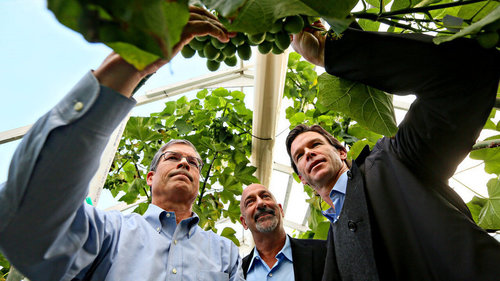
Advances in molecular genetics and DNA sequencing technology have allowed a San Diego start-up to domesticate jatropha, a plant with seeds that produce high-quality oil that can be refined into low-carbon biofuel.

Duane Tilden‘s insight:

>Hailed about six years ago as the next big thing in biofuels, jatropha attracted hundreds of millions of dollars in investments, only to fall from favor as the recession set in and as growers discovered that the wild bush yielded too few seeds to produce enough petroleum to be profitable.

But SGB, the biofuels company that planted the bushes, pressed on. Thanks to advances in molecular genetics and DNA sequencing technology, the San Diego start-up has, in a few years, succeeded in domesticating jatropha, a process that once took decades.

SGB is growing hybrid strains of the plant that produce biofuel in quantities that it says are competitive with petroleum priced at $99 a barrel. Oil is around $100 a barrel.

The company has deals to plant 250,000 acres of jatropha in Brazil, India and other countries expected to eventually produce about 70 million gallons of fuel a year. That has attracted the interest of energy giants, airlines and other multinational companies seeking alternatives to fossil fuels. They see jatropha as a hedge against spikes in petroleum prices and as a way to comply with government mandates that require the use of low-carbon fuels.<

See on www.nytimes.com