Smart Grid: Energy storage: Why are we ignoring thermal?

See on Scoop.itGreen Energy Technologies & Development

Smart Grid – We call storage the game-changer and we bemoan the high cost of batteries, pumped hydro and other techniques. A story on a new electric “storage heater” introduced in the UK

Duane Tilden‘s insight:

Thermal energy storage generally requires considerable mass (volume of water) to store needed energy.  Phase change materials may hold some promise in energy storage.

See on www.smartgridnews.com

Microgrid Energy Storage > ENGINEERING.com

See on Scoop.itGreen Energy Technologies & Development

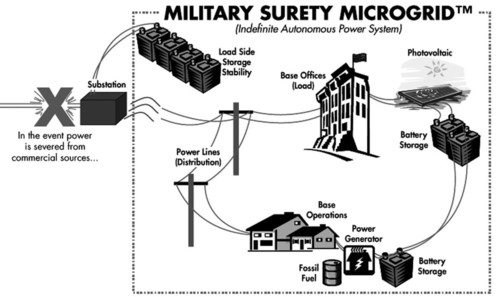
Primus Power, a manufacturer of grid-level energy storage solutions, has received a contract to develop an energy storage system that will be used with a microgrid at the United States Marine Corps Air Station (MCAS) in Miramar, California.

See on www.engineering.com

Energy Storage Technologies for the Smart Grid

See on Scoop.itGreen Energy Technologies & Development

Energy storage is a critical component of the future Smart Grid.

Duane Tilden‘s insight:

Peak Shaving

Peak shaving is another application of Smart Grid storage that witnesses rapid growth. Peak shaving represents the storage of energy generated or purchased in case of low demand time periods at lower prices, followed by the usage or selling of the stored energy at times of high prices and demand. Peak shaving is economically feasible if the cost of electrical grid storage is lower than that of local generation, which is the current peak shaving technique of choice for several industrial facilities.


Besides peak shaving, storage will also be the key for the efficient management of transmission capacity required for achieving global solar and wind energy goals. Energy storage will enable solar and wind power generators to supply electricity for maximum profit at peak usage periods and transfer the electricity to market through lower-capacity transmission lines. At present, sodium sulfur and lead-acid systems are widely used for peak shaving.

See on www.azom.com

Wind Power Opponents Fail to Deter Farmers

See on Scoop.itGreen & Sustainable News

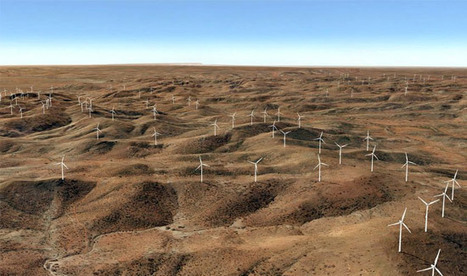
Epuron Wind Farm Rural landholders in the Southern Tablelands region of New South Wales are pushing to expand the development of solar and wind power farms by multinational energy companies despite the strident opposition of local detractors.

Duane Tilden‘s insight:

Many local farmers have jumped at the opportunity to collaborate with international players in the renewable energy sector. Prell is currently in negotiations with Spanish power company Union Fenosa to construct turbines on his farm, and told  Fairfax that he is highly optimistic about the  long-term prospects for wind power in the region.

See on designbuildsource.com.au

Why We’re So Far Behind On Biofuel Targets

See on Scoop.itGreen Energy Technologies & Development

A major cellulosic ethanol project is underway in Boardman, but the U.S. is hopelessly behind on reaching its targets for production nationwide.

Duane Tilden‘s insight:

Cellulosic ethanol is the new promised land for renewable biofuels in the U.S. It’s made from wood chips and farm waste – not food crops – so it doesn’t compete with businesses that need corn for livestock or food products. If they’re made from waste products, the Energy Information Administration says their lifecycle greenhouse gas emissions can be 80 to 90 percent less than petroleum products.


[…]

The EIA estimates output could grow to more than 5 million gallons by the end of this year, and up to 250 million gallons by 2015 as several plants ramp up production. That’s after admitting that previous projections "have proven to be "too optimistic."


According to the agency, delays and cancellations at production plants, cheap natural gas and the country’s debt crisis have all contributed to the missed targets. And then, of course, there’s also the fact that it costs more.

"Total production costs for many of

See on www.opb.org

EDGE Program – Our Growing Biofuels/Industrial Biotechnology Industry

See on Scoop.itGreen & Sustainable News

Educating and Developing workers for the Green Economy (EDGE) Program

Duane Tilden‘s insight:

Biofuels Science Certificate

The Biofuels Science Certificate is a hybrid program with lecture courses completed online, followed by intensive laboratory courses completed at the UCSD campus during summer. It is aimed at training professionals for field and laboratory roles in the growing biofuels industry. It provides students hands-on technical knowledge and experience in laboratory techniques used in biofuels production, analysis and processing. Students choose from one of the following specialization tracks: Molecular Biology, Aquatic Microbiology, or Analytical Chemistry.

See on algae.ucsd.edu

Secure integration of smart meters in the smart grid

Secure integration of smart meters in the smart grid.

How and why LinkedIn is becoming an engineering powerhouse

See on Scoop.itTwitter & Social Media

Five years ago, LinkedIn was a shell of the technology company it is today. Here’s an inside look at where it came from, what it’s become and where it’s going.

Duane Tilden‘s insight:

Next up, Hadoop

Thus far, LinkedIn’s biggest push has been in improving its nearline and online systems (“Basically, we’ve hit the ball out of the park here,” Ghosh said), so its next big push is offline — Hadoop, in particular. The company already uses Hadoop for the usual gamut of workloads — ETL, model-building, exploratory analytics and pre-computing data for nearline applications — and Ghosh wants to take it even further.


He laid out a multipart vision, most of which centers around tight integration between the company’s Hadoop clusters and relational database systems. Among the goals: better ETL frameworks, ad-hoc queries, alternative storage formats and an integrated metadata framework — which Ghosh calls the holy grail — that will make it easier for various analytic systems to use each other’s data. He said LinkedIn has something half-built that should be finished this year.

See on gigaom.com
US may face inevitable nuclear power exit

See on Scoop.itGreen & Sustainable News

In the third and final issue in a series focused on nuclear exits, the Bulletin of the Atomic Scientists, published by SAGE, turns its attention to the United States and looks at whether the country’s business-as-usual approach may yet lead to a…

Duane Tilden‘s insight:

Allowing existing reactors to simply run out their licensed lifetimes in the current scenario, nuclear power may simply disappear, he writes. "Absent an extremely large injection of government funding or further life extensions, the reactors currently operating are going to end their licensed lifetimes between now and the late 2050s," Bradford concludes. "They will become part of an economics-driven US nuclear phase-out a couple of decades behind the government-led nuclear exit in Germany."

See on www.sciencedaily.com

Shale Gas and Tight Oil: Boom? Bust? Petering Out? | The Energy Collective

See on Scoop.itGreen & Sustainable News

Governments and industry must recognize that shale gas and oil are not cheap or inex­haustible: 70% of US shale gas comes from fields that are either flat or in decline.

See on theenergycollective.com