[CHINA] Huangshan Mountain Village: sustainability grows in the Chinese landscape

See on Scoop.itGreen Building Design – Architecture & Engineering


MAD has unveiled plans for a towering village of apartment blocks beside the Huangshan Mountains in eastern China. 


Inspired by the topographical layers of the landscape, the buildings will have organically shaped floor plates and will emerge from amongst the treetops on a site beside the Taiping Lake.

See on www.dezeen.com

Saudi Arabia among the least energy efficient

See on Scoop.itGreen & Sustainable News

Kingdom s energy consumption will double by 2030 if hydrocarbon use continues at current levels…

See on gulfnews.com

Google Supporting USGBC on Green Building Materials

See on Scoop.itGreen Building Design – Architecture & Engineering

EcoGeek – Technology for the Environment…


“A grant of $3 million from Google to the US Green Building Council (USGBC) was announced during the annual Greenbuild conference which is taking place in San Francisco this week. …”

See on www.ecogeek.org

U.S. Green Building Council launches Green Building Information Gateway – Daily Commercial News

See on Scoop.itGreen Building Design – Architecture & Engineering

The U.S. Green Building Council (USGBC) has announced the launch of the Green Building Information Gateway.


“Users can search and explore green building activity around the world, analyze trends and patterns in green building practice and discover connections between projects, people, products and services. Additional information is available at: GBIG.org . “

See on www.dcnonl.com

Green Building Council encourages adapting to changing climate

See on Scoop.itGreen Building Design – Architecture & Engineering

The devastation caused by Hurricane Sandy highlights the fragile connection between the natural and built environments.

See on azstarnet.com

The Energy Efficiency Directive (EED) has been officially published! | BUILDUP

See on Scoop.itGreen Building Operations – Systems & Controls, Maintenance & Commissioning



(1)The Union is facing unprecedented challenges resulting
from increased dependence on energy imports and scarce
energy resources, and the need to limit climate change
and to overcome the economic crisis. Energy efficiency is
a valuable means to address these challenges. It improves
the Union’s security of supply by reducing primary
energy consumption and decreasing energy imports. It
helps to reduce greenhouse gas emissions in a cost-
effective way and thereby to mitigate climate change.
Shifting to a more energy-efficient economy should also
accelerate the spread of innovative technological
solutions and improve the competitiveness of industry
in the Union, boosting economic growth and creating
high quality jobs in several sectors related to energy
efficiency.

(2)The Conclusions of the European Council of 8 and
9 March 2007 emphasised the need to increase energy
efficiency in the Union to achieve the objective of saving
20 % of the Union’s primary energy consumption by
2020 compared to projections. …

(3)The Conclusions of the European Council of 17 June
2010 confirmed the energy efficiency target as one of
the headline targets of the Union’s new strategy for jobs
and smart, sustainable and inclusive growth (‘Europe
2020 Strategy’). …

(16)Bearing in mind that the Council conclusions of 10 June
2011 on the Energy Efficiency Plan 2011 stressed that
buildings represent 40 % of the Union’s final energy
consumption, and in order to capture the growth and
employment opportunities in the skilled trades and
construction sectors, as well as in the production of
construction products and in professional activities such
as architecture, consultancy and engineering, Member
States should establish a long-term strategy beyond
2020 for mobilising investment in the renovation of
residential and commercial buildings with a view to
improving the energy performance of the building
stock. That strategy should address cost-effective deep
renovations which lead to a refurbishment that reduces
both the delivered and the final energy consumption of a
building by a significant percentage compared with the
pre-renovation levels leading to a very high energy
performance. Such deep renovations could also be
carried out in stages.


Full PDF at http://bit.ly/U7lSav

See on www.buildup.eu

Solar shading: a natural, passive cooling method necessary for nearly zero-energy buildings.

See on Scoop.itGreen Building Design – Architecture & Engineering

The potential contribution from solar shading has been underestimated, despite the widely recognised fact that avoiding overheating reduces cooling demand.
Undoubtedly, much of the work starts at design stage. BUILD UP has a wealth of resources on this subject.

See on www.buildup.eu

Technology harvests energy from railroad train vibrations

See on Scoop.itGreen Energy Technologies & Development

Engineers have won a national award for an innovative energy harvester that has the potential to save millions of dollars in energy costs for railroads while reducing carbon dioxide emissions.


The team’s work, “Mechanical Motion Rectifier (MMR) based Railroad Energy Harvester,” was awarded “Best Application of Energy Harvesting” at the Energy Harvesting and Storage USA 2012 conference, held in Washington, DC on November 7-8, 2012.
The Stony Brook team, led by Professor Lei Zuo and two graduate students Teng Lin and John Wang from the Department of Mechanical Engineering and Advanced Energy Research and Technology Center, developed a new type of energy harvester that converts the irregular, oscillatory motion of train-induced rail track vibrations into regular, unidirectional motion, in the same way that an electric voltage rectifier converts AC voltage into DC.


Professor Zuo estimates that the invention could save more than $10 million in trackside power supply costs for railroads in New York State alone, along with a reduction of 3000 tons per year of CO2 and a half million dollars of electricity savings.

See on www.sciencedaily.com

Color-Coding System [Vending Machines] Helps Save Energy

See on Scoop.itGreen Building Operations – Systems & Controls, Maintenance & Commissioning

Today, vending machines dispense just about everything imaginable, including gum, drinks, sandwiches, and electronics.


“Most vending machines, specifically refrigerated systems, waste loads of electricity each year. It is estimated that a conventional vending machine uses 3,000 to 4,000 kilowatt hours (kWh) per year. This is about a third of all the electricity the average US household uses in a year’s time. A large vending machine, and one that is placed outside in a warm, sunny climate, can use even more power.” 


“…as of 2012, new refrigerated vending machines are required to use no more than 1,800 kWh per year. However, because vending machines can have a relatively long life span and are relatively inexpensive to repair, transfer to more energy-efficient systems may take years). Instead, they work 24 hours per day, seven days per week, whether needed or not.”


See on www.energymanagertoday.com

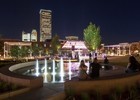
TULSA, Okla.: Tulsa’s Guthrie Green ‘Central Park’ by SWA Group Catalyzes Urban Regeneration in Growing Oklahoma Town | Business Wire | Rock Hill Herald Online

See on Scoop.itGreen Building Design – Architecture & Engineering

Former truck facility reborn as 2.7-acre park and music concourse with innovative geotherm energy to heat/cool adjacent arts buildings


“Early in the design, the team conceived of installing a ground-source heat pump system under the park. Consisting of 120 wells drilled to 500 feet depth, the “geo-exchange” system generates 600 tons (7.2 million BTUs/hour) of heating/cooling distributed via underground pipes to serve 120,000 square feet of nearby non-profit users as well as Guthrie Green’s cafe pavilion and bathrooms. Photovoltaic panels on the pavilion roof supply power for the heat pump system. The system enables 60% reduction in energy demand, with investment payback in five to seven years. The concept won the project a $2.5 million ARRA Stimulus Grant and other state/local funding.”


See on www.heraldonline.com