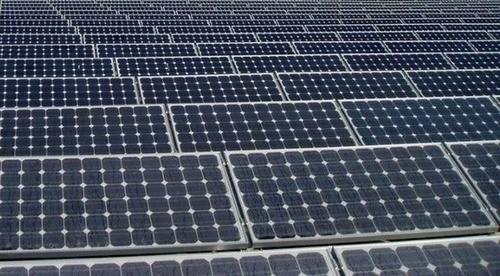
Soaring Solar Power Giving Politicians Headaches

“…As a cautionary tale, it’s worth gazing across the north sea. Germany had been subsidising its solar power recklessly. Due to the state guaranteeing the revenues for 20 years, no home owner could put a foot wrong by putting a solar panel on his roof. Green Entrepreneurs like Frank Asbeck, founder of market leader Solarworld, became millionaires – and the costs were rising constantly.

Who had to pay for all that? Mr. Average had to. Each and every kilowatt hour of solar electricity had to be subsidized by the customers, through individual energy bills. So prices rose. Soon, Angela Merkel was facing a severe backlash – by the energy intensive industry which was faced with severely mounting production costs, by the lesser partner in her coalition and by consumer groups. Germany’s political leader gave in soon: last summer, subsidies were cut drastically. …”

florianbamberg's avatarEnergy in Germany

Despite cuts in subsidies, solar power has been soaring in Germany throughout 2012. According to the industry association BSW-Solar, the energy produced has risen by 45 percent, to 28 billions of kilowatt hours.

View original post 87 more words

Maritimes Exploring How to Capture and Use Wind Power

Because wind can only create electricity when it is blowing, power utilities need backup generators in order to keep the lights on.

Wind energy supplies about nine per cent of the power load in Nova Scotia.

“Wind turbines are producing energy but when the wind stops, we’re balancing and offsetting that wind power with the coal plant, which creates greenhouse gases,” Jennex said.

Smart Grid Policy Trends to Watch in 2013 | The Energy Collective

See on Scoop.itGreen Energy Technologies & Development

So what will be the most influential Smart Grid trends in 2013? There’s always the potential for technology breakthroughs – particularly in fixed and mobile energy storage.  However, we’re well overdue for gamechanging policies…

Duane Tilden‘s insight:

Here are four policy trends that will gain momentum in 2013:

  1. Industry attention will focus on transactive energy, which conceptualizes the impacts of widely distributed energy resources on utility business models, technologies/services, markets, and consumers. […]
  2. … regulators will consider how to influence utilities to act as distribution grid load controllers to accommodate new sources of kilowatts or negawatts without detriments to grid reliability and resiliency.  […]
  3. The energy/water nexus will become a more dominant part of project and technology conversations.  […] Natural gas fracking technologies will come under greater scrutiny in terms of the impacts of drilling fluids and practices to the purity of ground and underground water supplies.
  4. In a rare show of bipartisanship, Congress will allow Master Limited Partnerships (MLPs) for renewable energy, which are currently limited to oil and gas investments.  […]

See on theenergycollective.com

Most Read Report of 2012: 10 Reasons Why Sustainable/Energy Retrofits of Commercial Buildings Will Be the Next Big Thing

See on Scoop.itGreen Energy Technologies & Development

According to the US Department of Energy, commercial buildings account for 35 percent of US (and 40 percent of global) electricity consumption. Existing commercial buildings on average spend 30 percent of their operating budgets on operating …

Duane Tilden‘s insight:

“Today, the majority of all commercial building owners and managers recognize that energy efficiency retrofits have the potential to yield substantial savings on operating costs, while reducing a building’s environmental footprint. …”

“While not intended to be an exclusive list, the drivers of this industry movement include the following:

1. New financial tools created by lenders, academics and entrepreneurs to facilitate underwriting the economic benefits of such retrofits will become mainstream, […]

2. Existing financing structures will become more acceptable, each serving certain segments of the marketplace: […]

3. Performance contracting will continue to be used as turn-key solutions for sustainable energy retrofit projects and assist in securing existing third-party financing.  […]

4. Green leases and green tenant demands are on the rise, causing landlords to support these market demands through increased energy efficiency.  […]

5. According to the Rocky Mountain Institute and Johnson Controls, the ESCO industry was sized in 2011 at $4.1 billion and is currently growing at a rate of 26 percent per year.  By 2020, Pike Research projects that the market for retrofits in commercial buildings will reach $152 billion worldwide.

6.  In order to meet legislative greenhouse gas (carbon reduction) mandates at the federal, state and local levels, large-scale retrofit projects, in which combined technologies are utilized to optimize buildings as a whole system, will have to be utilized on a national basis.  The Deep Energy Efficiency Pays (DEEP) program is one example […]

7. Advancements in building automation technologies and the convergence of information technology and building data are forcing the commercial marketplace towards DEEP retrofits on a global basis.  […]

8. In the United States, various federal agencies […] are creating and rolling out programs to incentivize building owners to engage in sustainable/energy retrofits.

9. One of the fastest-growing LEED rating systems over the past two years has been LEED for Existing Buildings Operating and Maintenance (LEED-EB: O&M).  […]

10.  Performance disclosures, highlighted by new legislation in California that mandates the disclosure of building performance to all new tenants and buyers, will drive building owners to increase overall efficiency metrics of existing commercial buildings through retrofits. ”

See on www.environmentalleader.com

Smart Grid: The Next 10 Years: 5 keys to smart grid success

See on Scoop.itGreen Energy Technologies & Development

Smart Grid – We’re wrapping up our series on the smart grid’s next 10 years with insights on what it’s going to take for smart grid success from Rob Wilhite, who is Global

Duane Tilden‘s insight:
  1. Interoperability and cyber security […]
  2. Incorporating customer-owned power generation and energy storage devices […]
  3. Data analytics and predictive modeling […]
  4. The scope of smart grids will broaden to smart energy systems on the one hand and smart cities on the other hand. […]
  5. Development of new standards and ecosystems of standards will continue and governments, utilities and end-users will enforce that interoperability of smart energy products and services is guaranteed. […]

See on www.smartgridnews.com

Substation automation’s importance to smart grid development

See on Scoop.itGreen Energy Technologies & Development

The term smart grid has grown to encompass a wide range of technologies, procedures, software and hardware, but one of the most critical advancements that has been made could be one the public hasn’t even heard about – substation automation.

Duane Tilden‘s insight:
  • … “Substations are used to transform voltage several times in many locations, ensuring safe and reliable delivery of power. These systems are also necessary for splitting the path of electricity flow into many directions, which can be used to isolate parts of the grid to make repairs or manage energy for various reasons.”
  • … “Substations require a huge amount of large, expensive equipment to operate, including transformers, circuit breakers, switches, capacitor banks, a network of protective relays and several others.” …
  • “All over the country, substation modernization projects have already begun. In the Northeast, Central Maine Power Company (CMP) recently announced it had activated its first major substation that is a part of its $1.4 billion Maine Power Reliability Program.”

See on www.subnet.com

Liquid Air for Utility-Scale Energy Storage? : Greentech Media

See on Scoop.itGreen Energy Technologies & Development

U.K.-based startup Highview Power Storage uses super-cooled air to store energy at potentially massive scale.

Duane Tilden‘s insight:

"In fact, it’s cost-competitive with the two most cost-effective energy storage technologies today: compressed air and pumped hydro. But where compressed air requires underground caverns, and pumped hydro requires dams and reservoirs, Highview’s system can scale up at 1 megawatt-hour of energy for every 10 tons of liquid air, Brett said."

See on www.greentechmedia.com

Tax credit extension for wind industry brings uncertainty

See on Scoop.itGreen Energy Technologies & Development

It’s unclear whether renewing the credit will undo recent layoffs.

Duane Tilden‘s insight:

“…The legislation is expected to help projects already or soon to be in the pipeline, but it’s unclear if a one-year extension will attract development of new projects or what the impact will be on restoring cut jobs….

The industry considers the 2.2-cents per kilowatt tax credit critical to wind being competitive with natural gas and solar energy.

The wind industry employs about 75,000 workers in the United States, and the credit extension could save 37,000 jobs, according to a statement from the American Wind Energy Association. But the group says uncertain federal policies have caused a “boom-bust” cycle for the industry. …”

See on www.omaha.com

Disadvantages of Solar Energy – InterNACHI

See on Scoop.itGreen Energy Technologies & Development

Solar energy has promise, but it still poses challenges

Duane Tilden‘s insight:

Some of the Disadvantages listed include:

–  lack of consistency and reliability.

–  size. To power an entire building, a large solar array is required.

–  panel deterioration. Like anything else left out in the sun, solar panels gradually become damaged by ultraviolet radiation. Rain, snow, dirt, temperature fluctuations, hail and wind also pose serious hazards.

–  cost.  The number of solar array panels needed to capture energy for an entire home typically costs tens of thousands of dollars….


See on www.nachi.org

Princeton’s nanomesh nearly triples solar cell efficiency | ExtremeTech

See on Scoop.itGreen Energy Technologies & Development

A research team at Princeton has used nanotechnology to create a mesh that increases efficiency over traditional organic solar cells nearly three fold.

Duane Tilden‘s insight:

"Led by Stephen Chou, the team has made two dramatic improvements: reducing reflectivity, and more effectively capturing the light that isn’t reflected. …Princeton’s new solar cell is much thinner and less reflective. By utilizing sandwiched plastic and metal with the nanomesh, this so-called “Plasmonic Cavity with Subwavelength Hole array” or “PlaCSH” substantially reduces the potential for losing the light itself. In fact, it only reflects about 4% of direct sunlight, leading to a 52% higher efficiency than conventional, organic solar cells.

PlaCSH is also capable of capturing a large amount of sunlight even when the sunlight is dispersed on cloudy days, which results in an amazing 81% increase in efficiency under indirect lighting conditions when compared to conventional organic solar cell technology. All told, PlaCSH is up to 175% more efficient than conventional solar cells. As you can see in the image to the right, the difference in reflectivity between conventional and PlaCSH solar cells is really quite dramatic."


see also:  http://www.opticsinfobase.org/oe/abstract.cfm?uri=oe-21-S1-A60

Stephen Y. Chou and Wei Ding

"Three of central challenges in solar cells are high light coupling into solar cell, high light trapping and absorption in a sub-absorption-length-thick active layer, and replacement of the indium-tin-oxide (ITO) transparent electrode used in thin-film devices. Here, we report a proposal and the first experimental study and demonstration of a new ultra-thin high-efficiency organic solar cell (SC), termed “plasmonic cavity with subwavelength hole-array (PlaCSH) solar cell”, that offers a solution to all three issues with unprecedented performances…."

See on www.extremetech.com