Berkeley Labs Advances Open ADR

See on Scoop.itGreen Energy Technologies & Development

In 2002, Lawrence Berkeley National Laboratory introduced its non-proprietary Open Automated Demand Response (OpenADR) -the standard for open automation of building electricity demand response and price communications.

“According to Berkeley Lab, although OpenADR 1.0 was developed for US markets, it is now becoming an integral component of the international Smart Grid, as well.


The demand response (DR) interface facilitates open, standardized communication that enables power providers and managers to securely communicate wholesale and retail price and reliability as well as DR program information with customers using existing electronic communications.”


“OpenADR 2.0a was released in August 2012, and 2.0b is currently in development. The OpenADR 2.0a profile specification addresses cyber-security requirements and facilitates global interoperability standards. It enables commercial, industrial, and residential customers to automate their response to high energy prices and grid instability through demand response; helping them better manage their energy costs during peak demand periods, while helping utilities maintain grid reliability during those high points of electricity demand.”


See on www.energymanagertoday.com

Data Centers: Five Steps to an Energy Efficient IT Environment | ZDNet

See on Scoop.itTwitter & Social Media

By David Chernicoff for Five Nines: The Next Gen Datacenter |December 7, 2012 — 16:46 GMT (08:46 PST)

Starting small can provide large benefits…


“Earlier this week I received an email from the PR firm for the Green Grid with this intriguing title. … a generic overview of steps that can be taken to improve your IT efficiency. “


“Three Simple Steps to Improve the Energy Efficiency of IT.”


1. Put all the pieces back

Close up the tiles, replace panels in the rack, and close up areas that should be closed and open areas that should be open. When you mess with the airflow in your datacenter I can guarantee that the end results will be a higher expenditure to keep the facility at the proper temperature. ….


2. Turn stuff off


3. Consolidate


“Now for those of you who want the higher level view that the Green Grid is providing in this case, here are their steps:

1. Calculate Your PUE. …

2. Keep It Cool.  …

3. Virtualization.  …

4. The Powers That Be.  …

5. Future Forward: Carbon and Water.  …

…”


See on www.zdnet.com

Data Centers: Five Steps to an Energy Efficient IT Environment | ZDNet

See on Scoop.itGreen Building Design – Architecture & Engineering

By David Chernicoff for Five Nines: The Next Gen Datacenter |December 7, 2012 — 16:46 GMT (08:46 PST)

Starting small can provide large benefits…


“Earlier this week I received an email from the PR firm for the Green Grid with this intriguing title. … a generic overview of steps that can be taken to improve your IT efficiency. “


“Three Simple Steps to Improve the Energy Efficiency of IT.”


1. Put all the pieces back

Close up the tiles, replace panels in the rack, and close up areas that should be closed and open areas that should be open. When you mess with the airflow in your datacenter I can guarantee that the end results will be a higher expenditure to keep the facility at the proper temperature. ….


2. Turn stuff off


3. Consolidate


“Now for those of you who want the higher level view that the Green Grid is providing in this case, here are their steps:

1. Calculate Your PUE. …

2. Keep It Cool.  …

3. Virtualization.  …

4. The Powers That Be.  …

5. Future Forward: Carbon and Water.  …

…”


See on www.zdnet.com

Energy forum opens in Italy to explore affordable green building solutions – Globaltimes.cn

See on Scoop.itGreen Energy Technologies & Development

An energy forum opened in this Italian town on Thursday to explore strategies for saving energy and present new ways of achieving affordable green buildings.


–  The seventh Energy Forum on Solar Building Skins attracted more than 250 participants from all over the world with a total of 24 presentations on 8 subjects, including “Evolving Solar Technologies,” “Enhanced Daylighting and Shading” and “Solar Retrofitting.”


–  Speakers are presenting the latest development in solar technologies, futuristic concepts such as “adaptive building skin, ” and software for the simulation of passive houses, among others.

See on www.globaltimes.cn

Green planners envision “Eco-districts” and “living buildings”

See on Scoop.itGreen Building Design – Architecture & Engineering

San Diego could be a model for “low impact developments” that would reduce pollution, planners said at a San Diego Coastkeeper forum Thursday.


“A living building produces all its energy from renewable sources and captures and treats all its own water, while operating with “maximum beauty,” Thiele said.”


“A living neighborhood employs those principles on a large scale. Thiele even envisions “eco-districts” which spread the concept among the city’s council districts.”

See on www.utsandiego.com

Sandia National Laboratories: Energy-Water Nexus

See on Scoop.itGreen & Sustainable News

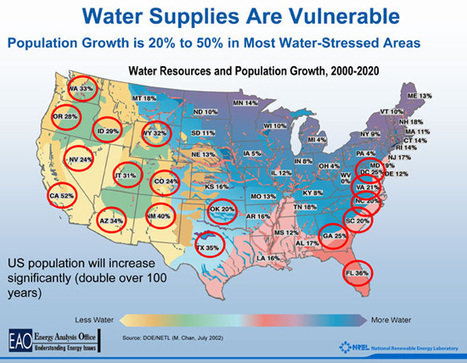
The continued security and economic health of the United States depends on a sustainable supply of both energy and water.


U.S. Energy Sustainability – The Missing Piece

“U.S. energy sustainability is a complex puzzle of interlocking parts. … However, one critical component of the R&D mix is missing – water. ..”


The Energy-Water Connection

“Energy production requires a reliable, abundant, and predictable source of water, a resource that is already in short supply throughout much of the U.S. and the world. The electricity industry is second only to agriculture as the largest user of water in the United States. Electricity production from fossil fuels and nuclear energy requires 190,000 million gallons of water per day, accounting for 39% of all freshwater withdrawals in the nation, with 71% of that going to fossil-fuel electricity generation alone.1 Coal, the most abundant fossil fuel, currently accounts for 52% of U.S. electricity generation, and each kWh generated from coal requires withdrawal of 25 gallons of water. That means U.S. citizens may indirectly depend upon as much water turning on the lights and running appliances as they directly use taking showers and watering lawns. According to the 2001 National Energy Policy, our growing population and economy will require 393,000 MW of new generating capacity (or 1,300 to 1,900 new power plants-more than one built each week) by the year 2020, putting further strain on the nation’s water resources.”


See on www.sandia.gov

Proposals for Green Building Standard to Keep Water from ‘Going Down the Drain’ – Sustainable Plant

See on Scoop.itGreen Building Design – Architecture & Engineering

Proposed measures to improve water efficiency of high-performance, non-low-rise residential buildings include limitations on full-flush volume for toilets and use of municipal reclaimed water for irrigation.


“Measures to improve water efficiency, including limitations on full-flush volume for toilets and use of municipal reclaimed water for irrigation, are being proposed for ANSI/ASHRAE/USGBC/IES Standard 189.1-2011, Standard for the Design of High-Performance, Green Buildings Except Low-Rise Residential Buildings. …”


“The addendum would limit the full-flush volume for all toilets to 1.28 gal per flush and limit kitchen faucet capacity to 1.8 gpm …”


“Proposed addendum v also would set limits on the use of municipal reclaimed water for irrigation. Municipal reclaimed water is highly treated, usually to drinking water standards, and often in short supply. Furthermore, the growing use of municipal reclaimed water for groundwater recharge of potable water supplies increases its value. …”


‘“It is unreasonable to allow the unfettered use of reclaimed water, considered a precious resource, as a means to save energy when there are more viable alternatives,” Pape said. “Therefore, the use of municipal reclaimed water would be prohibited for roof-cooling applications and for permanent irrigation of vegetated roofs using either in-ground or above-ground irrigation systems. There are many other alternative water sources that can be used for this puprpose, including graywater, condensate recovery, rainwater and cooling tower discharge.”’

See on www.sustainableplant.com

ecobee Inc. | ecobee Partners With Austin Energy To Launch The Power Partner Thermostat Program Pilot

See on Scoop.itGreen Building Operations – Systems & Controls, Maintenance & Commissioning

TORONTO, Dec. 6, 2012 /CNW/ – ecobee Inc., the energy solutions company known for its easy-to-use Wi-Fi enabled Smart Thermostat products, announced today that it has formed a strategic partnership with Austin Energy to launch the Texas utility’s 2013 Power Partner Thermostat Program Pilot.


– “We feel that ecobee and its smart thermostat products are a good fit as they’ll not only help us reduce the demands on our own system, but they’ll also give our customers a chance to save energy and be rewarded for their efforts,” says Scott Jarman, Interim Director Energy Efficiency Services of Austin Energy.


– ecobee works with over 2,800 leading heating and cooling service company partners that sell and support ecobee’s energy management solutions. These service company relationships were important to Austin Energy’s goals of allowing customers to purchase their energy management solutions from a trusted partner.


See on www.newswire.ca

From Good Jobs To Bad Jobs To No Jobs – The Tragic Downfall Of The American Worker

See on Scoop.itGreen & Sustainable News

There was a time in America when virtually anyone that wanted a job could go out and get one and the United States boasted the largest and most prosperous…


“Many Americans that actually do have jobs right now find that they simply don’t make enough to take care of themselves and their families. They are called “the working poor”, and their ranks are growing steadily. Today, about one out of every four workers in the United States brings home wages that are at or below the federal poverty level.”


“But if you still do have a job, you should consider yourself to be fortunate.  There are millions upon millions of Americans out there without any job at all.

Did you know that 53 percent of all Americans with a bachelor’s degree under the age of 25 were either unemployed or underemployed during 2011?

Hordes of fresh college graduates are entering the marketplace each year only to find that the good jobs that they were promised simply are not there.”


See on theeconomiccollapseblog.com

Ideas for Building Resilient Communities After Hurricane Sandy

See on Scoop.itGreen & Sustainable News

Much of the landscape must be returned to its natural state, combined with distributed renewable energy and water.


“We ended the Dust Bowl by returning much of the landscape back to its native state and changing how we treated the land we continue to occupy. And we will end disasters like Hurricane Sandy the same way: taking as much of our coastline as possible back to its pre-settlement state as the least expensive way of protecting ourselves from a future of super storms, and rebuilding the rest in as resilient — as temporary or as indestructible — a way possible, with those living in harms way having to pay much more for public services as a result of that choice. It may not sound like a “Marshall Plan,” but it may be the only plan that, in the end, works. “

See on www.sustainablebusiness.com